Question: In the Media Literacy document, Pick TWO Core Concepts that you found interesting from this week's material Under each of the two chosen Core Concepts,
In the Media Literacy document,
- Pick TWO Core Concepts that you found interesting from this week's material
- Under each of the two chosen Core Concepts, choose THREE Guiding Questions to answer.
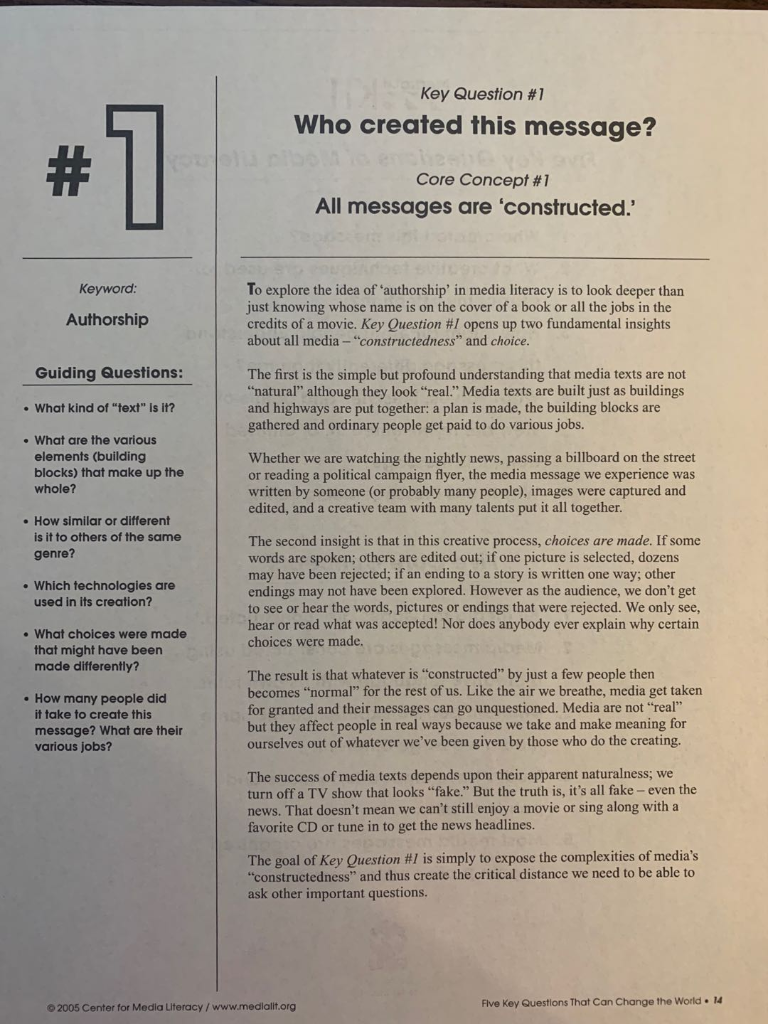
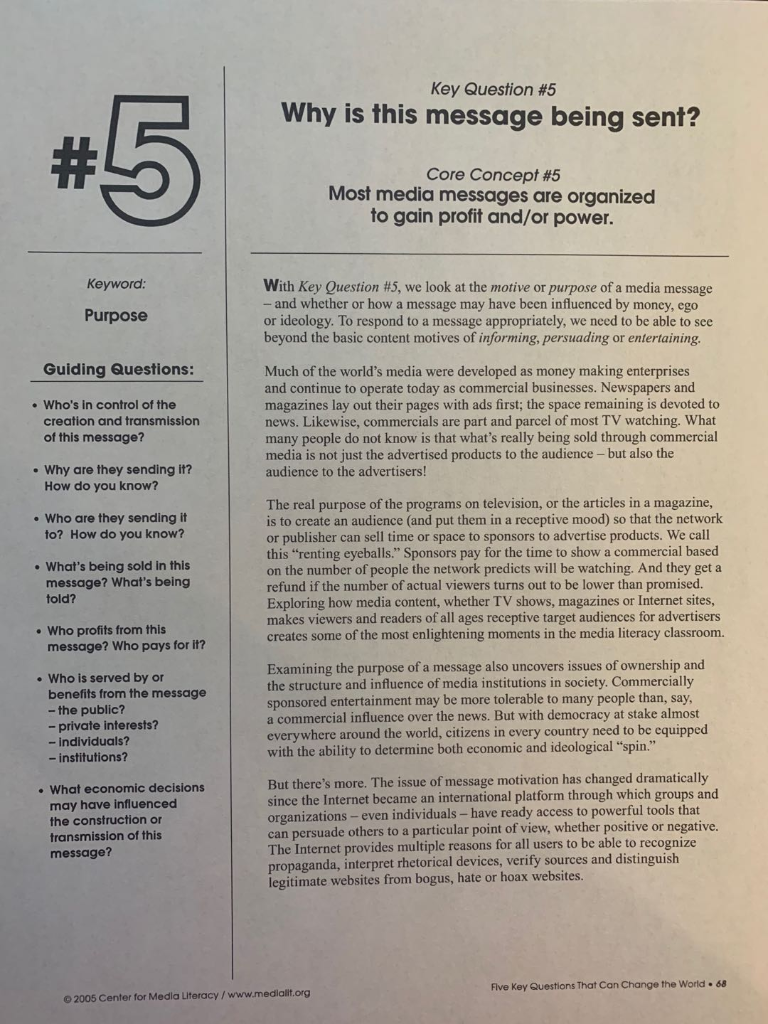
Key Question #1 Who created this message? #1 Core Concept #1 All messages are 'constructed.' Keyword: Authorship To explore the idea of authorship in media literacy is to look deeper than just knowing whose name is on the cover of a book or all the jobs in the credits of a movie. Key Question #1 opens up two fundamental insights about all media - "constructedness" and choice. Guiding Questions: What kind of "text" is it? What are the various elements (building blocks) that make up the whole? The first is the simple but profound understanding that media texts are not "natural" although they look "real." Media texts are built just as buildings and highways are put together: a plan is made, the building blocks are gathered and ordinary people get paid to do various jobs. Whether we are watching the nightly news, passing a billboard on the street or reading a political campaign flyer, the media message we experience was written by someone (or probably many people), images were captured and edited, and a creative team with many talents put it all together. The second insight is that in this creative process, choices are made. If some words are spoken; others are edited out; if one picture is selected, dozens may have been rejected; if an ending to a story is written one way; other endings may not have been explored. However as the audience, we don't get to see or hear the words, pictures or endings that were rejected. We only see, hear or read what was accepted! Nor does anybody ever explain why certain choices were made. How similar or different is it to others of the same genre? Which technologies are used in its creation? What choices were made that might have been made differently? How many people did it take to create this message? What are their various jobs? The result is that whatever is "constructed by just a few people then becomes "normal" for the rest of us. Like the air we breathe, media get taken for granted and their messages can go unquestioned. Media are not "real" but they affect people in real ways because we take and make meaning for ourselves out of whatever we've been given by those who do the creating, The success of media texts depends upon their apparent naturalness, we turn off a TV show that looks "fake." But the truth is, it's all fake - even the news. That doesn't mean we can't still enjoy a movie or sing along with a favorite CD or tune in to get the news headlines. The goal of Key Question #1 is simply to expose the complexities of media's "constructedness" and thus create the critical distance we need to be able to ask other important questions. 2005 Center for Media Literacy / www.medialit.org Flve Key Questions That Can Change the World. 14 Key Question #5 Why is this message being sent? #5 # Core Concept #5 Most media messages are organized to gain profit and/or power. Keyword: Purpose With Key Question #5, we look at the motive or purpose of a media message and whether or how a message may have been influenced by money, ego or ideology. To respond to a message appropriately, we need to be able beyond the basic content motives of informing, persuading or entertaining. see Guiding Questions: Who's in control of the creation and transmission of this message? Much of the world's media were developed as money making enterprises and continue to operate today as commercial businesses. Newspapers and magazines lay out their pages with ads first; the space remaining is devoted to news. Likewise, commercials are part and parcel of most TV watching. What many people do not know is that what's really being sold through commercial media is not just the advertised products to the audience - but also the audience to the advertisers! Why are they sending it? How do you know? Who are they sending it to? How do you know? What's being sold in this message? What's being told? The real purpose of the programs on television, or the articles in a magazine, is to create an audience and put them in a receptive mood) so that the network or publisher can sell time or space to sponsors to advertise products. We call this "renting eyeballs." Sponsors pay for the time to show a commercial based on the number of people the network predicts will be watching. And they get a refund if the number of actual viewers turns out to be lower than promised. Exploring how media content, whether TV shows, magazines or Internet sites, makes viewers and readers of all ages receptive target audiences for advertisers creates some of the most enlightening moments in the media literacy classroom. Who profits from this message? Who pays for it? Who is served by or benefits from the message - the public? - private interests? - Individuals? - institutions? Examining the purpose of a message also uncovers issues of ownership and the structure and influence of media institutions in society. Commercially sponsored entertainment may be more tolerable to many people than, say, a commercial influence over the news. But with democracy at stake almost everywhere around the world, citizens in every country need to be equipped with the ability to determine both economic and ideological "spin." But there's more. The issue of message motivation has changed dramatically since the Internet became an international platform through which groups and organizations - even individuals - have ready access to powerful tools that can persuade others to a particular point of view, whether positive or negative. The Internet provides multiple reasons for all users to be able to recognize propaganda, interpret rhetorical devices, verify sources and distinguish legitimate websites from bogus, hate or hoax websites. What economic decisions may have influenced the construction or transmission of this message? Five Key Questions That Can Change the World. 68 2005 Center for Media Literacy / www.medialit.org









 Study Help