







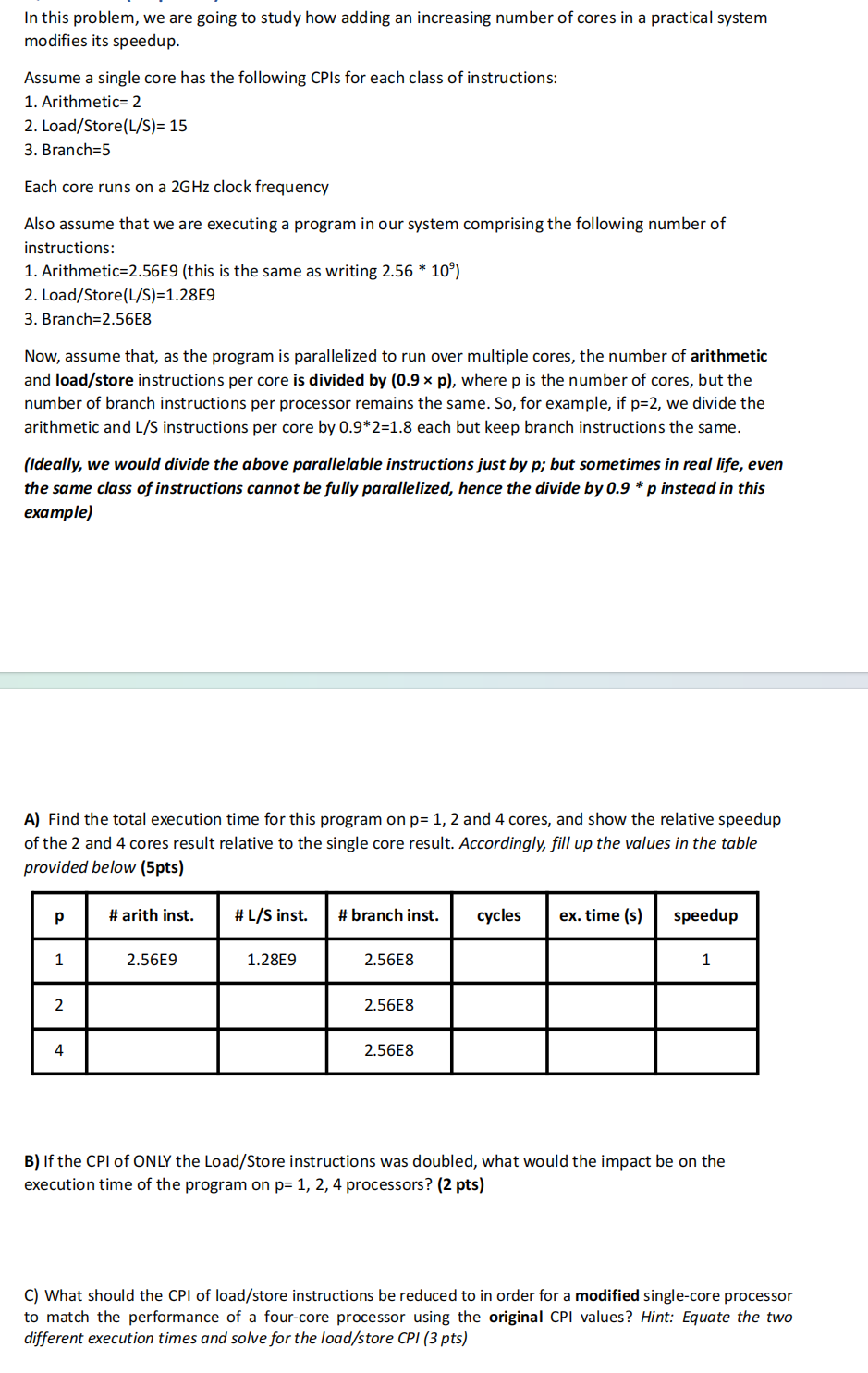
Question: In this problem, we are going to study how adding an increasing number of cores in a practical system modifies its speedup. Assume a single
In this problem, we are going to study how adding an increasing number of cores in a practical system
modifies its speedup.
Assume a single core has the following CPIs for each class of instructions:
Arithmetic
LoadStore
Branch
Each core runs on a clock frequency
Also assume that we are executing a program in our system comprising the following number of
instructions:
Arithmetic this is the same as writing
LoadStore
Branch
Now, assume that, as the program is parallelized to run over multiple cores, the number of arithmetic
and loadstore instructions per core is divided by where is the number of cores, but the
number of branch instructions per processor remains the same. So for example, if we divide the
arithmetic and instructions per core by each but keep branch instructions the same.
Ideally we would divide the above parallelable instructions just by p; but sometimes in real life, even
the same class of instructions cannot be fully parallelized, hence the divide by instead in this
example
A Find the total execution time for this program on and cores, and show the relative speedup
of the and cores result relative to the single core result. Accordingly, fill up the values in the table
provided below pts
B If the CPI of ONLY the LoadStore instructions was doubled, what would the impact be on the
execution time of the program on processors? pts
C What should the CPI of loadstore instructions be reduced to in order for a modified singlecore processor
to match the performance of a fourcore processor using the original CPI values? Hint: Equate the two
different execution times and solve for the loadstore CPI pts
Step by Step Solution
There are 3 Steps involved in it
1 Expert Approved Answer
Step: 1 Unlock

Question Has Been Solved by an Expert!
Get step-by-step solutions from verified subject matter experts
Step: 2 Unlock
Step: 3 Unlock
 Study Help