





Question: In this problem, we will consider f to be some function defined on a subset of the real numbers, and we'll assume all of its
In this problem, we will consider f to be some
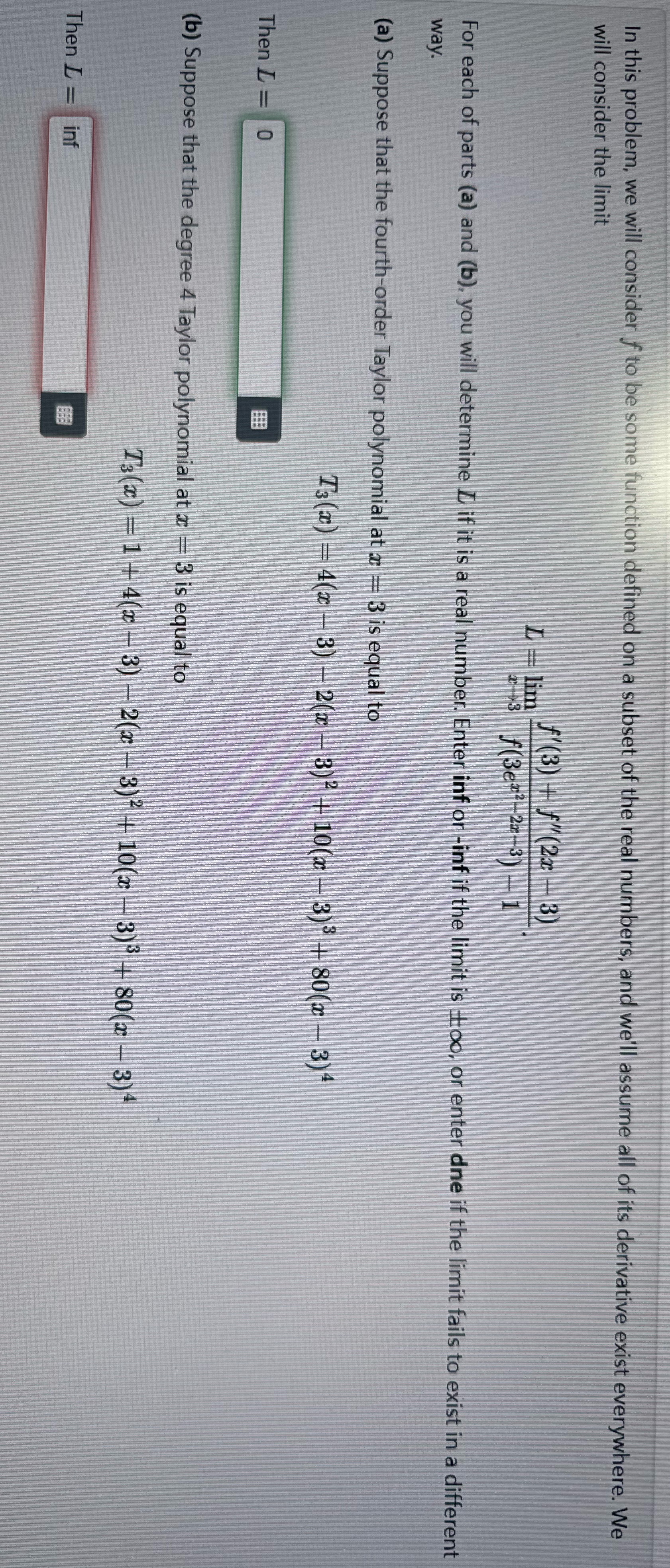
In this problem, we will consider f to be some function defined on a subset of the real numbers, and we'll assume all of its derivative exist everywhere. We will consider the limit f' (3) + f"(2x - 3) 2->3 f(3ez2-2x-3) _1 For each of parts (a) and (b), you will determine _ if it is a real number. Enter inf or -inf if the limit is too, or enter dne if the limit fails to exist in a different way. (a) Suppose that the fourth-order Taylor polynomial at x - 3 is equal to T3(2) = 4(x - 3) - 2(2 - 3)2 + 10(2 - 3)3 + 80(x - 3)4 Then I = (b) Suppose that the degree 4 Taylor polynomial at a = 3 is equal to T3(x) - 1 + 4(x - 3) - 2(x - 3)2 + 10(2 - 3)3 + 80(2 - 3)4 Then L =

Step by Step Solution

There are 3 Steps involved in it

1 Expert Approved Answer
Step: 1 Unlock blur-text-image

Question Has Been Solved by an Expert!

Get step-by-step solutions from verified subject matter experts

Step: 2 Unlock
Step: 3 Unlock

Students Have Also Explored These Related Mathematics Questions!