







Question: In this problem, we will figure out how conductivity transforms between frames of reference. A laboratory is filled with a material whose conductivity is .
In this problem, we will figure out how conductivity transforms between frames of reference.
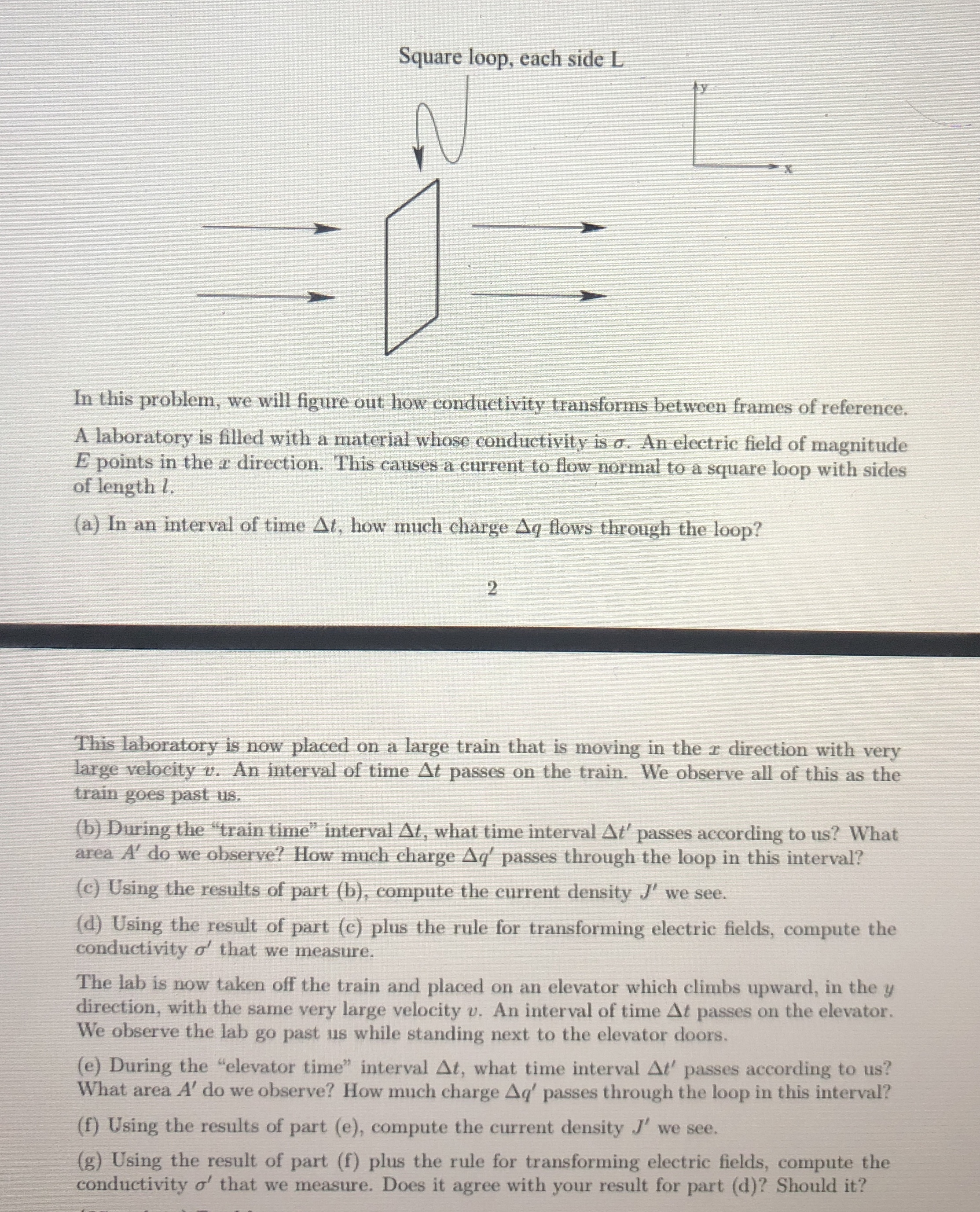
A laboratory is filled with a material whose conductivity is An electric field of magnitude points in the direction. This causes a current to flow normal to a square loop with sides of length
a In an interval of time how much charge flows through the loop?
This laboratory is now placed on a large train that is moving in the direction with very large velocity An interval of time passes on the train. We observe all of this as the train goes past us
b During the "train time" interval what time interval passes according to us What area do we observe? How much charge passes through the loop in this interval?
c Using the results of part b compute the current density we see.
d Using the result of part c plus the rule for transforming electric fields, compute the conductivity that we measure.
The lab is now taken off the train and placed on an elevator which climbs upward, in the direction, with the same very large velocity An interval of time passes on the elevator. We observe the lab go past us while standing next to the elevator doors.
e During the "elevator time" interval what time interval passes according to us What area do we observe? How much charge passes through the loop in this interval?
f Using the results of part e compute the current density we see.
g Using the result of part f plus the rule for transforming electric fields, compute the conductivity that we measure. Does it agree with your result for part d Should it
Step by Step Solution
There are 3 Steps involved in it
1 Expert Approved Answer
Step: 1 Unlock

Question Has Been Solved by an Expert!
Get step-by-step solutions from verified subject matter experts
Step: 2 Unlock
Step: 3 Unlock
 Study Help