







Question: In this section, use the continuous-time convolution GUI, cconvdemo, to do the following: (a) Set the input to an exponential: x(t) = -0.25+ {u(t) ult-6)}.
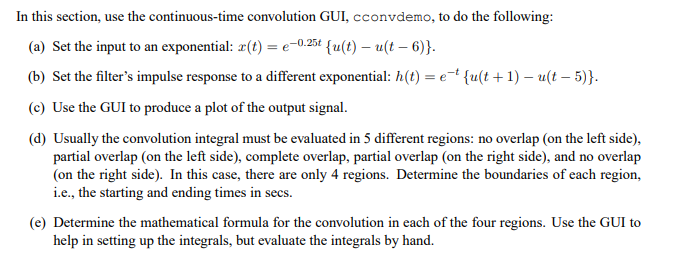
In this section, use the continuous-time convolution GUI, cconvdemo, to do the following: (a) Set the input to an exponential: x(t) = -0.25+ {u(t) ult-6)}. (b) Set the filter's impulse response to a different exponential: h(t)=e+{u(t+1) u(t 5)}. (C) Use the GUI to produce a plot of the output signal. (d) Usually the convolution integral must be evaluated in 5 different regions: no overlap (on the left side), partial overlap (on the left side), complete overlap, partial overlap (on the right side), and no overlap (on the right side). In this case, there are only 4 regions. Determine the boundaries of each region, i.e., the starting and ending times in secs. (e) Determine the mathematical formula for the convolution in each of the four regions. Use the GUI to help in setting up the integrals, but evaluate the integrals by hand. In this section, use the continuous-time convolution GUI, cconvdemo, to do the following: (a) Set the input to an exponential: x(t) = -0.25+ {u(t) ult-6)}. (b) Set the filter's impulse response to a different exponential: h(t)=e+{u(t+1) u(t 5)}. (C) Use the GUI to produce a plot of the output signal. (d) Usually the convolution integral must be evaluated in 5 different regions: no overlap (on the left side), partial overlap (on the left side), complete overlap, partial overlap (on the right side), and no overlap (on the right side). In this case, there are only 4 regions. Determine the boundaries of each region, i.e., the starting and ending times in secs. (e) Determine the mathematical formula for the convolution in each of the four regions. Use the GUI to help in setting up the integrals, but evaluate the integrals by hand
Step by Step Solution
There are 3 Steps involved in it

Get step-by-step solutions from verified subject matter experts
 Study Help