







Question: In your initial post, address the following items: 1. Define the null and alternative hypotheses in mathematical terms as well as in words. . ldentify
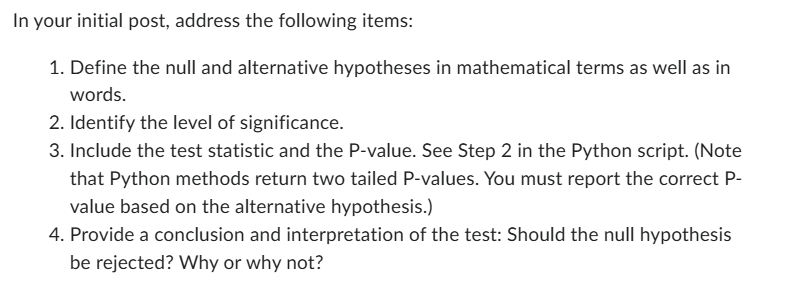
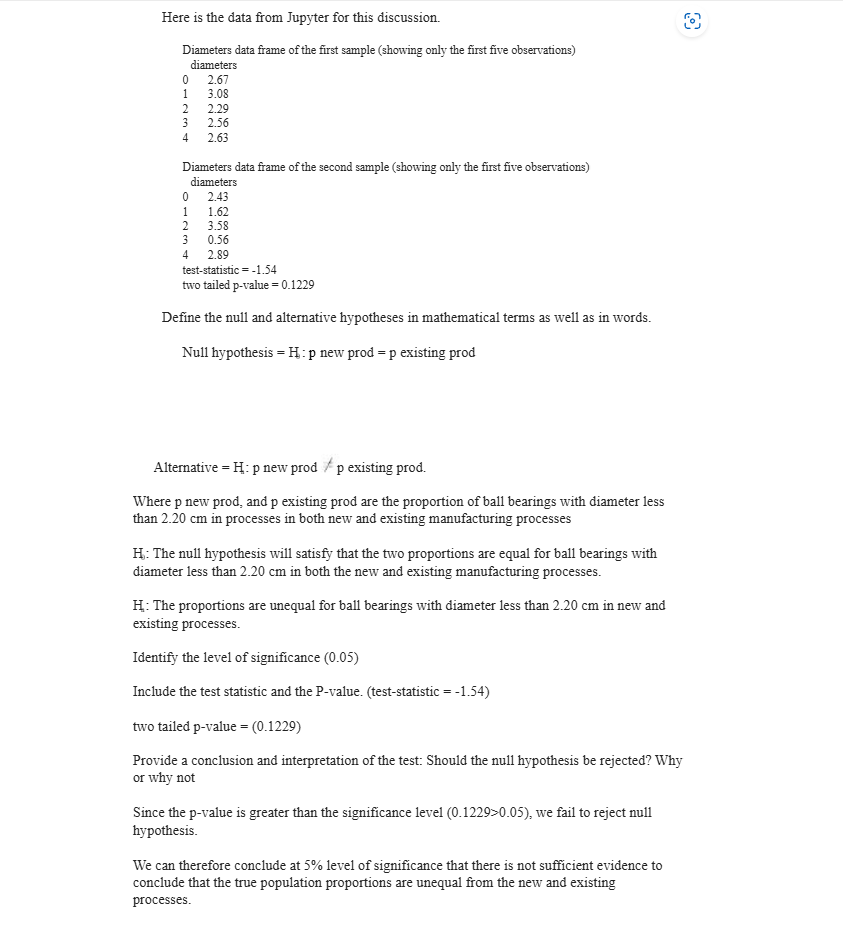
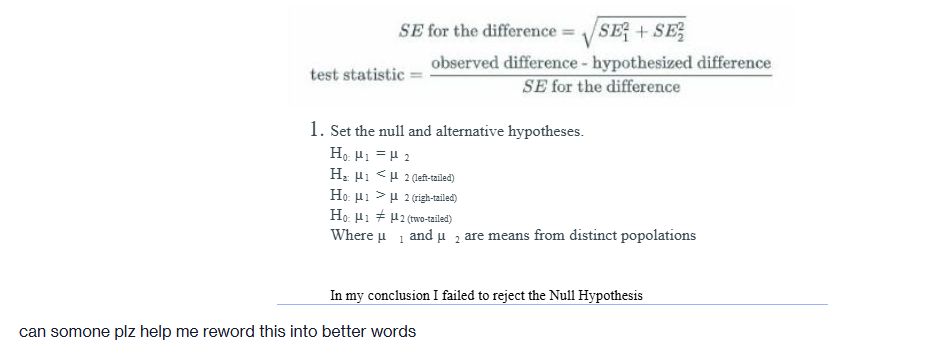
In your initial post, address the following items: 1. Define the null and alternative hypotheses in mathematical terms as well as in words. . ldentify the level of significance. . Include the test statistic and the P-value. See Step 2 in the Python script. (Note that Python methods return two tailed P-values. You must report the correct P- value based on the alternative hypothesis.) Provide a conclusion and interpretation of the test: Should the null hypothesis be rejected? Why or why not? Here is the data from Tupyter for this discussion. o) Diameters data frame of the first sample (showing only the first five observations) diameters 0 267 1 308 2022 3 2356 4 263 Dhameters data frame of the second sample (showimng only the first five observations) diameters 0 243 1 162 2 338 3 0356 4 289 test-statistic = -1.54 two tailed p-value = 01229 Define the null and alternative hypotheses in mathematical terms as well as in words. Null hypothesis = H : p new prod = p existing prod Alternative = H: p new prod / p existing prod. Where p new prod, and p existing prod are the propertion of ball bearings with diameter less than 2 20 cm in processes in both new and existing manufacturing processes H;: The null hypothesis will satisfy that the two proportions are equal for ball bearings with diameter less than 2.20 cm in both the new and existing manufacturing processes. H: The proportions are unequal for ball bearings with diameter less than 2 20 cm in new and existing processes. Identify the level of significance (0.05) Include the test statistic and the P-value. (test-statistic = -1.54) two tailed p-value = (0.1229) Provide a conclusion and interpretation of the test: Should the null hypothesis be rejected? Why or why not Since the p-value is greater than the significance level (0.1229=0.03), we fail to reject null hypothesis. We can therefore conclude at 5% level of significance that there is not sufficient evidence to conclude that the true population proportions are unequal from the new and existing processes. SE for the difference = SE; + SE; observed difference - hypothesized difference test statistic = SE for the difference 1. Set the null and alternative hypotheses. Ho: H1 = H 2 Ha: H1
Step by Step Solution
There are 3 Steps involved in it

Get step-by-step solutions from verified subject matter experts
 Study Help