







Question: INDUSTRIAL ORGANIZATION AND ANTITRUST POLICY Econ class Reference - Modern Industrial Organization by Dennis W. Carlton and Jeffrey M. Perloff, 4th edition, 2015. Question 2
INDUSTRIAL ORGANIZATION AND ANTITRUST POLICY Econ class
Reference - Modern Industrial Organization by Dennis W. Carlton and Jeffrey M. Perloff, 4th edition, 2015.
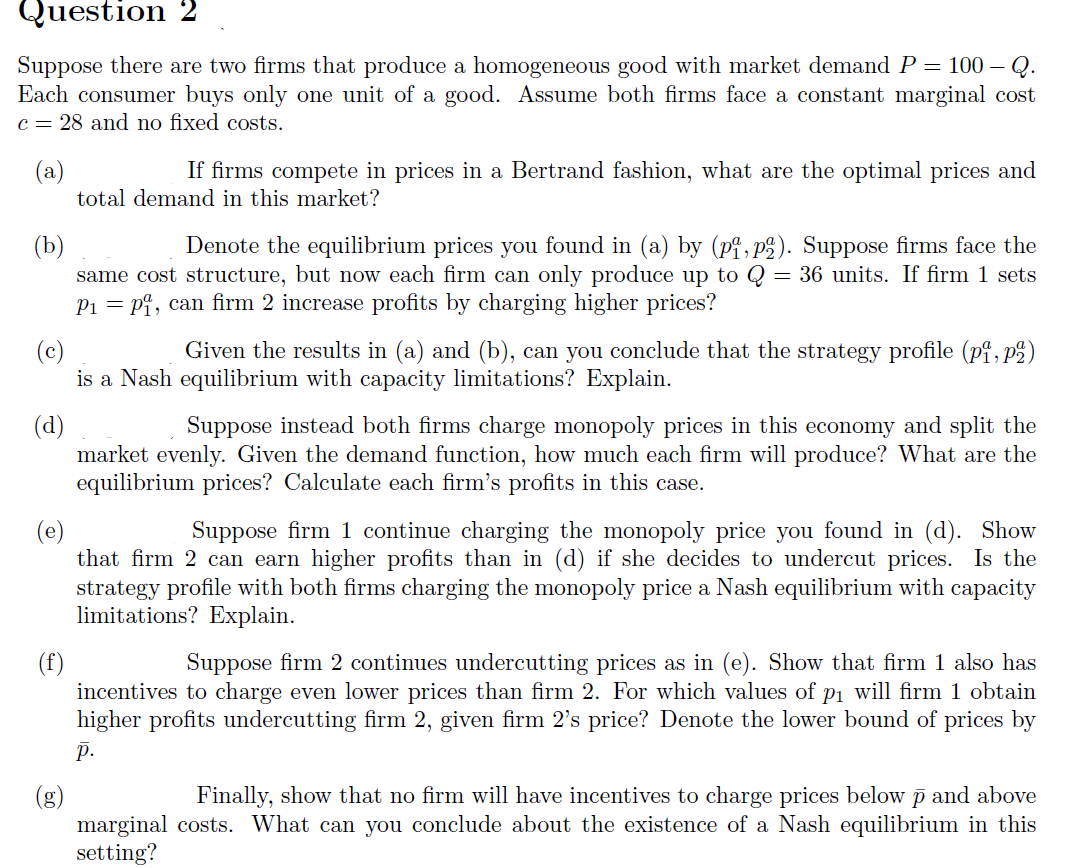
Question 2 Suppose there are two firms that produce a homogeneous good with market demand P = 100 - Q. Each consumer buys only one unit of a good. Assume both firms face a constant marginal cost c = 28 and no fixed costs. (a) If firms compete in prices in a Bertrand fashion, what are the optimal prices and total demand in this market? (b) Denote the equilibrium prices you found in (a) by (pi, pg). Suppose firms face the same cost structure, but now each firm can only produce up to Q = 36 units. If firm 1 sets P1 = pi, can firm 2 increase profits by charging higher prices? (c) Given the results in (a) and (b), can you conclude that the strategy profile (pi, p2) is a Nash equilibrium with capacity limitations? Explain. (d) Suppose instead both firms charge monopoly prices in this economy and split the market evenly. Given the demand function, how much each firm will produce? What are the equilibrium prices? Calculate each firm's profits in this case. (e) Suppose firm 1 continue charging the monopoly price you found in (d). Show that firm 2 can earn higher profits than in (d) if she decides to undercut prices. Is the strategy profile with both firms charging the monopoly price a Nash equilibrium with capacity limitations? Explain. (f ) Suppose firm 2 continues undercutting prices as in (e). Show that firm 1 also has incentives to charge even lower prices than firm 2. For which values of p1 will firm 1 obtain higher profits undercutting firm 2, given firm 2's price? Denote the lower bound of prices by p. (g Finally, show that no firm will have incentives to charge prices below p and above marginal costs. What can you conclude about the existence of a Nash equilibrium in this setting
Step by Step Solution
There are 3 Steps involved in it

Get step-by-step solutions from verified subject matter experts
 Study Help