Question: Instructions Assignment #2 (Individual and Interpersonal Processes) Assignment Overview This assignment explores emotions and moods. More specifically, their impact on your job satisfaction and performance.
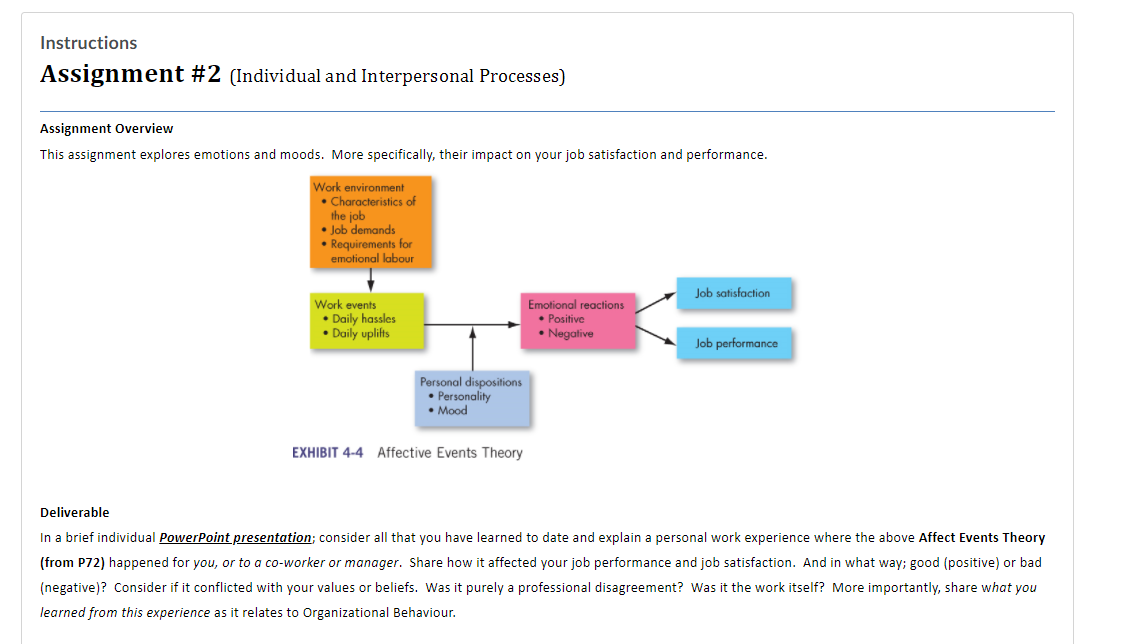
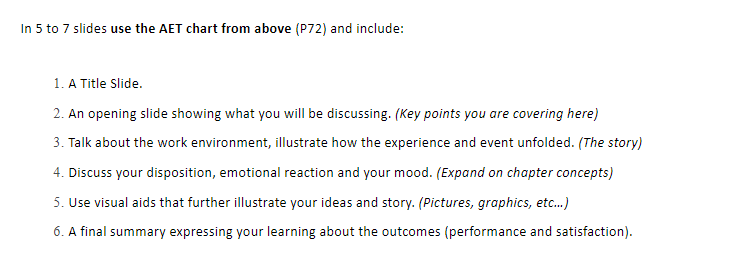
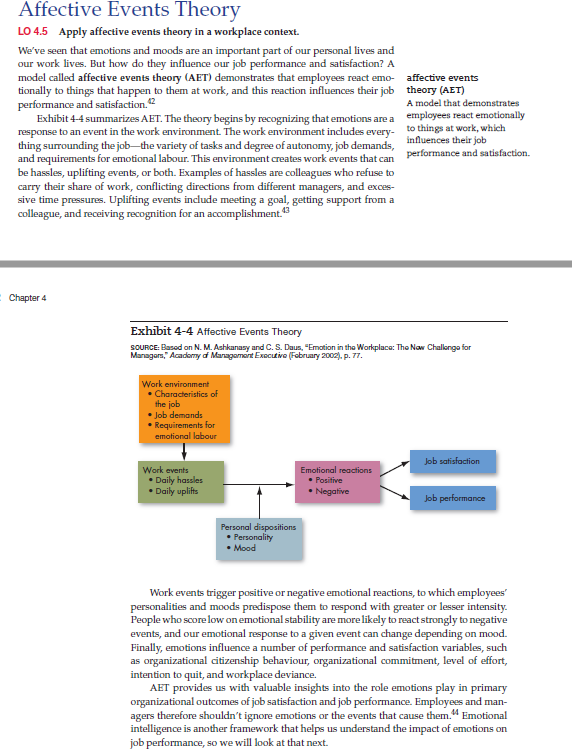
Instructions Assignment #2 (Individual and Interpersonal Processes) Assignment Overview This assignment explores emotions and moods. More specifically, their impact on your job satisfaction and performance. Work environment Characteristics of the job Job demands Requirements for emotional labour Job satisfaction Work events Daily hassles Daily uplifts Emotional reactions Positive Negative Job performance Personal dispositions Personality Mood EXHIBIT 4.4 Affective Events Theory Deliverable In a brief individual PowerPoint presentation; consider all that you have learned to date and explain a personal work experience where the above Affect Events Theory (from P72) happened for you, or to a co-worker or manager. Share how it affected your job performance and job satisfaction. And in what way; good (positive) or bad (negative)? Consider if it conflicted with your values or beliefs. Was it purely a professional disagreement? Was it the work itself? More importantly, share what you learned from this experience as it relates to Organizational Behaviour. In 5 to 7 slides use the AET chart from above (P72) and include: 1. A Title Slide. 2. An opening slide showing what you will be discussing. (Key points you are covering here) 3. Talk about the work environment, illustrate how the experience and event unfolded. (The story) 4. Discuss your disposition, emotional reaction and your mood. (Expand on chapter concepts) 5. Use visual aids that further illustrate your ideas and story. (Pictures, graphics, etc...) A final summary expressing your learning about the outcomes (performance and satisfaction). Affective Events Theory LO 4.5 Apply affective events theory in a workplace context. We've seen that emotions and moods are an important part of our personal lives and our work lives. But how do they influence our job performance and satisfaction? A model called affective events theory (AET) demonstrates that employees react emo- affective events tionally to things that happen to them at work, and this reaction influences their job theory (AET) performance and satisfaction.2 A model that demonstrates Exhibit 4-4 summarizes AET. The theory begins by recognizing that emotions are a employees react emotionally response to an event in the work environment. The work environment includes every to things at work, which thing surrounding the jobthe variety of tasks and degree of autonomy,job demands, influences their job and requirements for emotional labour. This environment creates work events that can performance and satisfaction. be hassles, uplifting events, or both. Examples of hassles are colleagues who refuse to carry their share of work, conflicting directions from different managers, and exces- sive time pressures. Uplifting events include meeting a goal, getting support from a colleague, and receiving recognition for an accomplishment." Chapter 4 Exhibit 4-4 Affective Events Theory SOURCE: Based on N. M. Ashkanasy and C. S. Daus. "Emotion in the Workplaca: The Now Challenge for Managers, Academy of Management Executive (February 2002).p.77. Work environment Characteristics of the job Job demands Requirements for emotional labour Job satisfaction Work events Daily hassles Daily uplifts Emotional reactions Positive Negative Job performance Personal dispositions Personality Mood Work events trigger positive or negative emotional reactions, to which employees" personalities and moods predispose them to respond with greater or lesser intensity. People who score low on emotional stability are more likely to react strongly to negative events, and our emotional response to a given event can change depending on mood. Finally, emotions influence a number of performance and satisfaction variables, such as organizational citizenship behaviour, organizational commitment, level of effort, intention to quit, and workplace deviance. AET provides us with valuable insights into the role emotions play in primary organizational outcomes of job satisfaction and job performance. Employees and man- agers therefore shouldn't ignore emotions or the events that cause them." Emotional intelligence is another framework that helps us understand the impact of emotions on job performance, so we will look at that next









 Study Help