





Question: Instructions: Based on the root words provided, add a suitable affix or affixes (prefix or suffix or both prefix and suffix) for the blanks. The

Instructions: Based on the root words provided, add a suitable affix or affixes (prefix or suffix or both prefix and suffix) for the blanks. The newly-formed word must fit the context of the text.
Example: (0)
This is indeed the case as the formal (0)__________(define) of Entrepreneurship is that it is the process of starting a business.
Instructions: Based on the root words provided,
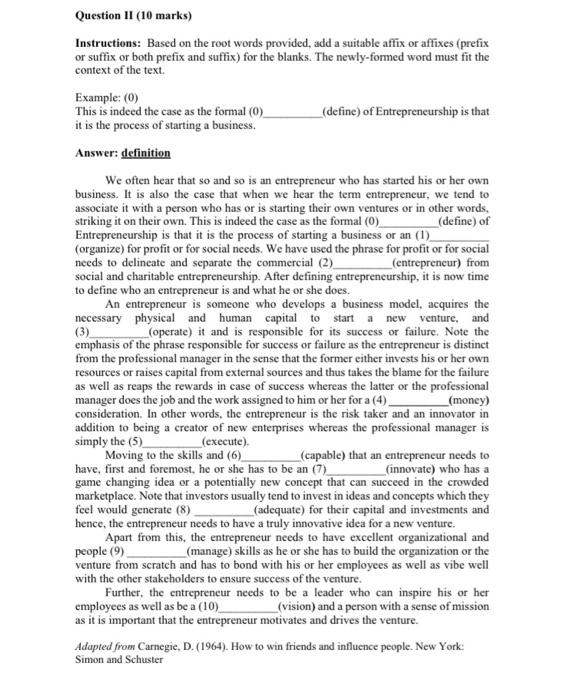
Question II (10 marks) Instructions: Based on the root words provided, add a suitable affix or affixes (prefix or suffix or both prefix and suffix) for the blanks. The newly-formed word must fit the context of the text. Example: (0) This is indeed the case as the formal (0) (define) of Entrepreneurship is that it is the process of starting a business. Answer: definition We often hear that so and so is an entrepreneur who has started his or her own business. It is also the case that when we hear the term entrepreneur, we tend to associate it with a person who has or is starting their own ventures or in other words, striking it on their own. This is indeed the case as the formal (O) (define) of Entrepreneurship is that it is the process of starting a business or an (1) (organize) for profit or for social needs. We have used the phrase for profit or for social needs to delineate and separate the commercial (2) (entrepreneur) from social and charitable entrepreneurship. After defining entrepreneurship, it is now time to define who an entrepreneur is and what he or she does. An entrepreneur is someone who develops a business model, acquires the necessary physical and human capital to start a new venture, and (3) (operate) it and is responsible for its success or failure. Note the emphasis of the phrase responsible for success or failure as the entrepreneur is distinct from the professional manager in the sense that the former either invests his or her own resources or raises capital from external sources and thus takes the blame for the failure as well as reaps the rewards in case of success whereas the latter or the professional manager does the job and the work assigned to him or her for a (4)_ (money) consideration. In other words, the entrepreneur is the risk taker and an innovator in addition to being a creator of new enterprises whereas the professional manager is simply the (5) (execute). Moving to the skills and (6) (capable) that an entrepreneur needs to have, first and foremost, he or she has to be an (7) _(innovate) who has a game changing idea or a potentially new concept that can succeed in the crowded marketplace. Note that investors usually tend to invest in ideas and concepts which they feel would generate (8) (adequate) for their capital and investments and hence, the entrepreneur needs to have a truly innovative idea for a new venture. Apart from this, the entrepreneur needs to have excellent organizational and people (9) (manage) skills as he or she has to build the organization or the venture from scratch and has to bond with his or her employees as well as vibe well with the other stakeholders to ensure success of the venture. Further, the entrepreneur needs to be a leader who can inspire his or her employees as well as be a (10) (vision) and a person with a sense of mission as it is important that the entrepreneur motivates and drives the venture. Adapted from Carnegie, D. (1964). How to win friends and influence people. New York: Simon and Schuster

Step by Step Solution

There are 3 Steps involved in it

1 Expert Approved Answer
Step: 1 Unlock blur-text-image

Question Has Been Solved by an Expert!

Get step-by-step solutions from verified subject matter experts

Step: 2 Unlock
Step: 3 Unlock

Students Have Also Explored These Related General Management Questions!