







Question: INSTRUCTIONS Using the following narrative to design a database by drawing an Entity-Relationship Diagram. Include the maximum and minimum cardinalities for each relationship you identify.
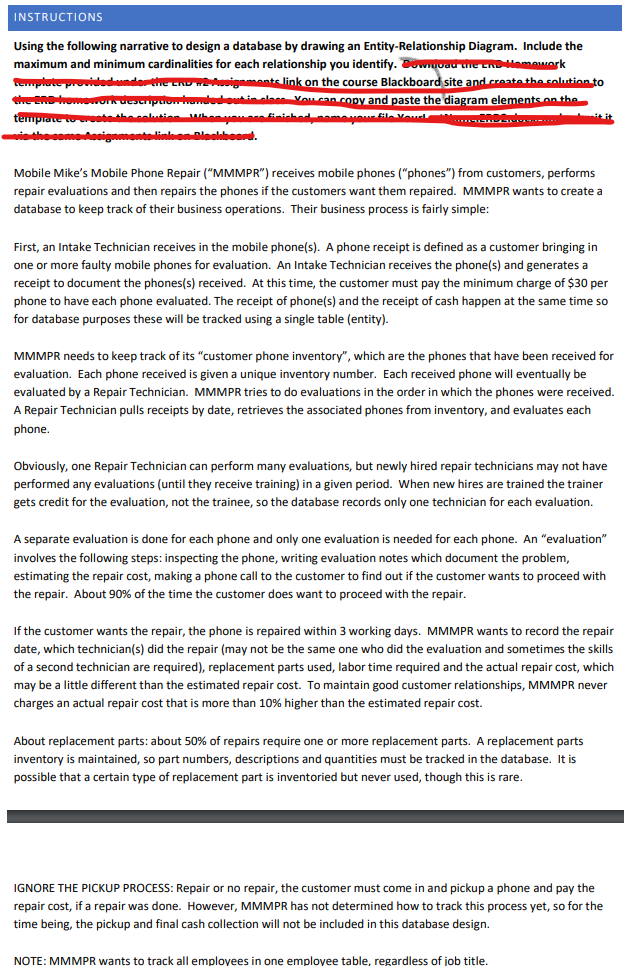
INSTRUCTIONS Using the following narrative to design a database by drawing an Entity-Relationship Diagram. Include the maximum and minimum cardinalities for each relationship you identify. Downpau enc En Homework conte link on the course Blackboard site and create the solution to You can copy and paste the diagram elements on the temprace Mobile Mike's Mobile Phone Repair ("MMMPR") receives mobile phones ("phones") from customers, performs repair evaluations and then repairs the phones if the customers want them repaired. MMMPR wants to create a database to keep track of their business operations. Their business process is fairly simple: First, an Intake Technician receives in the mobile phone(s). A phone receipt is defined as a customer bringing in one or more faulty mobile phones for evaluation. An Intake Technician receives the phone(s) and generates a receipt to document the phones(s) received. At this time, the customer must pay the minimum charge of $30 per phone to have each phone evaluated. The receipt of phone(s) and the receipt of cash happen at the same time so for database purposes these will be tracked using a single table (entity)- MMMPR needs to keep track of its "customer phone inventory", which are the phones that have been received for evaluation. Each phone received is given a unique inventory number. Each received phone will eventually be evaluated by a Repair Technician. MMMPR tries to do evaluations in the order in which the phones were received. A Repair Technician pulls receipts by date, retrieves the associated phones from inventory, and evaluates each phone. Obviously, one Repair Technician can perform many evaluations, but newly hired repair technicians may not have performed any evaluations (until they receive training) in a given period. When new hires are trained the trainer gets credit for the evaluation, not the trainee, so the database records only one technician for each evaluation. A separate evaluation is done for each phone and only one evaluation is needed for each phone. An "evaluation" involves the following steps: inspecting the phone, writing evaluation notes which document the problem, estimating the repair cost, making a phone call to the customer to find out if the customer wants to proceed with the repair. About 90% of the time the customer does want to proceed with the repair. If the customer wants the repair, the phone is repaired within 3 working days. MMMPR wants to record the repair date, which technician(s) did the repair (may not be the same one who did the evaluation and sometimes the skills of a second technician are required), replacement parts used, labor time required and the actual repair cost, which may be a little different than the estimated repair cost. To maintain good customer relationships, MMMPR never charges an actual repair cost that is more than 10% higher than the estimated repair cost. About replacement parts: about 50% of repairs require one or more replacement parts. A replacement parts inventory is maintained, so part numbers, descriptions and quantities must be tracked in the database. It is possible that a certain type of replacement part is inventoried but never used, though this is rare. IGNORE THE PICKUP PROCESS: Repair or no repair, the customer must come in and pickup a phone and pay the repair cost, if a repair was done. However, MMMPR has not determined how to track this process yet, so for the time being, the pickup and final cash collection will not be included in this database design. NOTE: MMMPR wants to track all employees in one employee table, regardless of job title
Step by Step Solution
There are 3 Steps involved in it

Get step-by-step solutions from verified subject matter experts
 Study Help