Question: Using the following narrative to design a database by drawing an Entity-Relationship Diagram. Include the maximum and minimum cardinalities for each relationship you identify. Download
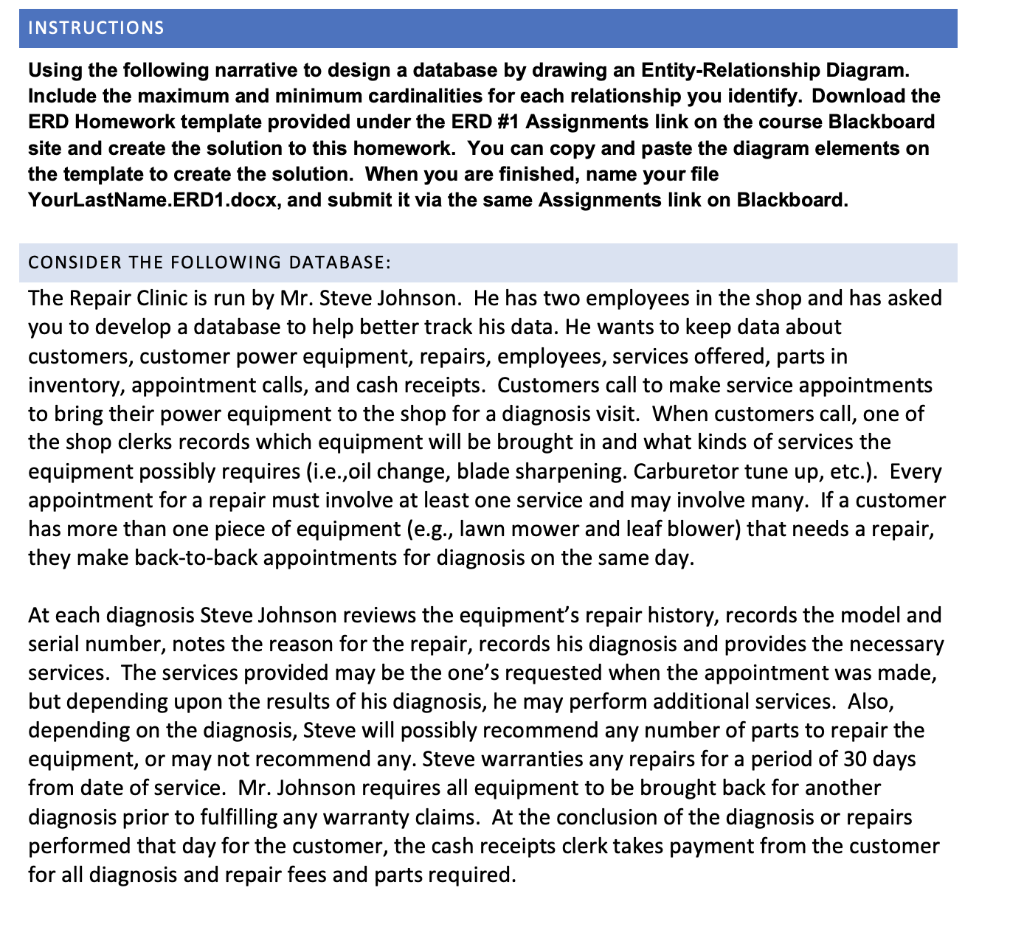
Using the following narrative to design a database by drawing an Entity-Relationship Diagram. Include the maximum and minimum cardinalities for each relationship you identify. Download the ERD Homework template provided under the ERD #1 Assignments link on the course Blackboard site and create the solution to this homework. You can copy and paste the diagram elements on the template to create the solution. When you are finished, name your file YourLastName.ERD1.docx, and submit it via the same Assignments link on Blackboard. CONSIDER THE FOLLOWING DATABASE: The Repair Clinic is run by Mr. Steve Johnson. He has two employees in the shop and has asked you to develop a database to help better track his data. He wants to keep data about customers, customer power equipment, repairs, employees, services offered, parts in inventory, appointment calls, and cash receipts. Customers call to make service appointments to bring their power equipment to the shop for a diagnosis visit. When customers call, one of the shop clerks records which equipment will be brought in and what kinds of services the equipment possibly requires (i.e.,oil change, blade sharpening. Carburetor tune up, etc.). Every appointment for a repair must involve at least one service and may involve many. If a customer has more than one piece of equipment (e.g., lawn mower and leaf blower) that needs a repair, they make back-to-back appointments for diagnosis on the same day. At each diagnosis Steve Johnson reviews the equipment's repair history, records the model and serial number, notes the reason for the repair, records his diagnosis and provides the necessary services. The services provided may be the one's requested when the appointment was made, but depending upon the results of his diagnosis, he may perform additional services. Also, depending on the diagnosis, Steve will possibly recommend any number of parts to repair the equipment, or may not recommend any. Steve warranties any repairs for a period of 30 days from date of service. Mr. Johnson requires all equipment to be brought back for another diagnosis prior to fulfilling any warranty claims. At the conclusion of the diagnosis or repairs performed that day for the customer, the cash receipts clerk takes payment from the customer for all diagnosis and repair fees and parts required. Using the following narrative to design a database by drawing an Entity-Relationship Diagram. Include the maximum and minimum cardinalities for each relationship you identify. Download the ERD Homework template provided under the ERD #1 Assignments link on the course Blackboard site and create the solution to this homework. You can copy and paste the diagram elements on the template to create the solution. When you are finished, name your file YourLastName.ERD1.docx, and submit it via the same Assignments link on Blackboard. CONSIDER THE FOLLOWING DATABASE: The Repair Clinic is run by Mr. Steve Johnson. He has two employees in the shop and has asked you to develop a database to help better track his data. He wants to keep data about customers, customer power equipment, repairs, employees, services offered, parts in inventory, appointment calls, and cash receipts. Customers call to make service appointments to bring their power equipment to the shop for a diagnosis visit. When customers call, one of the shop clerks records which equipment will be brought in and what kinds of services the equipment possibly requires (i.e.,oil change, blade sharpening. Carburetor tune up, etc.). Every appointment for a repair must involve at least one service and may involve many. If a customer has more than one piece of equipment (e.g., lawn mower and leaf blower) that needs a repair, they make back-to-back appointments for diagnosis on the same day. At each diagnosis Steve Johnson reviews the equipment's repair history, records the model and serial number, notes the reason for the repair, records his diagnosis and provides the necessary services. The services provided may be the one's requested when the appointment was made, but depending upon the results of his diagnosis, he may perform additional services. Also, depending on the diagnosis, Steve will possibly recommend any number of parts to repair the equipment, or may not recommend any. Steve warranties any repairs for a period of 30 days from date of service. Mr. Johnson requires all equipment to be brought back for another diagnosis prior to fulfilling any warranty claims. At the conclusion of the diagnosis or repairs performed that day for the customer, the cash receipts clerk takes payment from the customer for all diagnosis and repair fees and parts required









 Study Help