







Question: Intervicwing is the most commonly used employee selection technique. Interviews take several forms and can be conducted in person or digitally. This activity is important
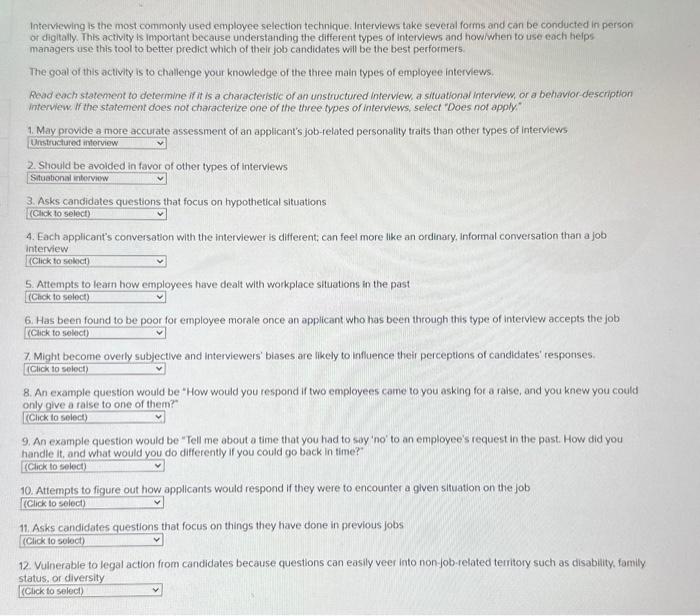
Intervicwing is the most commonly used employee selection technique. Interviews take several forms and can be conducted in person or digitally. This activity is important because understanding the different types of interviews and howiwhen to use each belps managers use this tool to better predict which of their job candidates will be the best performers. The goal of this activily is to challenge your knowledge of the three main types of employee interviews. Read each statement to determine if it is a characteristic of an unstructured interview, a situational intervew, or a behavior-description intervew. If the statement does not characterize one of the three types of intervews, select "Does not apply. 1. Mav orovide a more accurate assessment of an applican's job-related personality traits than other types of interviews 2. Should be avolded in favor of other types of interviews 3. Asks candidates questions that focus on hypothetical situations 4. Each applicant's conversation with the interviewer is different; can feel more like an ordinary, informal conversation than a job interview 5. Attempts to leain how employees have dealt with workplace situations in the past 6. Has been found to be poor for employee morale once an applicant who has been through this type of interview accepts the job 7. Miaht become overly subjective and interviewers' biases are likely to influence their perceptions of candidates' responses. 8. An example question would be "How would you respond if two employees came to you asking for a raise, and you knew you could onlv aive a ralse to one of them? 9. An example question would be "Tell me about a time that you had to say 'no' to an employee's request in the past. How did you handle it. and what would vou do differently if you could go back in time?" 10. Attemots to fiqure out how applicants would respond if they were to encounter a given situation on the job 11. Asks candidates questions that focus on things they have done in previous jobs 12. Vulnerable to legal action from candidates because questions can easily veer into non-job-related territory such as disability, family status. or diversity
Step by Step Solution
There are 3 Steps involved in it

Get step-by-step solutions from verified subject matter experts
 Study Help