



Question: Introduction Compare the chart you created to the Big - O complexity chart and answer the following questions. What do you estimate the time complexity
Introduction Compare the chart you created to the BigO complexity chart and answer the following questions.
What do you estimate the time complexity to be
Use the closest function from the chart to estimate how many operations rings would require?
Is this a practical algorithm for large input sizes? Explain your reasoning.
BigO Complexity Chart
Bad Fair Good
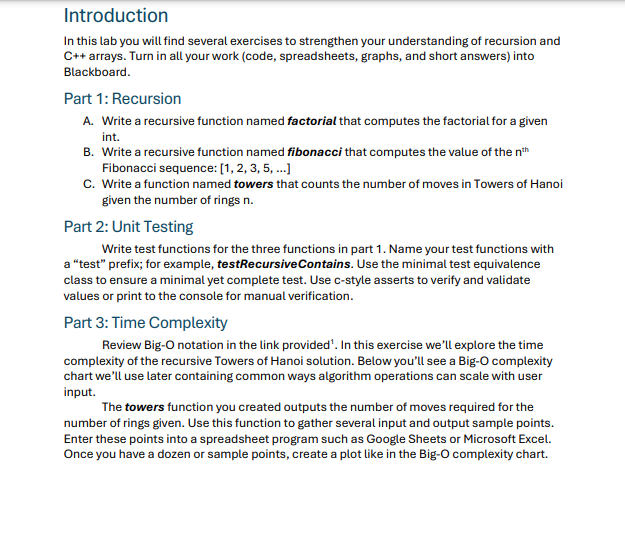
In this lab you will find several exercises to strengthen your understanding of recursion and
C arrays. Turn in all your work code spreadsheets, graphs, and short answers into
Blackboard.
Part : Recursion
A Write a recursive function named factorial that computes the factorial for a given
int.
B Write a recursive function named fibonacci that computes the value of the
Fibonacci sequence: dots
C Write a function named towers that counts the number of moves in Towers of Hanoi
given the number of rings
Part : Unit Testing
Write test functions for the three functions in part Name your test functions with
a "test" prefix; for example, testRecursiveContains. Use the minimal test equivalence
class to ensure a minimal yet complete test. Use cstyle asserts to verify and validate
values or print to the console for manual verification.
Part : Time Complexity
Review BigO notation in the link provided In this exercise we'll explore the time
complexity of the recursive Towers of Hanoi solution. Below you'll see a BigO complexity
chart we'll use later containing common ways algorithm operations can scale with user
input.
The towers function you created outputs the number of moves required for the
number of rings given. Use this function to gather several input and output sample points.
Enter these points into a spreadsheet program such as Google Sheets or Microsoft Excel.
Once you have a dozen or sample points, create a plot like in the BigO complexity chart.
Step by Step Solution
There are 3 Steps involved in it
1 Expert Approved Answer
Step: 1 Unlock

Question Has Been Solved by an Expert!
Get step-by-step solutions from verified subject matter experts
Step: 2 Unlock
Step: 3 Unlock