





Question: Inventory Management EOQ EXAMPLE: GIVE IT A TRY EOQ helps to determine the importance of order frequency and quantity. (Let's see how much we can
Inventory Management EOQ EXAMPLE: GIVE IT A TRYInventory Management EOQ EXAMPLE: GIVE IT A TRY

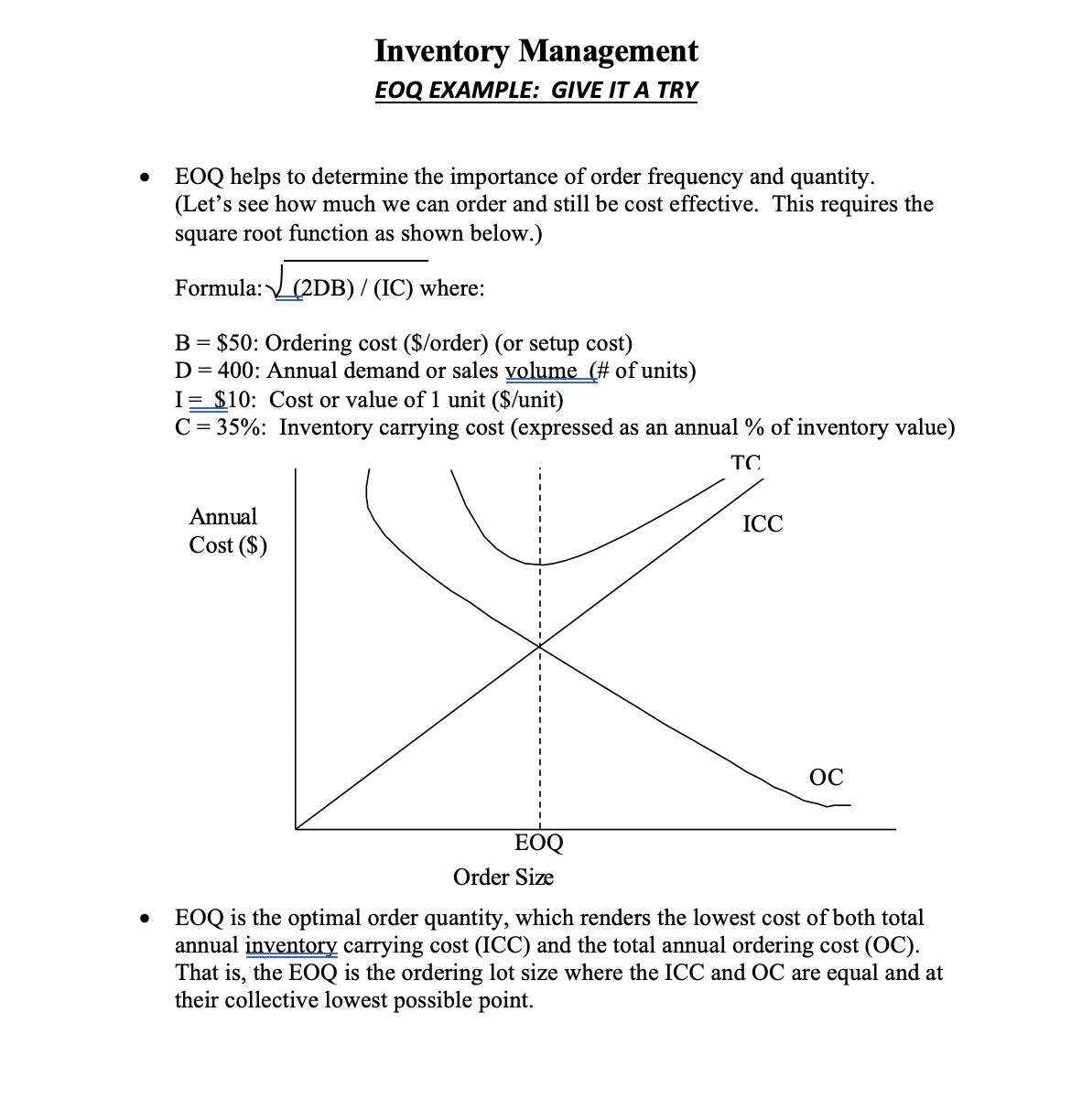
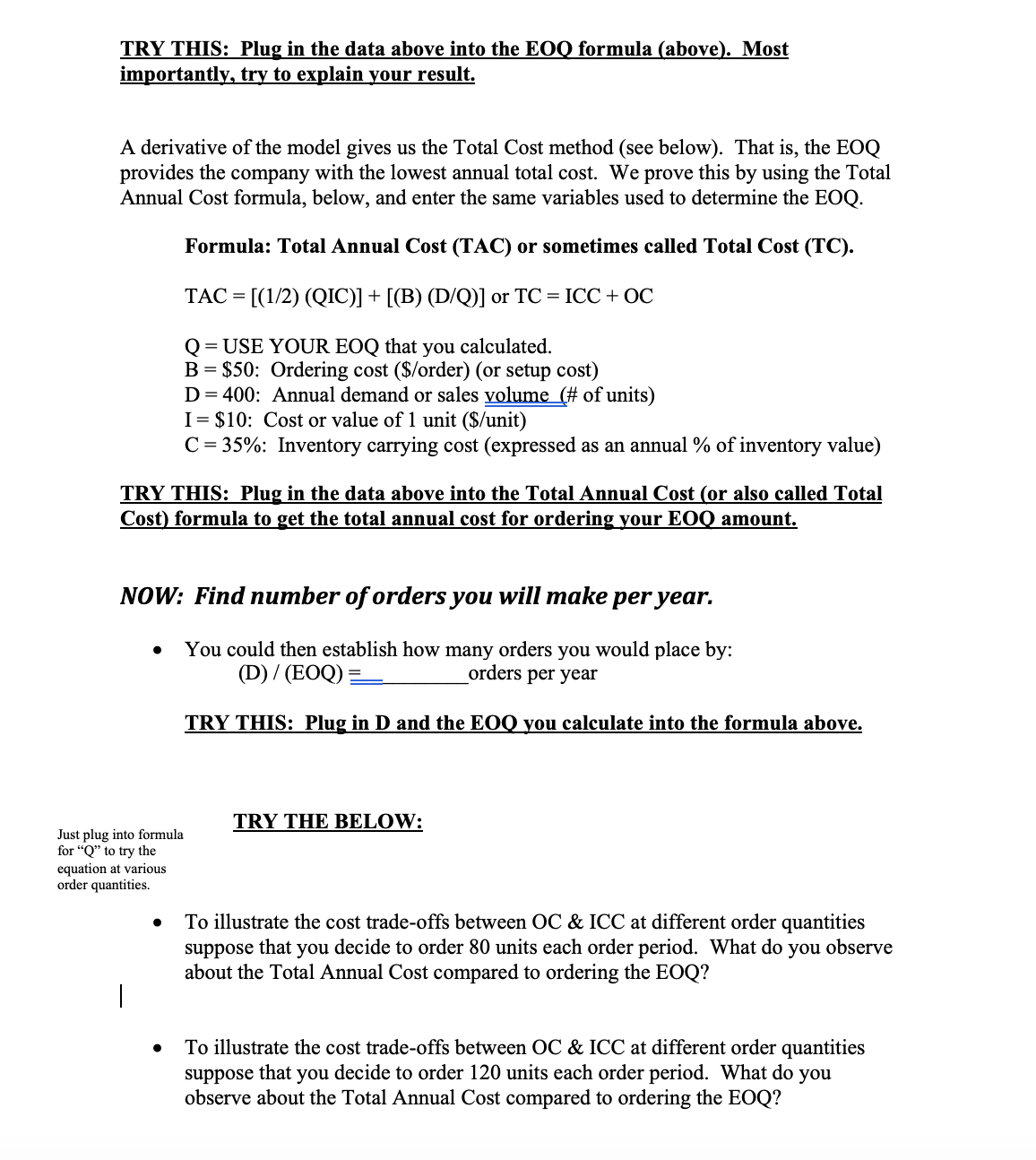
Inventory Management EOQ EXAMPLE: GIVE IT A TRY EOQ helps to determine the importance of order frequency and quantity. (Let's see how much we can order and still be cost effective. This requires the square root function as shown below.) Formula:(2DB) / (IC) where: B = $50: Ordering cost ($/order) (or setup cost) D = 400: Annual demand or sales volume_(# of units) I= $10: Cost or value of 1 unit ($/unit) C = 35%: Inventory carrying cost (expressed as an annual % of inventory value) TC Annual Cost ($) OC EOQ Order Size EOQ is the optimal order quantity, which renders the lowest cost of both total annual inventory carrying cost (ICC) and the total annual ordering cost (OC). That is, the EOQ is the ordering lot size where the ICC and OC are equal and at their collective lowest possible point. ICC TRY THIS: Plug in the data above into the EOQ formula (above). Most importantly, try to explain your result. A derivative of the model gives us the Total Cost method (see below). That is, the EOQ provides the company with the lowest annual total cost. We prove this by using the Total Annual Cost formula, below, and enter the same variables used to determine the EOQ. Formula: Total Annual Cost (TAC) or sometimes called Total Cost (TC). TAC = [(1/2) (QIC)] + [(B) (D/Q)] or TC = ICC + OC Q = USE YOUR EOQ that you calculated. B = $50: Ordering cost ($/order) (or setup cost) D = 400: Annual demand or sales volume (# of units) I= $10: Cost or value of 1 unit ($/unit) C = 35%: Inventory carrying cost (expressed as an annual % of inventory value) TRY THIS: Plug in the data above into the Total Annual Cost (or also called Total Cost) formula to get the total annual cost for ordering your EOQ amount. NOW: Find number of orders you will make per year. You could then establish how many orders you would place by: (D)/(EOQ) = orders per year TRY THIS: Plug in D and the EOQ you calculate into the formula above. TRY THE BELOW: To illustrate the cost trade-offs between OC & ICC at different order quantities suppose that you decide to order 80 units each order period. What do you observe about the Total Annual Cost compared to ordering the EOQ? | To illustrate the cost trade-offs between OC & ICC at different order quantities suppose that you decide to order 120 units each order period. What do you observe about the Total Annual Cost compared to ordering the EOQ? Just plug into formula for "Q" to try the equation at various order quantities

Step by Step Solution

There are 3 Steps involved in it

1 Expert Approved Answer
Step: 1 Unlock blur-text-image

Question Has Been Solved by an Expert!

Get step-by-step solutions from verified subject matter experts

Step: 2 Unlock
Step: 3 Unlock

Students Have Also Explored These Related General Management Questions!