







Question: IRAC METHOD CASE EXAMPLE Callender v. MCO Properties 885 P.2d 123 (Ariz. 1994) ...On March 26, 1988, appellant John Scott Callender was boating with friends
IRAC METHOD 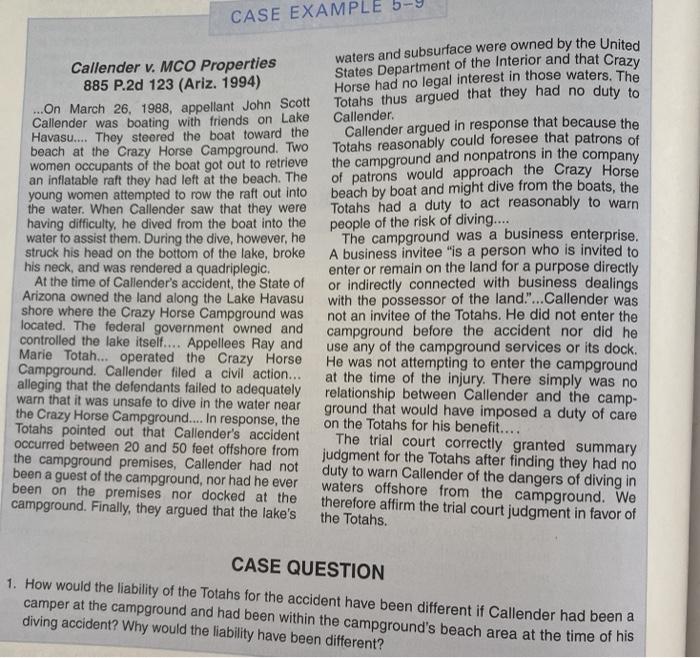
CASE EXAMPLE Callender v. MCO Properties 885 P.2d 123 (Ariz. 1994) ...On March 26, 1988, appellant John Scott Callender was boating with friends on Lake Havasu.... They steered the boat toward the beach at the Crazy Horse Campground. Two women occupants of the boat got out to retrieve an inflatable raft they had left at the beach. The young women attempted to row the raft out into the water. When Callender saw that they were having difficulty, he dived from the boat into the water to assist them. During the dive, however, he struck his head on the bottom of the lake, broke his neck, and was rendered a quadriplegic. At the time of Callender's accident, the State of Arizona owned the land along the Lake Havasu shore where the Crazy Horse Campground was located. The federal government owned and controlled the lake itself.... Appellees Ray and Marie Totah... operated the Crazy Horse Campground. Callender filed a civil action... alleging that the defendants failed to adequately warn that it was unsafe to dive in the water near the Crazy Horse Campground.... In response, the Totahs pointed out that Callender's accident occurred between 20 and 50 feet offshore from the campground premises, Callender had not been a guest of the campground, nor had he ever been on the premises nor docked at the campground. Finally, they argued that the lake's waters and subsurface were owned by the United States Department of the Interior and that Crazy Horse had no legal interest in those waters. The Totahs thus argued that they had no duty to Callender Callender argued in response that because the Totahs reasonably could foresee that patrons of the campground and nonpatrons in the company of patrons would approach the Crazy Horse beach by boat and might dive from the boats, the Totahs had a duty to act reasonably to warn people of the risk of diving.... The campground was a business enterprise. A business invitee "is a person who is invited to enter or remain on the land for a purpose directly or indirectly connected with business dealings with the possessor of the land."...Callender was not an invitee of the Totahs. He did not enter the campground before the accident nor did he use any of the campground services or its dock. He was not attempting to enter the campground at the time of the injury. There simply was no relationship between Callender and the camp- ground that would have imposed a duty of care on the Totahs for his benefit.... The trial court correctly granted summary judgment for the Totahs after finding they had no duty to warn Callender of the dangers of diving in waters offshore from the campground. We therefore affirm the trial court judgment in favor of the Totahs. CASE QUESTION 1. How would the liability of the Totahs for the accident have been different if Callender had been a camper at the campground and had been within the campground's beach area at the time of his diving accident? Why would the liability have been different Step by Step Solution
There are 3 Steps involved in it
1 Expert Approved Answer
Step: 1 Unlock

Question Has Been Solved by an Expert!
Get step-by-step solutions from verified subject matter experts
Step: 2 Unlock
Step: 3 Unlock
 Study Help