







Question: Isotopes and Average Atomic Mass Name Elements come in a variety of isotopes, meaning they are made up of atoms with the same atomic number
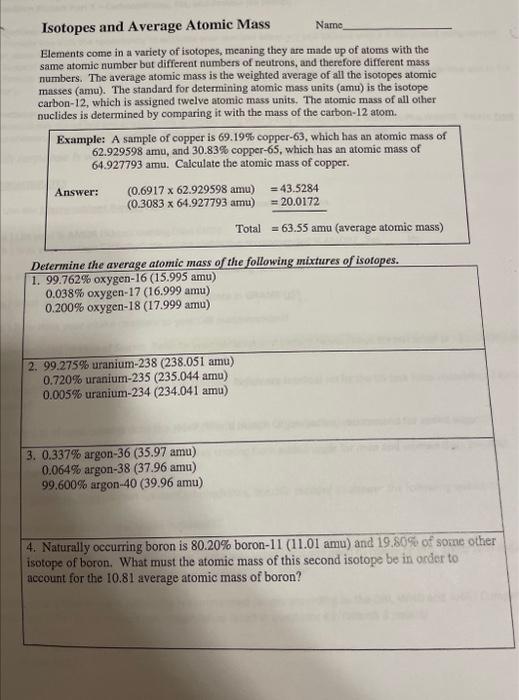
Isotopes and Average Atomic Mass Name Elements come in a variety of isotopes, meaning they are made up of atoms with the same atomic number but different numbers of neutrons, and therefore different mass numbers. The average atomic mass is the weighted average of all the isotopes atomic masses (amu). The standard for determining atomic mass units (amu) is the isotope carbon-12, which is assigned twelve atomic mass units. The atomic mass of all other nuclides is determined by comparing it with the mass of the carbon-12 atom. Example: A sample of copper is 69.19% copper-63, which has an atomic mass of 62.929598amu, and 30.83% copper-65, which has an atomic mass of 64.927793 amu. Calculate the atomic mass of copper. Answer: (0.691762.929598amu)(0.308364.927793amu)Total=43.5284=20.0172=63.55amu(averageatomicmass) Determine the average atomic mass of the following mixtures of isotopes. 1. 99.762% oxygen-16 (15.995 amu) 0.038% oxygen-17 (16.999 amu) 0.200% oxygen-18 (17.999 amu) 2. 99.275% uranium-238 (238.051 amu) 0.720% uranium-235 (235.044 amu) 0.005% uranium-234 (234.041 amu) 3. 0.337% argon-36 (35.97 amu) 0.064% argon-38 (37.96 amu) 99.600% argon-40 (39.96 amu) 4. Naturally occurring boron is 80.20% boron-11 (11.01 amu) and 19.80% of sorne other isotope of boron. What must the atomic mass of this second isotope be in order to account for the 10.81 average atomic mass of boron
Step by Step Solution
There are 3 Steps involved in it

Get step-by-step solutions from verified subject matter experts
 Study Help