







Question: It is only one question (a). Help me with the formulation, please. All data are given in the photos. Supplier selection and order allocation Problem
It is only one question (a). Help me with the formulation, please. All data are given in the photos.
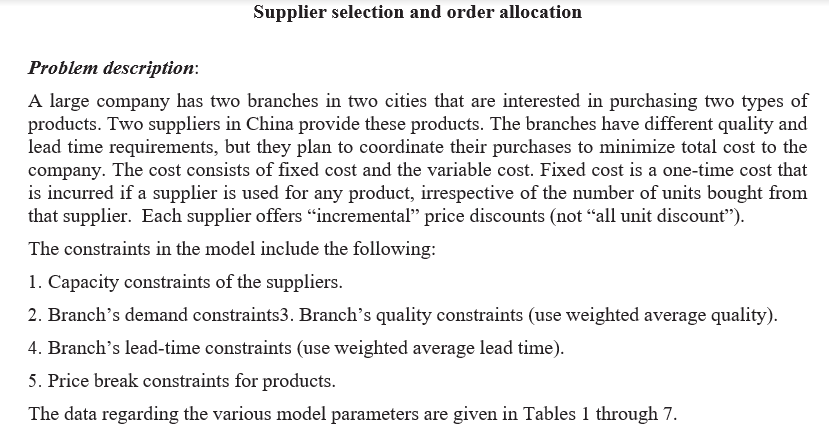
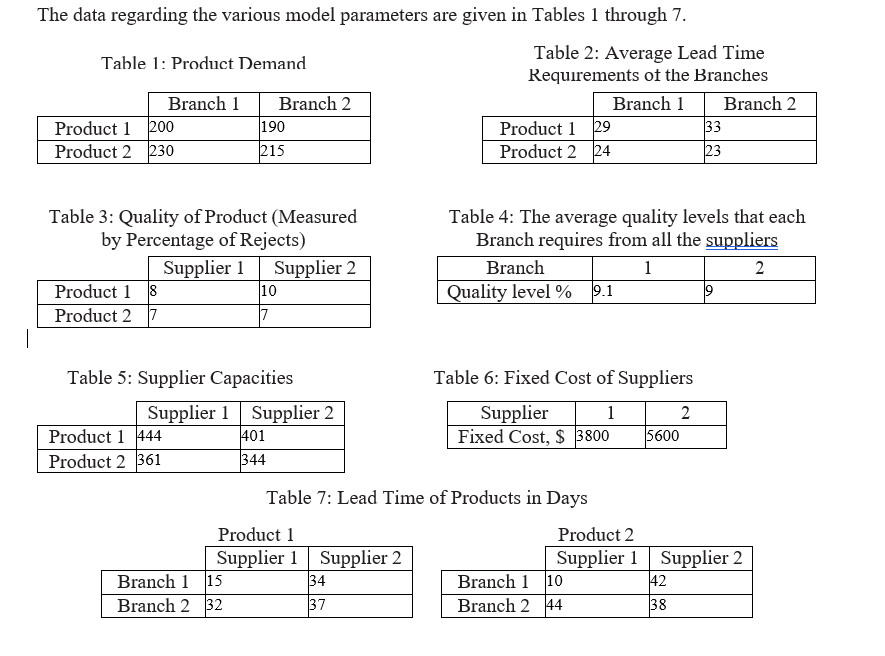
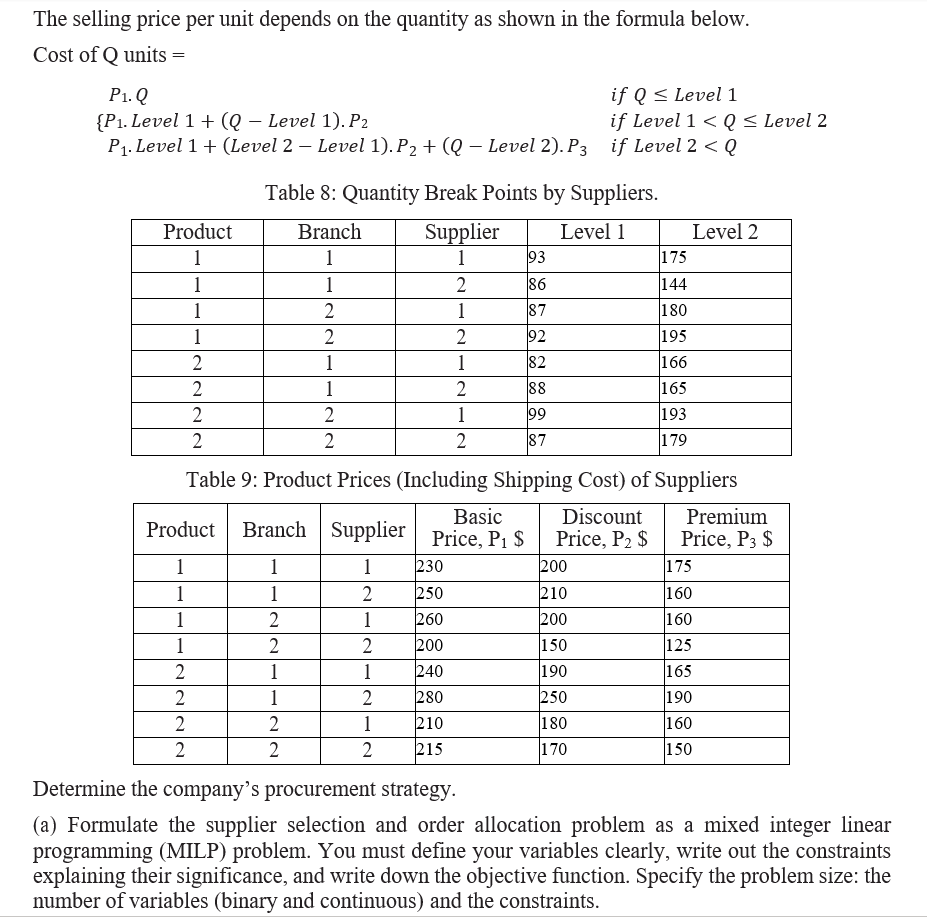
Supplier selection and order allocation Problem description: A large company has two branches in two cities that are interested in purchasing two types of products. Two suppliers in China provide these products. The branches have different quality and lead time requirements, but they plan to coordinate their purchases to minimize total cost to the company. The cost consists of xed cost and the variable cost. Fixed cost is a one-time cost that is incurred if a supplier is used for any product, irrespective of the number of units bought from that supplier. Each supplier offers \"incremental\" price discounts (not \"all unit discount"). The constraints in the model include the following: 1. Capacity constraints of the suppliers. 2. Branch's demand constraints3. Branch's quality constraints (use weighted average quality). 4. Branch's lead-tirne constraints {use weighted average lead time). 5. Price break constraints for products. The data regarding the various model parameters are given in Tables 1 through 7. The data regarding the various model parameters are given in Tables 1 through 3". Table 2: Average Lead Time Requirements 01 the Branches Table 1 : Product Demand Table 3: Quality of Product (Measured Table 4: The average qualityr levels that each by Percentage of Rejects) Branch requires from all the m Quality level % 9.1 9 Product 2 7 Table 5: Supplier Capacities Table 6: Fixed Cost of Suppliers Supplier l Supplier 2 Supplier 1 2 Product 1 444 401 Fixed Cost, $ 3800 5600 Product 2 361 344 Table 7: Lead Time of Products in Days Product 1 Product 2 1Supplier l 3Supplier2 __ 2 Branch 2 4 38 The selling price per unit depends on the quantity as shown in the formula below. Cost of Q units = PLQ if Q 5 Level 1 [PL Level 1 + (Q Level 1).)\": if Level 1 at Q 5 Level 2 P1. Level 1 + (Level 2 Level 1). P2 + (Q Level 2).P3 if Level 2
Step by Step Solution
There are 3 Steps involved in it

Get step-by-step solutions from verified subject matter experts
 Study Help