







Question: It represented an exciting new development in a world where the only computers were terminals linked to mainframes. To exploit this new technology, a group
It represented an exciting new development in a world where the only computers were terminals linked to mainframes. To exploit this new technology, a group of computer enthusiasts set up the Homebrew Computer Club to share skills, knowledge and equipment. Steve Jobs attended some of these early meetings with his friend Steve Woz Wozniak. While Woz was interested in creating ever more elegant computer designs, Jobs initial interest was limited his engineering expertise was non-existent compared to the other enthusiasts. As more commercial kits started to appear at the Club, however, Jobs started to think about how he could profit from this new field. He saw that there might be a market for the assembled product, and he took to dropping hints to Woz about the machine that was being built on his kitchen table. On April 1st, 1976 they decided to consolidate this partnership with an agreement signed by Jobs (45 percent), Woz (45 percent), and Ron Wayne (10 percent) who also worked at Atari. The side line became a business as the partners started to buy components, install them, deliver them to the retailer, and pay suppliers to fulfil a $25,000 contract. As a result, growth had continued despite obvious shortcomings with the Apple II (e.g., the hardware had not been upgraded in six years; the keyboard was limited to upper case letters, it did not contain the full set of characters and had no up and down arrows to move the cursor). The Apple IIe was introduced in early 1983 to address these problems and was $400 cheaper. At this stage, Apple had a decentralized structure around loose product groupings (Figure 1). The company had developed a unique culture under Steve Jobs. It emphasized individual achievement, entrepreneurialism, and commitment, or perhaps to be more accurate, devotion to the company. An evangelical spirit pervaded Apple coupled with an attitude that was described as: laid back and cocky ... Apple employees believe, somewhat self-righteously, that their mission is to bring computer literacy to the masses. The concept of evangelism is an important component of Apples culture. Corporate evangelists refers to people who extensively promote a corporations products. However, as the name evangelism implies, the role of evangelist takes on greater meaning. Evangelists believe strongly in the company and will spread that belief to others, who them also promote the company to others. In this way, Apple was able to form what it refers to as a Mac cultcustomers who are very loyal to Apples Mac computers and who will spread a positive message about Macs to their friends and families. At Apple, a laser disc blasted out Michael Jackson music in the lobby and the staff wore jeans and sneakers. Suits and ties were rarely seen and interaction was informal. Rooms were named after creative artists like Picasso and Rembrandt, and aesthetic values were important from the design of the product to the design of the working environment. Figure 1 Apple organization chart c. 1982 (Adapted from John Sculley at Apple Computer (A) Harvard Business School Case #9-486-001) The 1980s: A Time for Change By 1983, Apple was facing a very different environment: competition had increased with more than one hundred manufacturers producing 150 models of personal computers ranging in price from $99 to $37,500. These new competitors had found it relatively easy to enter the personal computer market: the technology was not particularly sophisticated, capital was available, and distribution channels the biggest barrier to entry were expanding rapidly. As a result, Apple had found itself squeezed on both sides: from both superior proprietary technology and lowpriced Apple imitations (like the Pineapple in the US, the Lemon in Italy, and the Orange in Asia). One way Apple looked to protect itself was shifting its approach to intellectual property. In 1982 Apple filed a lawsuit against Franklin Computer Corporation that highly impacted intellectual property laws for decades to come. Apple alleged that Franklin was illegally formatting copies of Apple IIs operating system so that they would run on Franklin computers. Franklins lawyers argued that portions of computer programs were not subject to copyright law. At first the courts sided with Franklin, but the verdict was later overturned. The courts eventually determined that codes and programs are protected under copyright law. The days of open source software were now gone for Apple, from the 1980s Apple aggressively maintained a culture of secrecy and vigorously targeted any IP theft in the courts. By the early 1980s the personal computer market was dividing into five broad segments: home, education, small business, corporations and the professional user. Each had different needs. The professional market (10 percent of 1983 sales) was relatively sophisticated and required a wide range of options and applications. The corporate market (25 percent) required communications capabilities and standardization. The small business market (25 percent) was highly fragmented and users were typically unfamiliar with computers. The education market (10 percent) ranged from basic applications in elementary schools to sophisticated users in universities. The home computer market (33 percent) was the least well defined in terms of needs and price, ranging from professionals home use to school childrens educational toys. Faced with these new challenges, Apple sought to bring in new leadership. On May 2nd 1983, John Sculley became President and CEO of Apple. He had spent the last five years as President of Pepsi-Cola Co. Inc. He had a degree in architectural design from Brown University and an MBA from the Wharton School at the University of Pennsylvania. He was credited with several innovations such as the large size plastic bottles, the promotion of caffeine free colas and the development of the Pepsi Challenge advertising campaign. Steve Jobs had personally spent over four months courting him for the position at Apple, telling him, You can sell sugared water to children the rest of your career or you can change the world a little. The idea of a change and a compensation package rumoured to be nearly $2 million finally tempted Sculley although his honeymoon was cut short when he was greeted with an 80 percent drop in profits for the three months ending September 1983. The mainstay of Sculleys strategy was the Macintosh. It would be capable of word processing, drawing and financial spreadsheets. The Lisa II a cheaper, faster model than the original was also planned. A portable version of the Apple II was also announced. The Apple II, the Lisa, and the Macintosh were the basis of a technology-driven, product-oriented strategy; and Apple continued to target the small business and educational markets as an alternative to IBM. The Mac symbolized Jobs vision of Apple as a unique and different product. It went against conventional wisdom and the company had originally become successful by going against the conventional wisdom. The second part of Sculleys strategy was the rationalization of product lines into two product divisions (Figure 2). Apple II and Apple III products were combined in the Apple II division, headed by Del Yocam, a six-year veteran of Apple who had come up through the manufacturing ranks. The Lisa and the Macintosh became the responsibility of the Mac division, where Jobs was Vice-president. The aim of the two new divisions, each with decentralized manufacturing, product development and marketing functions was to facilitate a coherent product strategy. Until now the Apple III, Lisa and Mac each used different operating systems and the Mac was not compatible with any of its predecessors. These difficulties had been partially attributed to the fact that Jobs had earlier stormed off the Lisa development team, complaining that a low-cost, easy to use product was needed for the masses, rather than a high-priced, business-oriented product. So, although he had helped develop the successful Macintosh, Jobs actions had inhibited the development of a coherent product line. Sculley also attempted to control costs, reduce overhead, and rationalize product lines. He centralized reporting relationships: 15 general managers who had previously reported to group vice-presidents now reported directly to him. Almost half of the 15 member senior management team was replaced or left. The workforce of 5,300 was reduced to 4,600. The generous profit sharing programme was suspended. The marketing budget jumped to $80 million from $12 million in two years, while the research budget remained stable. Despite their personality differences, the intense, level-headed Sculley and mercurial, tempestuous Jobs managed to forge a strong friendship, despite the fact that Jobs was both above Sculley (as Chairman with a 12 per cent ownership stake) and below (as Vice-president of the Mac Division). Source: Adapted from Transnational Management, Text, Cases and Readings in Cross-Border Management by Christopher A. Bartlett and Sumantra Ghosal, Irwin Publications, Homewood, Illinois, 1992: 726 Sculley also managed to fit into Apples unique culture. He sent out tickets to Indiana Jones and the Temple of Doom to employees. He mastered the intricacies of hardware and software technology, and abandoned his business suit in favour of a more casual look. By the end of Sculleys his first year, it was looking like an inspired appointment. Sculley had introduced two successful computers: the Mac and the Apple II, and discontinued the disappointing Apple III. The Mac promised to be a major success: it was priced below $2,000 and was a powerful, easy to use machine that was particularly strong in graphics. It had been successfully aimed at small business and university students. Despite this initial success, competitive pressures continued to affect Apple. It was becoming clear that Apple would have to be more successful in the business sector to sustain growth and maintain market share, yet the company still lacked a coherent strategy for tackling this challenge. In addition, the lack of IBM compatibility and its limited communication capabilities continued to hurt sales of the Mac. Jobs go-it-alone vision was no longer such an effective strategy. Apple also had yet to develop a strategy for reaching the business market without alienating its more than 2,000 dealers. However, any attempt by Apple to develop a direct sales force would worry dealers who would fear being cut out of the supply chain and who were already upset by the constant discounting of many of Apples products. Apples advertising strategy also needed changing. A TV commercial showed a long line of business executives as lemmings blindly jumping off a cliff. Only the last one, presumably an intrepid Mac-user, pulled off his blindfold and saved himself. By showing this, Apple had managed to insult the very people it was trying to reach. Apple was also suffering from internal problems. Most of the companys attention was centred on the Mac division, headed by the charismatic Jobs. He perpetuated the unorthodox culture that typified Apple. Employees were young and dress codes unconventional. Rock music was played at night and classical music during the day, fruit juice was provided free to employees, and a masseur was on call. At the annual meeting in January 1985, the Mac team was in the front row seats listening to Steve Jobs announce mainly Mac products. Apple II employees watched on closed circuit TV from another room while virtually nothing was said about Apple II computers or the people who had made it a top selling product for nearly seven years. During the quarter ending December 1984, the Apple division had brought in $500 million of the companys $698 million in revenues. Despite its performance, Jobs was dismissive of the Apple II division. He had once addressed its marketing staff as members of the dull and boring product division. We used to say that the Mac people had God on their team said an employee of the Apple II division. 1985 also saw the departure of a number of key personnel. The most dramatic was the departure of Steve Wozniak who left in February following a well-publicized row with Steve Jobs to form a new company and took the designer of the new Apple IIc with him. Woz was particularly indignant about the lack of respect the Apple II division was receiving. Apples first massmarket computer, the Apple II continued to be Apples workhorse in terms of sales even after the launch of the Macintosh. At least 6 other key personnel also left. Most were from the Apple II division and had become increasingly disenchanted with the lack of attention and a culture that they perceived to be becoming increasingly corporate in nature. Relations were also starting to sour between Jobs and Sculley. A rift had grown as business pressures mounted: each advocated different strategies for placing Apple on a firmer footing. The recession changed the focus for John Sculley from how fast can we build them to how quickly can we bring down inventories and control expenses. Jobs, on the other hand, wanted the original orientation to continue. Sculley was finding this dissension problematic since he was sandwiched between Jobs two positions as vice president of the Mac Division and Chairman of the Board. Sculley said at the time I had given Steve greater power than he had ever had and I had created a monster. Sculley asked Jobs to step down as vice president. Jobs refused. Sculley told directors that he was asking Steve to relinquish control of the Mac division because he could no longer work effectively: if the Board would not back him, he would resign. At the end of a twoday meeting, the Board decided unanimously to ask Jobs to step down as executive vice president. On May 31st 1985, Sculley signed the paperwork removing Steve Jobs from his position. Six weeks later, Apple recorded its first loss as a public company and saw its stock hit a three-year low of less than $15. Initially, Board members hoped that Jobs would stay with the company. In September, however, Jobs announced his plans to start a new venture. The Board was considering purchasing a 10 percent stake in the new enterprise but on learning that Jobs was taking five key employees with him, immediately demanded his resignation. Steve Jobs then left the company he had founded. Toward the 1990s Sculley split Apple into two functional groups one for product development and manufacturing and the other for marketing and sales instead of the previously decentralized divisions (Figure 3). His aim was to reduce duplication and ensure a lower breakeven point. It was hoped that the merging of the product divisions would end the intense rivalry between Apple II and Mac personnel that had sapped morale. Del Yocam was put in charge of all engineering, manufacturing and distribution operations, including product development. A centralized marketing division was responsible for marketing and sales. Sculley also laid off one-third of the 6,000 workers, including part of the field sales force that had recently been hired, and closed three of its six factories. He instituted strict financial controls, formal reporting procedures, and tough product development deadlines. Sculleys efforts bore the desired results: profits doubled between 1985 and 1987 and the price of Apple stock soared more than 500 per cent. In 1990, Sculley became 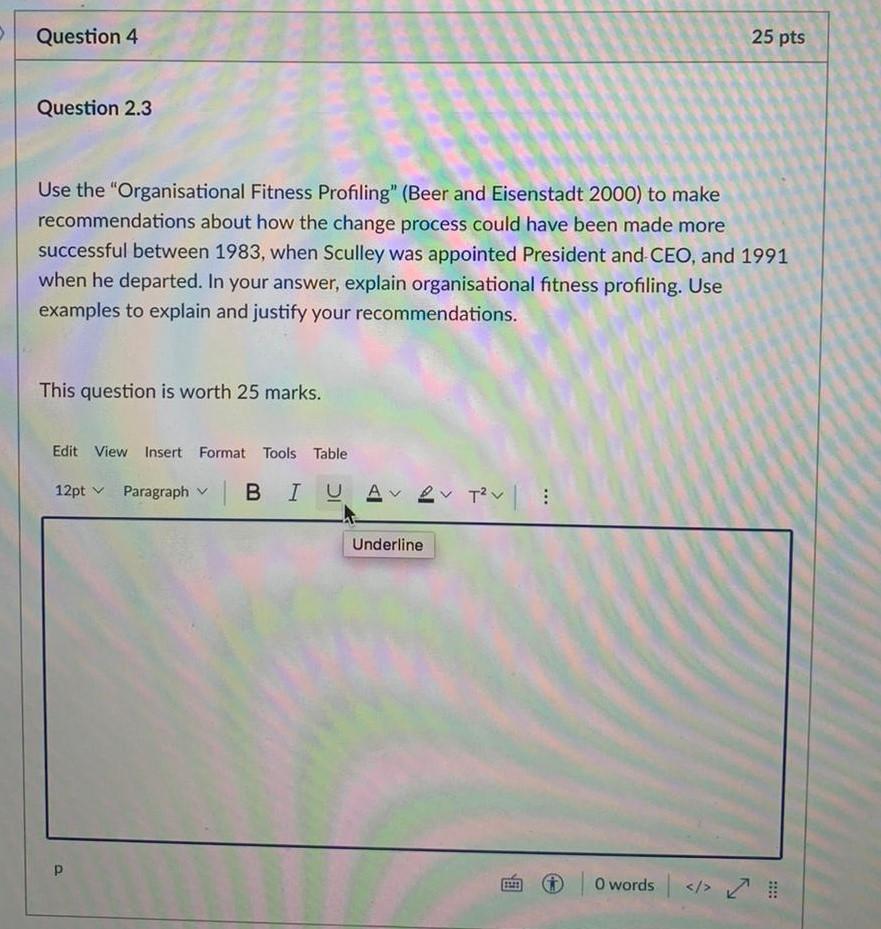
Step by Step Solution
There are 3 Steps involved in it

Get step-by-step solutions from verified subject matter experts
 Study Help