Question: Item 9 In the case below, the original source material is given along with a sample of student work. Determine the type of plagiarism by
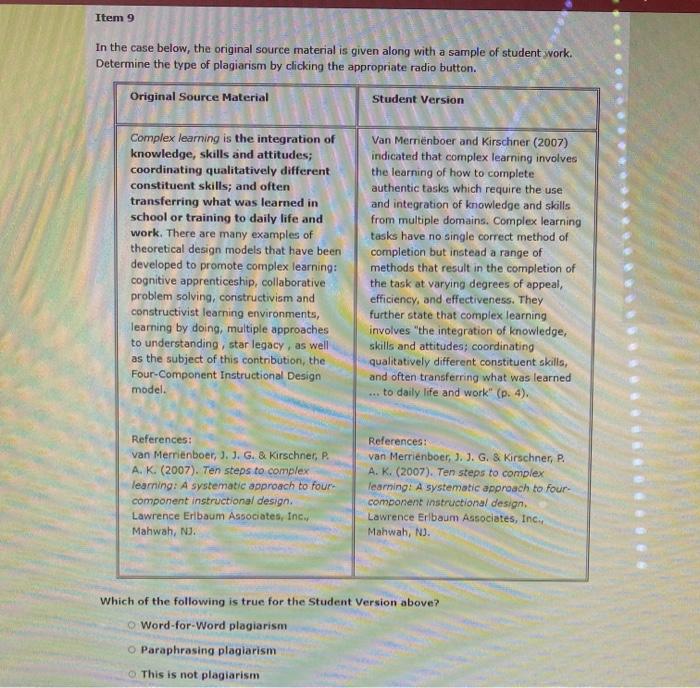
Item 9 In the case below, the original source material is given along with a sample of student work. Determine the type of plagiarism by clicking the appropriate radio button. Original Source Material Student Version Complex learning is the integration of knowledge, skills and attitudes; coordinating qualitatively different constituent skills; and often transferring what was learned in school or training to daily life and work. There are many examples of theoretical design models that have been developed to promote complex learning: cognitive apprenticeship, collaborative problem solving, constructivism and constructivist learning environments, learning by doing, multiple approaches to understanding, star legacy, as well as the subject of this contribution, the Four-Component Instructional Design model. Van Merrienboer and Kirschner (2007) indicated that complex learning involves the learning of how to complete authentic tasks which require the use and integration of knowledge and skills from multiple domains. Complex learning tasks have no single correct method of completion but instead a range of methods that result in the completion of the task at varying degrees of appeal, efficiency, and effectiveness. They further state that complex learning involves the integration of knowledge, skills and attitudes; coordinating qualitatively different constituent skills, and often transferring what was learned ... to daily life and work" (p. 4), References: van Merrienboer, J. J. G. & Kirschner, P. A. K. (2007). Ten steps to complex learning: A systematic approach to four- component instructional design. Lawrence Erlbaum Associates, Inc. Mahwah, NJ. References: van Merrienboer, J. J. G. & Kirschner, P. A. K. (2007). Ten steps to complex learning: A systematic approach to four- component instructional design Lawrence Erlbaum Associates, Inc., Mahwah, NJ. Which of the following is true for the Student Version above? Word-for-Word plagiarism O Paraphrasing plagiarism This is not plagiarism









 Study Help