Question: Its HR related Subject you need to answer the below questions by reading below material pages thank you Qs-1 Qualities of a good recruitment manager/assistant?
Its HR related Subject you need to answer the below questions by reading below material pages thank you
Qs-1 Qualities of a good recruitment manager/assistant?
Qs-2 Role of recruitment manager/assistant?
Qs-3 List the stake holders involved in recruitment and selection process?
Qs-4 What is recruitment and selection policy?
Qs-5 What is recruitment and selection procedure?
Qs-6 what is the difference between recruitment and pre recruitment cycel?
Qs-7 List the alternatives to recruitment ( at least six)
Qs-8 List the characteristic an interviewer generally observed or test in an applicant?
Qs-9 List the content of application form ( Blank form )
Qs-10 What are the ways to test an applicant ? ( List them and explain any 2)
Qs-11 Following are the types of candidate selection methods. ( Explain them into two to three lines )
0 ) External vs internal recruitment
0 ) Sourcing channel classification
0) Talent Pool referral recruitment
0) Internship and apprenticeship
\
Kindly answer the questions mentioned in these pages 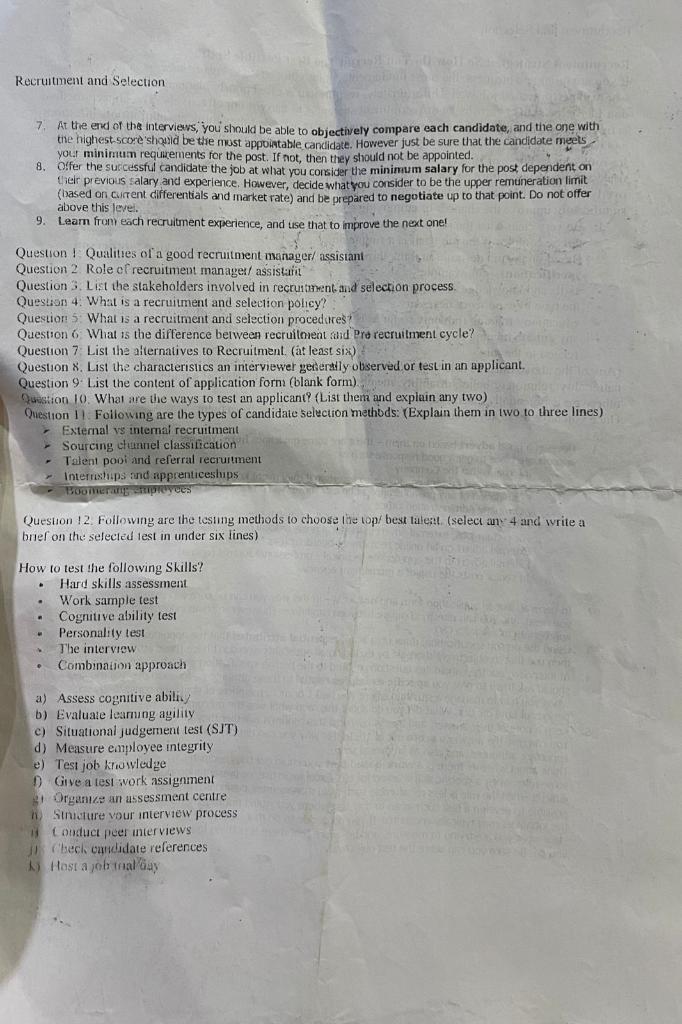
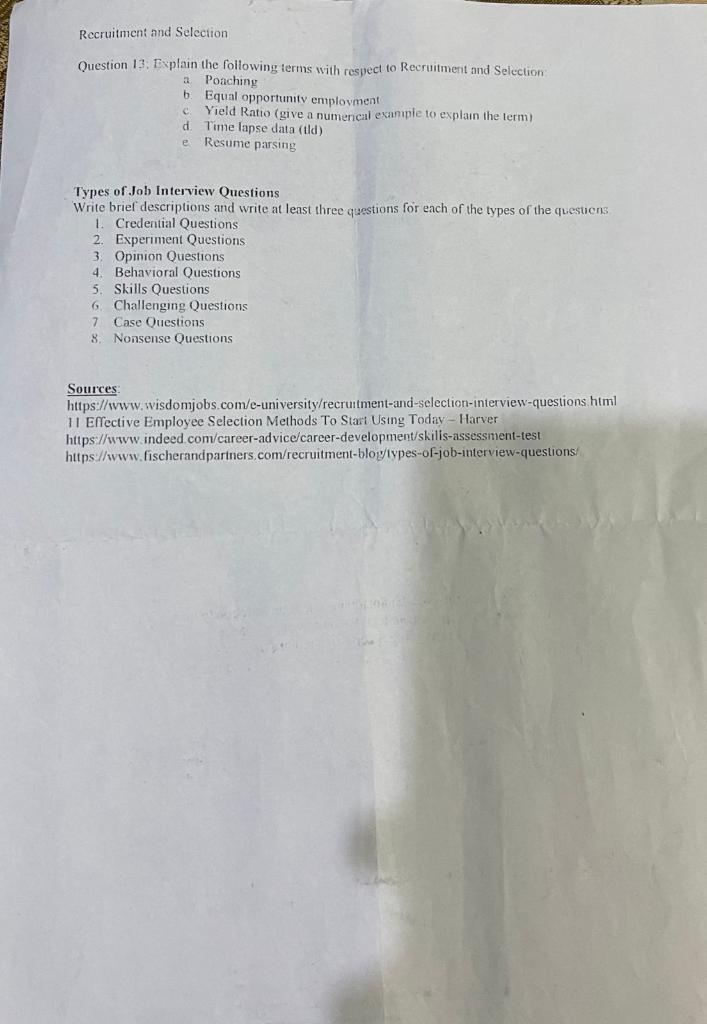
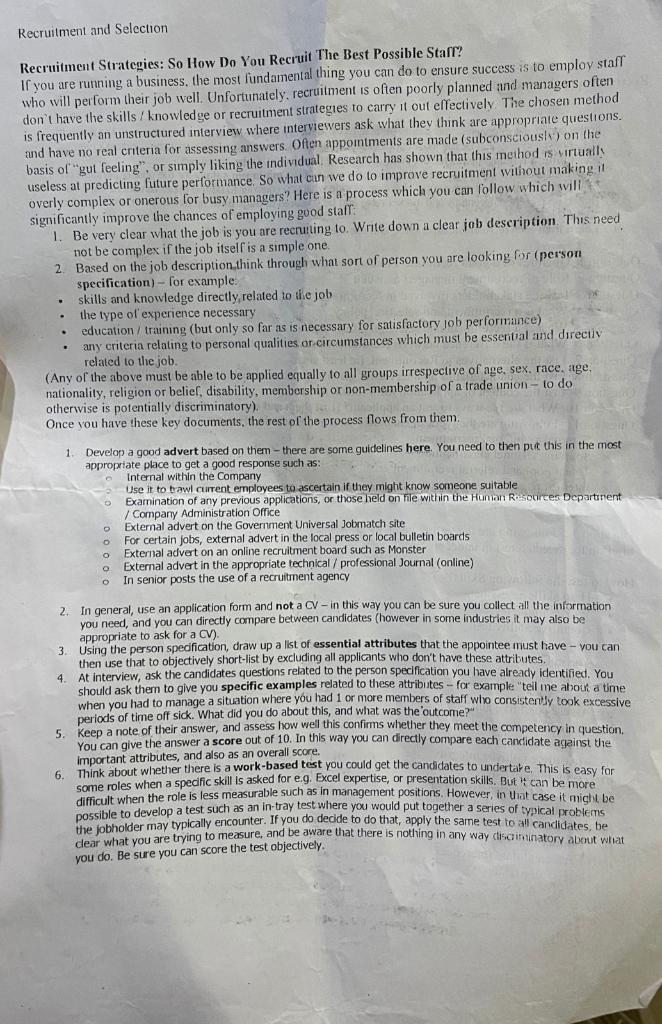
Recruitment and Selection Recruitment Strategies: So How Do You Recruit The Best Possible Staff? If you are running a business, the most fundamental thing you can do to ensure success is to employ staff who will perform their job well. Unfortunately, recruitment is often poorly planned and managers often don't have the skills / knowledge or recruitment strategies to carry it out effectively. The chosen method is frequently an unstructured interview where interviewers ask what they think are appropriate questions. and have no real criteria for assessing answers. Often appointments are made (subconsciously) on the basis of "gut feeling", or simply liking the individual. Research has shown that this method is virtually useless at predicting future performance. So what can we do to improve recruitment without making it overly complex or onerous for busy managers? Here is a process which you can follow which will significantly improve the chances of employing good staff: 1. Be very clear what t the job is you are recruiting to. Write down a clear job description. This need not be complex if the job itself is a simple one. 2. Based on the job description think through what sort of person you are looking for (person for specification) - example skills and knowledge directly, related to the job the type of experience necessary education/training (but only so far as is necessary for satisfactory job performance) any criteria relating to personal qualities or circumstances which must be essential and directiv related to the job. (Any of the above must be able to be applied equally to all groups irrespective of age, sex, race, age. nationality, religion or belief, disability, membership or non-membership of a trade union- to do otherwise is potentially discriminatory). Once you have these key documents, the rest of the process flows from them. 1 Develop a good advert based on them - there are some guidelines here. You need to then put this in the most appropriate place to get a good response such as: Internal within the Company Use it to trawl current employees to ascertain if they might know someone suitable. O Examination of any previous applications, or those held on file within the Human Resources Department / Company Administration Office External advert on the Government Universal Jobmatch site O O For certain jobs, external advert in the local press or local bulletin boards O External advert on an online recruitment board such as Monster O External advert in the appropriate technical / professional Journal (online) In senior posts the use of a recruitment agency O ON 2. In general, use an application form and not a CV-in this way you can be sure you collect all the information you need, and you can directly compare between candidates (however in some industries it may also be appropriate to ask for a CV). 3 Using the person specification, draw up a list of essential attributes that the appointee must have - you can then use that to objectively short-list by excluding all applicants who don't have these attributes. 4 At interview, ask the candidates questions related to the person specification you have already identified. You should ask them to give you specific examples related to these attributes-for example "teil me about a time when you had to manage a situation where you had 1 or more members of staff who consistently took excessive periods of time off sick. What did you do about this, and what was the outcome?" 5. Keep a note of their answer, and assess how well this confirms whether they meet the competency in question. You can give the answer a score out of 10. In this way you can directly compare each candidate against the important attributes, and also as an overall score. 6 Think about whether there is a work-based test you could get the candidates to undertake. This is easy for some roles when a specific skill is asked for e.g. Excel expertise, or presentation skills. But it can be more difficult when the role is less measurable such as in management positions. However, in that case it might be possible to develop a test such as an in-tray test where you would put together a series of typical problems the jobholder may typically encounter. Ify be aware to do that, apply the same test to all candidates, be clear what you are trying to measure, and be aware that there is nothing in any way discriminatory about what you do. Be sure you can score the test objectively. bar Thickness of fenster wor Recruitment and Selection 7. At the end of the interviews, you should be able to objectively compare each candidate, and the one with the highest score should be the most appointable candidate. However just be sure that the candidate meets your minimum requirements for the post. If not, then they should not be appointed. 8. Offer the successful candidate the job at what you consider the minimum salary for the post dependent on their previous salary and experience. However, decide what you consider to be the upper remuneration limit (based on current differentials and market rate) and be prepared to negotiate up to that point. Do not offer above this level. 9. Learn from each recruitment experience, and use that to improve the next one! Question Qualities of a good recruitment manager/ assistant Question 2. Role of recruitment manager/ assistafit Question 3. List the stakeholders involved in recruitment and selection process. Question 4: What is a recruitment and selection policy? Question 5: What is a is a recruitment and selection procedures? 6 What is the difference between recruitment and Pre recruitment cycle? Question 6 Question 7 List the alternatives to Question 8. List the to Recruitment. (at ment. (at least six) 8. List the characteristics an interviewer generally observed or test in an applicant. Question 9 List the content. t of application form (blank form). Question 10. What are the ways to test an applicant? (List them and explain any two) Question 11 Following are the types of candidate selection methods: (Explain them in two to three lines) External vs internal recruitment 11 Sourcing channel classification Talent pool and referral recruitment Internships and apprenticeships Boomerang suproyees Question 12. Following are the testing methods to choose the top/ best talent, (select any 4 and write a brief on the selected test in under six lines) How to test the following Skills? Hard skills assessment kap belo Work sample test Cognitive ability test Personality test The interview TREN CAR be Combination approach Catarbild a) Assess cognitive abili/ MENU b) Evaluate learning agility c) Situational judgement test (SIT) d) Measure employee integrity e) Test job knowledge Give a test work assignment g Organize an assessment centre Structure your interview process Conduct peer interviews J Check candidate references k) Host a job thal Gay dobb og Recruitment and Selection Question 13. Explain the following terms with respect to Recruitment and Selection a Poaching b Equal opportunity employment Yield Ratio (give a numerical example to explain the term) Time lapse data (tld) d e Resume parsing Types of Job Interview Questions Write brief descriptions and write at least three questions for each of the types of the questions 1. Credential Questions 2. Experiment Questions 3. Opinion Questions 4. Behavioral Questions 5. Skills Questions 6. Challenging Questions 7 Case Questions 8. Nonsense Questions Sources: https://www.wisdomjobs.com/e-university/recruitment-and-selection-interview-questions.html 11 Effective Employee Selection Methods To Start Using Today - Harver https://www.indeed.com/career-advice/career-development/skills-assessment-test https://www.fischerandpartners.com/recruitment-blog/types-of-job-interview-questions/









 Study Help