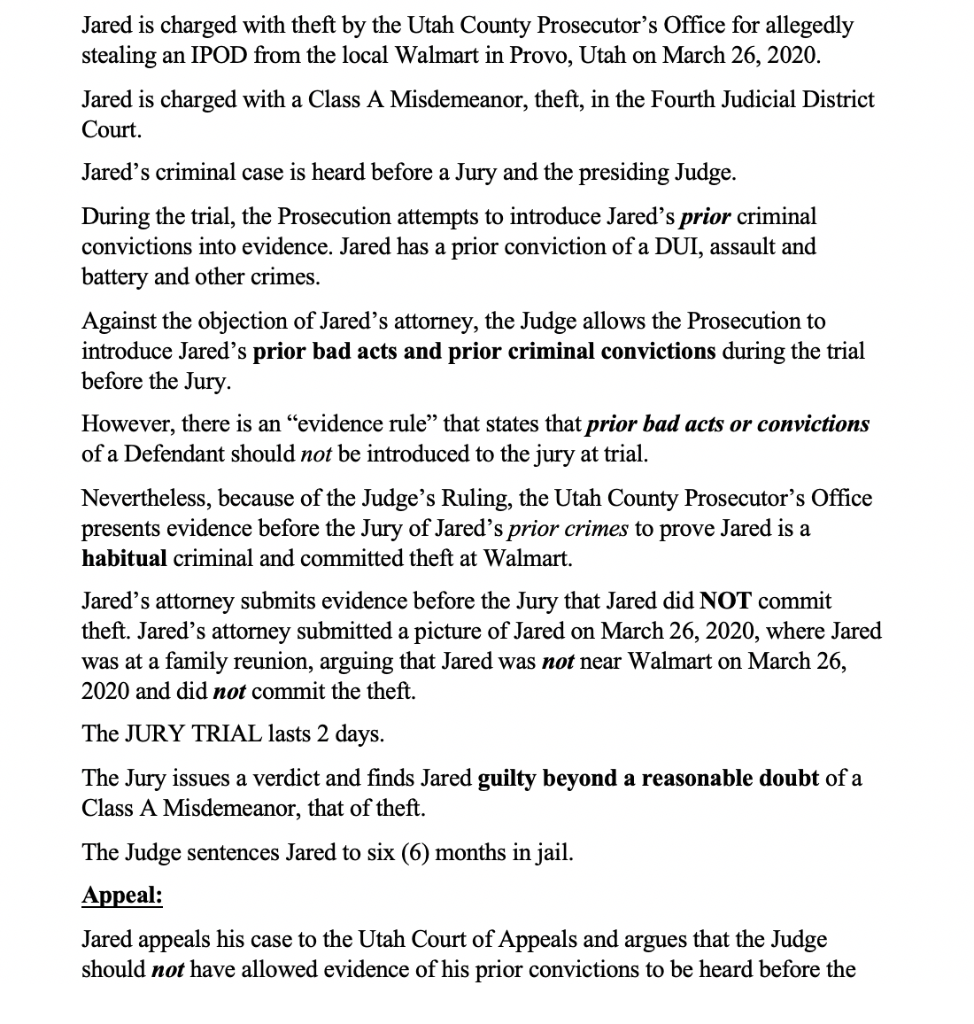
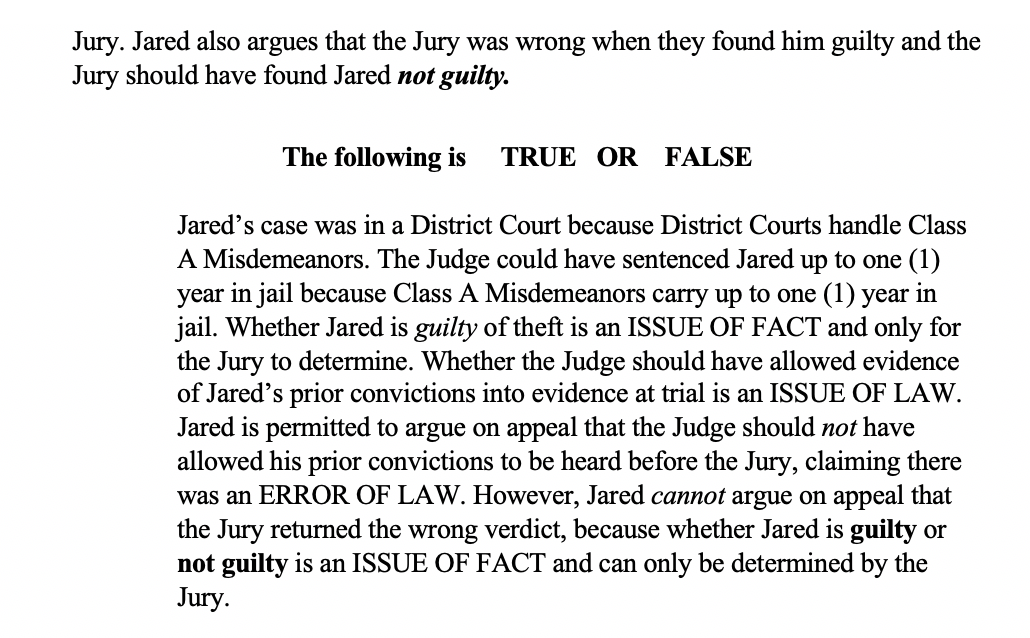
Jared is charged with theft by the Utah County Prosecutor's Office for allegedly stealing an IPOD from the local Walmart in Provo, Utah on March 26, 2020. Jared is charged with a Class A Misdemeanor, theft, in the Fourth Judicial District Court. Jared's criminal case is heard before a Jury and the presiding Judge. During the trial, the Prosecution attempts to introduce Jared's prior criminal convictions into evidence. Jared has a prior conviction of a DUI, assault and battery and other crimes. Against the objection of Jared's attorney, the Judge allows the Prosecution to introduce Jared's prior bad acts and prior criminal convictions during the trial before the Jury. However, there is an evidence rule that states that prior bad acts or convictions of a Defendant should not be introduced to the jury at trial. Nevertheless, because of the Judge's Ruling, the Utah County Prosecutor's Office presents evidence before the Jury of Jared's prior crimes to prove Jared is a habitual criminal and committed theft at Walmart. Jared's attorney submits evidence before the Jury that Jared did NOT commit theft. Jared's attorney submitted a picture of Jared on March 26, 2020, where Jared was at a family reunion, arguing that Jared was not near Walmart on March 26, 2020 and did not commit the theft. The JURY TRIAL lasts 2 days. The Jury issues a verdict and finds Jared guilty beyond a reasonable doubt of a Class A Misdemeanor, that of theft. The Judge sentences Jared to six (6) months in jail. Appeal: Jared appeals his case to the Utah Court of Appeals and argues that the Judge should not have allowed evidence of his prior convictions to be heard before the Jury. Jared also argues that the Jury was wrong when they found him guilty and the Jury should have found Jared not guilty. The following is TRUE OR FALSE Jared's case was in a District Court because District Courts handle Class A Misdemeanors. The Judge could have sentenced Jared up to one (1) year in jail because Class A Misdemeanors carry up to one (1) year in jail. Whether Jared is guilty of theft is an ISSUE OF FACT and only for the Jury to determine. Whether the Judge should have allowed evidence of Jared's prior convictions into evidence at trial is an ISSUE OF LAW. Jared is permitted to argue on appeal that the Judge should not have allowed his prior convictions to be heard before the Jury, claiming there was an ERROR OF LAW. However, Jared cannot argue on appeal that the Jury returned the wrong verdict, because whether Jared is guilty or not guilty is an ISSUE OF FACT and can only be determined by the Jury. Jared is charged with theft by the Utah County Prosecutor's Office for allegedly stealing an IPOD from the local Walmart in Provo, Utah on March 26, 2020. Jared is charged with a Class A Misdemeanor, theft, in the Fourth Judicial District Court. Jared's criminal case is heard before a Jury and the presiding Judge. During the trial, the Prosecution attempts to introduce Jared's prior criminal convictions into evidence. Jared has a prior conviction of a DUI, assault and battery and other crimes. Against the objection of Jared's attorney, the Judge allows the Prosecution to introduce Jared's prior bad acts and prior criminal convictions during the trial before the Jury. However, there is an evidence rule that states that prior bad acts or convictions of a Defendant should not be introduced to the jury at trial. Nevertheless, because of the Judge's Ruling, the Utah County Prosecutor's Office presents evidence before the Jury of Jared's prior crimes to prove Jared is a habitual criminal and committed theft at Walmart. Jared's attorney submits evidence before the Jury that Jared did NOT commit theft. Jared's attorney submitted a picture of Jared on March 26, 2020, where Jared was at a family reunion, arguing that Jared was not near Walmart on March 26, 2020 and did not commit the theft. The JURY TRIAL lasts 2 days. The Jury issues a verdict and finds Jared guilty beyond a reasonable doubt of a Class A Misdemeanor, that of theft. The Judge sentences Jared to six (6) months in jail. Appeal: Jared appeals his case to the Utah Court of Appeals and argues that the Judge should not have allowed evidence of his prior convictions to be heard before the Jury. Jared also argues that the Jury was wrong when they found him guilty and the Jury should have found Jared not guilty. The following is TRUE OR FALSE Jared's case was in a District Court because District Courts handle Class A Misdemeanors. The Judge could have sentenced Jared up to one (1) year in jail because Class A Misdemeanors carry up to one (1) year in jail. Whether Jared is guilty of theft is an ISSUE OF FACT and only for the Jury to determine. Whether the Judge should have allowed evidence of Jared's prior convictions into evidence at trial is an ISSUE OF LAW. Jared is permitted to argue on appeal that the Judge should not have allowed his prior convictions to be heard before the Jury, claiming there was an ERROR OF LAW. However, Jared cannot argue on appeal that the Jury returned the wrong verdict, because whether Jared is guilty or not guilty is an ISSUE OF FACT and can only be determined by the Jury




