







Question: Please read the case study from your textbook - State of Utah v. Leonard (pg. 351 - 352, Case Study 9-10). 1.Why is failure to
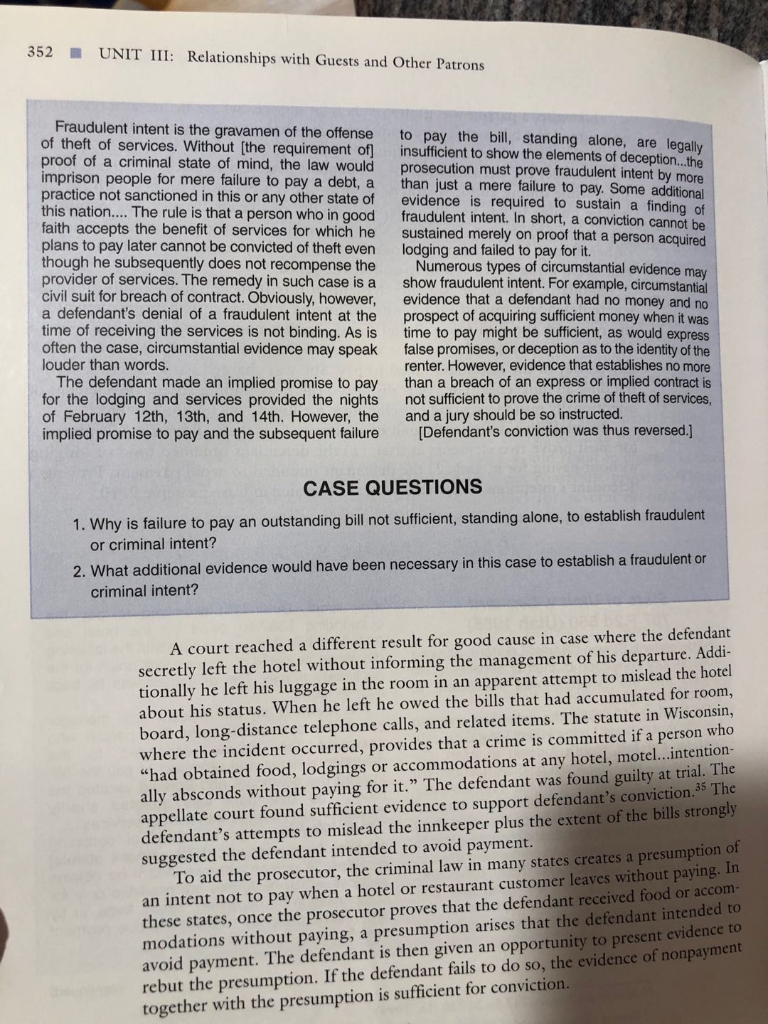
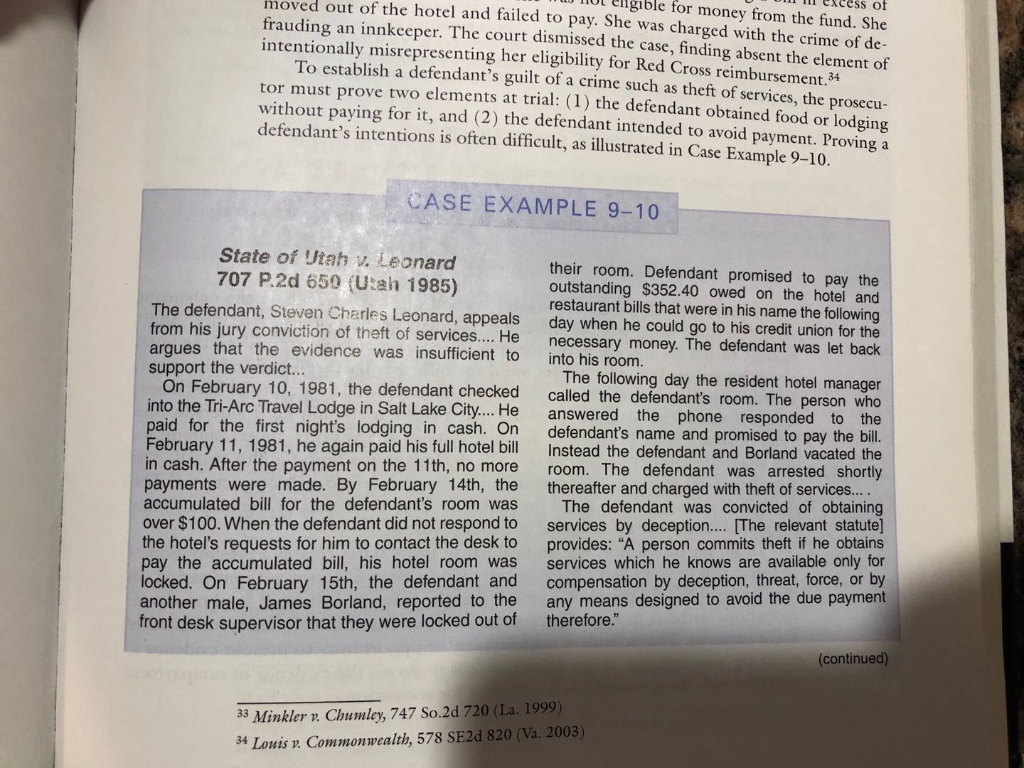
Please read the case study from your textbook - State of Utah v. Leonard (pg. 351 - 352, Case Study 9-10).
1.Why is failure to pay an outstanding bill not sufficient, standing alone, to establish fraudulent or criminal intent?
2. What additional evidence would have been necessary in this case to establish a fraudulent or criminal intent?
352 UNIT III: Relationships with Guests and Other Patrons Fraudulent intent is the gravamen of the offense of theft of services. Without the requirement of proof of a criminal state of mind, the law would imprison people for mere failure to pay a debt, a practice not sanctioned in this or any other state of this nation.... The rule is that a person who in good faith accepts the benefit of services for which he plans to pay later cannot be convicted of theft even though he subsequently does not recompense the provider of services. The remedy in such case is a civil suit for breach of contract. Obviously, however, a defendant's denial of a fraudulent intent at the time of receiving the services is not binding. As is often the case, circumstantial evidence may speak louder than words. The defendant made an implied promise to pay for the lodging and services provided the nights of February 12th, 13th, and 14th. However, the implied promise to pay and the subsequent failure to pay the bill, standing alone, are legally insufficient to show the elements of deception the prosecution must prove fraudulent intent by more than just a mere failure to pay. Some additional evidence is required to sustain a finding of fraudulent intent. In short, a conviction cannot be sustained merely on proof that a person acquired lodging and failed to pay for it. Numerous types of circumstantial evidence may show fraudulent intent. For example, circumstantial evidence that a defendant had no money and no prospect of acquiring sufficient money when it was time to pay might be sufficient, as would express false promises, or deception as to the identity of the renter. However, evidence that establishes no more than a breach of an express or implied contract is not sufficient to prove the crime of theft of services, and a jury should be so instructed. [Defendant's conviction was thus reversed.] CASE QUESTIONS 1. Why is failure to pay an outstanding bill not sufficient, standing alone, to establish fraudulent or criminal intent? 2. What additional evidence would have been necessary in this case to establish a fraudulent or criminal intent? A court reached a different result for good cause in case where the defendant secretly left the hotel without informing the management of his departure. Addi- tionally he left his luggage in the room in an apparent attempt to mislead the hotel about his status. When he left he owed the bills that had accumulated for room, board, long-distance telephone calls, and related items. The statute in Wisconsin, where the incident occurred, provides that a crime is committed if a person who had obtained food, lodgings or accommodations at any hotel, motel...intention- ally absconds without paying for it. The defendant was found guilty at trial. The appellate court found sufficient evidence to support defendant's conviction. The defendant's attempts to mislead the innkeeper plus the extent of the bills strongly suggested the defendant intended to avoid payment. To aid the prosecutor, the criminal law in many states creates a presumption on an intent not to pay when a hotel or restaurant customer leaves without paying. In these states, once the prosecutor proves that the defendant received food or accom- modations without paying, a presumption arises that the defendant intended to avoid payment. The defendant is then given an opportunity to present evidence to rebut the presumption. If the defendant fails to do so, the evidence of nonpayment together with the presumption is sufficient for conviction. U n excess of WOTL ellgible for money from the fund. She moved out of the hotel and failed to pay. She was charged with the crime of de- frauding an innkeeper. The court dismissed the case, finding absent the element of intentionally misrepresenting her eligibility for Red Cross reimbursement 34 To establish a defendant's guilt of a crime such as theft of services, the prosecu- tor must prove two elements at trial: (1) the defendant obtained food or lodging without paying for it, and (2) the defendant intended to avoid payment. Proving a defendant's intentions is often difficult, as illustrated in Case Example 9-10. CASE EXAMPLE 9-10 State of Utah v. Leonard 707 P.2d 650 (Utah 1985) The defendant, Steven Charles Leonard, appeals from his jury conviction of theft of services.... He argues that the evidence was insufficient to support the verdict... On February 10, 1981, the defendant checked into the Tri-Arc Travel Lodge in Salt Lake City.... He paid for the first night's lodging in cash. On February 11, 1981, he again paid his full hotel bill in cash. After the payment on the 11th, no more payments were made. By February 14th, the accumulated bill for the defendant's room was over $100. When the defendant did not respond to the hotel's requests for him to contact the desk to pay the accumulated bill, his hotel room was locked. On February 15th, the defendant and another male, James Borland, reported to the front desk supervisor that they were locked out of their room. Defendant promised to pay the outstanding $352.40 owed on the hotel and restaurant bills that were in his name the following day when he could go to his credit union for the necessary money. The defendant was let back into his room. The following day the resident hotel manager called the defendant's room. The person who answered the phone responded to the defendant's name and promised to pay the bill. Instead the defendant and Borland vacated the room. The defendant was arrested shortly thereafter and charged with theft of services.... The defendant was convicted of obtaining services by deception.... [The relevant statute] provides: "A person commits theft if he obtains services which he knows are available only for compensation by deception, threat, force, or by any means designed to avoid the due payment therefore." (continued) 33 Minkler v. Chumley, 747 So.2d 720 (La. 1999) 34 Louis v. Commonwealth, 578 SE2d 820 (Va. 2003)Step by Step Solution
There are 3 Steps involved in it
1 Expert Approved Answer
Step: 1 Unlock

Question Has Been Solved by an Expert!
Get step-by-step solutions from verified subject matter experts
Step: 2 Unlock
Step: 3 Unlock
 Study Help