







Question: Java Assignment with 5 classes (Customer, Gold, Silver, Main, Billing) Cellphone companies offer various service plans to their customers, and customers are charged different fees
Java Assignment with 5 classes (Customer, Gold, Silver, Main, Billing)
Cellphone companies offer various service plans to their customers, and customers are charged different fees based on their plan. Your assignment is to create a program that allows a cellphone company to generate monthly bills for their customers. For this assignment we will assume that a cellphone service company offers the following service plans:
Bronze: $40 per month for 450 minutes and 45 for every additional minute.
Silver: $60 per month for 900 minutes and 40 for every additional minute.
Gold: $70 per month for unlimited minutes
The company also provides the following discounts:
Bronze: The customer receives no discounts.
Silver: The customer receives a 2% discount if they were a customer for more than 10 years.
Gold: The customer receives a 4% discount if they have been a customer for more than 10 years.
Your Tasks: Create the classes described by the UML diagram with all the methods and variables shown. You are allowed to add additional methods or variables.
1. Create Customer.java to represent a Bronze cellphone service customer.
Attributes
i. name: the customers full name
ii. accountNum: customers account number
iii. minutesUsed: total number of minutes used by customer this month
iv. baseCharge: the base monthly charge ($40, $60, $70)
v. minsLimit: the minutes the plan includes
vi. chargePerAdditionalMin: the charge per minute when minsLimit is exceeded
vii. discount: the percentage discount the customer receives
Methods:
i. constructor: initializes the customers name and account number to parameters
ii. toString(): return name, account number, monthly charge for the customer as a string
iii. setMinutesUsed(int min): set the minutesUsed to the parameter passed in
iv. getDiscount():returns the discount amount provided to this customer for the month
v. getCharges(): returns the monthly fee for this customer with discount included
vi. setDiscount(int numYears): sets the discount percent based on years
vii. getFullCharge(): returns the fee without the discount
2. Create 2 sub-classes of Customer.java: Silver.java, and Gold.java that does the following:
i. inherits the data values and methods from the Customer class.
ii. Both child classes will override the setDiscount(int numYears)
iii. Gold will also override the getFullCharge()
iv. Add additional data values and or methods as appropriate.
3. Create a driver class Billing.java which does the following:
Attributes:
i. Your choice
Methods:
i. constructor: takes the location of a file as a String
ii. Your choice of additional methods that does the following:
* Reads the file passed to the constructor. The file lists the name, account number, plan type, and number of minutes used for at most 100 customers. (See canvas for a sample file customer.txt). Put all customers into an array of type Customer[].
* Compute the monthly charge for each customer based on their service plan and minutes.
* Print to screen all the customers name, account number, monthly charges, and discount. The list should be sorted in ascending order based on the customers monthly charge. (This requires completing step 4). Call the Arrays.sort() method passing it the Customers array.
4. Make your Customer class implement the Comparable interface.
5. Make a Main.java class which has the main method and calls appropriate methods of Billing.
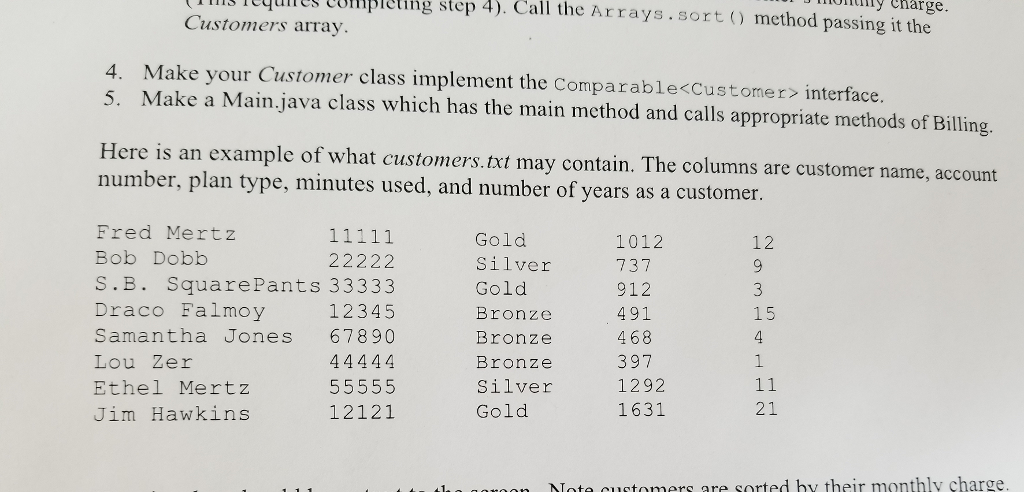
Here is an example of what customers.txt may contain. The columns are customer name, account number, plan type, minutes used, and number of years as a customer.
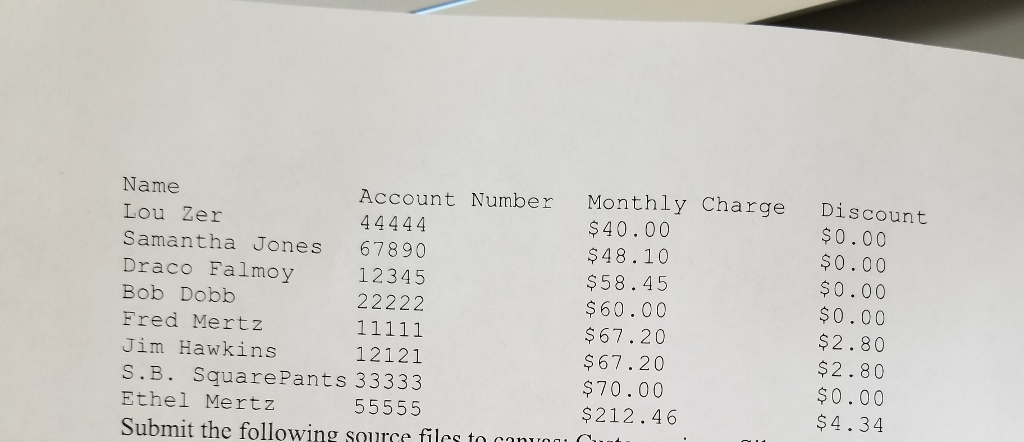
Here is what should be output to the screen . Note customers are sorted by their monthly charge. Also note that the discount amount is the discount*fullCharge value.
Tint Tequne 0ompleting step 4). Call the Arrays.sort) method passing it the monly charge Customers array. 4. 5. Make your Customer class implement the Comparable
Step by Step Solution
There are 3 Steps involved in it

Get step-by-step solutions from verified subject matter experts
 Study Help