Question: Julie must select the appropriate forecasting method and estimate the likely forecast error. 1. Which method should she choose and Why? 2. Using the method
Julie must select the appropriate forecasting method and estimate the likely forecast error.
1. Which method should she choose and Why?
2. Using the method selected, forecast demand for years 6 to 8
Please show in excel with formulas
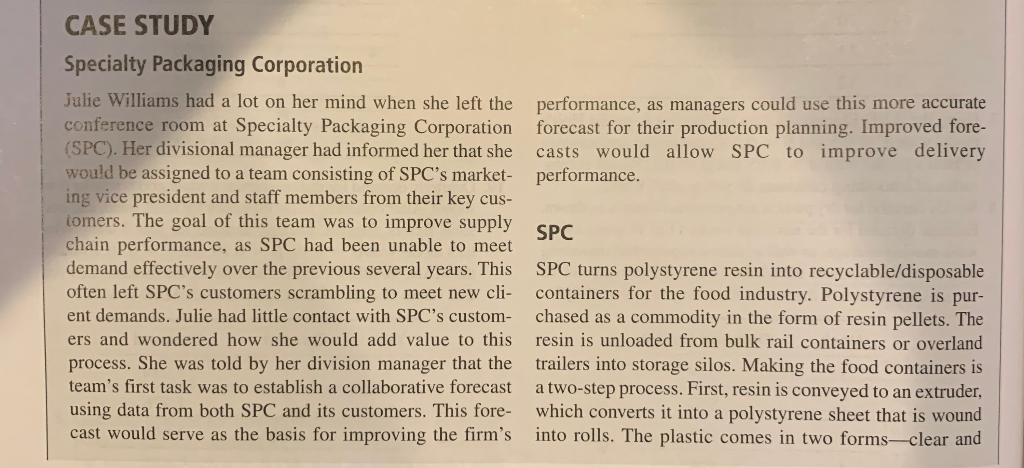
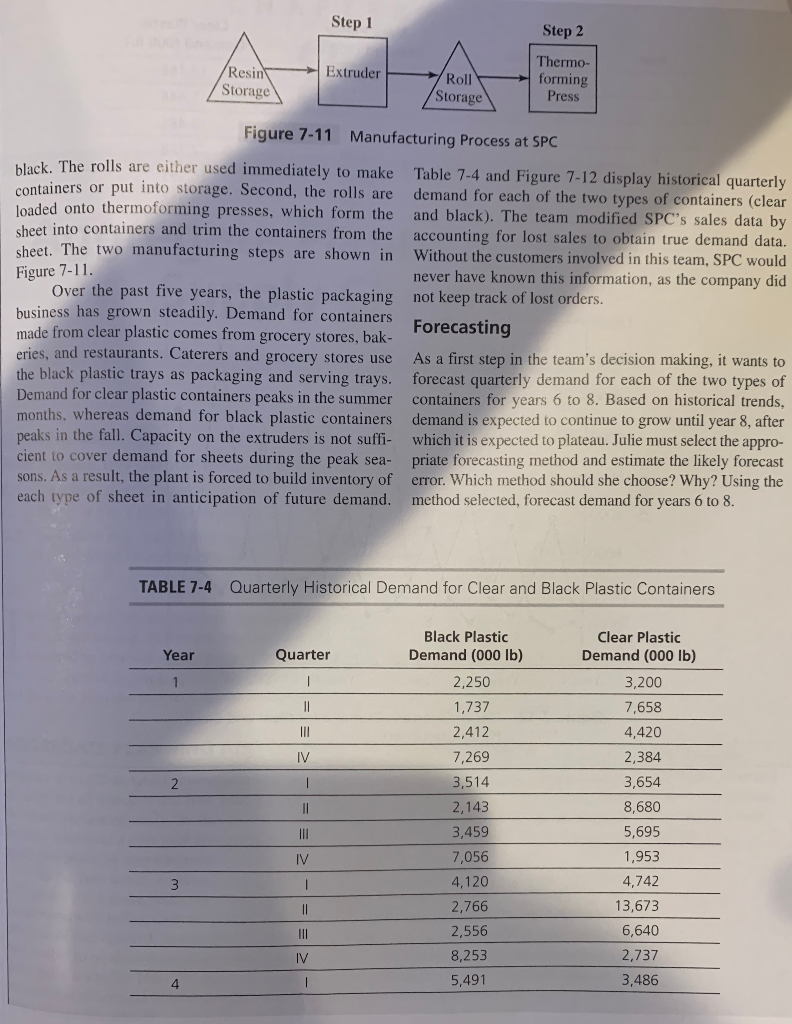
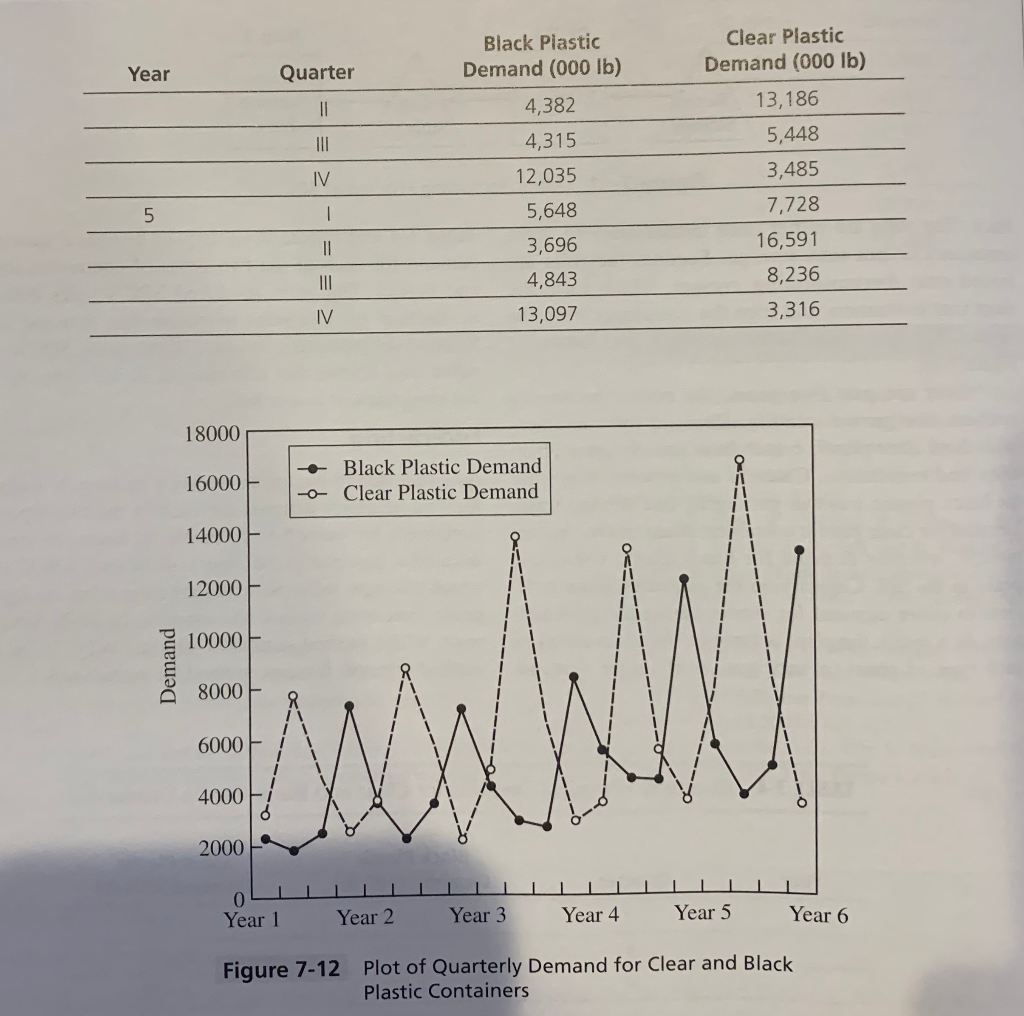
CASE STUDY Specialty Packaging Corporation performance, as managers could use this more accurate forecast for their production planning. Improved fore- casts would allow SPC to improve delivery performance. SPC Julie Williams had a lot on her mind when she left the conference room at Specialty Packaging Corporation (SPC). Her divisional manager had informed her that she would be assigned to a team consisting of SPC's market- ing vice president and staff members from their key cus- tomers. The goal of this team was to improve supply chain performance, as SPC had been unable to meet demand effectively over the previous several years. This often left SPC's customers scrambling to meet new cli- ent demands. Julie had little contact with SPC's custom- ers and wondered how she would add value to this process. She was told by her division manager that the team's first task was to establish a collaborative forecast using data from both SPC and its customers. This fore- cast would serve as the basis for improving the firm's SPC turns polystyrene resin into recyclable/disposable containers for the food industry. Polystyrene is pur- chased as a commodity in the form of resin pellets. The resin is unloaded from bulk rail containers or overland trailers into storage silos. Making the food containers is a two-step process. First, resin is conveyed to an extruder, which converts it into a polystyrene sheet that is wound into rolls. The plastic comes in two forms-clear and Step 1 Step 2 Resin Extruder Thermo- forming Press +/Rollt Storage Storage Figure 7-11 Manufacturing Process at SPC black. The rolls are either used immediately to make containers or put into storage. Second, the rolls are loaded onto thermoforming presses, which form the sheet into containers and trim the containers from the sheet. The two manufacturing steps are shown in Figure 7-11. Over the past five years, the plastic packaging business has grown steadily. Demand for containers made from clear plastic comes from grocery stores, bak- eries, and restaurants. Caterers and grocery stores use the black plastic trays as packaging and serving trays. Demand for clear plastic containers peaks in the summer months, whereas demand for black plastic containers peaks in the fall. Capacity on the extruders is not suffi- cient to cover demand for sheets during the peak sea- sons. As a result, the plant is forced to build inventory of each type of sheet in anticipation of future demand Table 7-4 and Figure 7-12 display historical quarterly demand for each of the two types of containers (clear and black). The team modified SPC's sales data by accounting for lost sales to obtain true demand data. Without the customers involved in this team, SPC would never have known this information, as the company did not keep track of lost orders. Forecasting As a first step in the team's decision making, it wants to forecast quarterly demand for each of the two types of containers for years 6 to 8. Based on historical trends, demand is expected to continue to grow until year 8, after which it is expected to plateau. Julie must select the appro- priate forecasting method and estimate the likely forecast error. Which method should she choose? Why? Using the method selected, forecast demand for years 6 to 8. TABLE 7-4 Quarterly Historical Demand for Clear and Black Plastic Containers Year Quarter III IV Black Plastic Demand (000 lb) 2,250 1,737 2,412 7,269 3,514 2,143 3,459 7,056 4,120 2,766 2,556 8,253 5,491 Clear Plastic Demand (000 lb) 3,200 7,658 4,420 2,384 3,654 8,680 5,695 1,953 4,742 13,673 6,640 2,737 3,486 III IV III IV 4 1 Year Quarter IV Black Plastic Demand (000 lb) 4,382 4,315 12,035 5,648 3,696 4,843 13,097 Clear Plastic Demand (000 lb) 13,186 5,448 3,485 7,728 16,591 8,236 3,316 III IV 18000 16000 + 0 Black Plastic Demand Clear Plastic Demand 14000 i 12000 O









 Study Help