







Question: Just problem 2 please 1. A one-mile-long sewer pipe has filled with a propane/air mixture at 110% theoretical air at 1 atm and 298K (due
Just problem 2 please
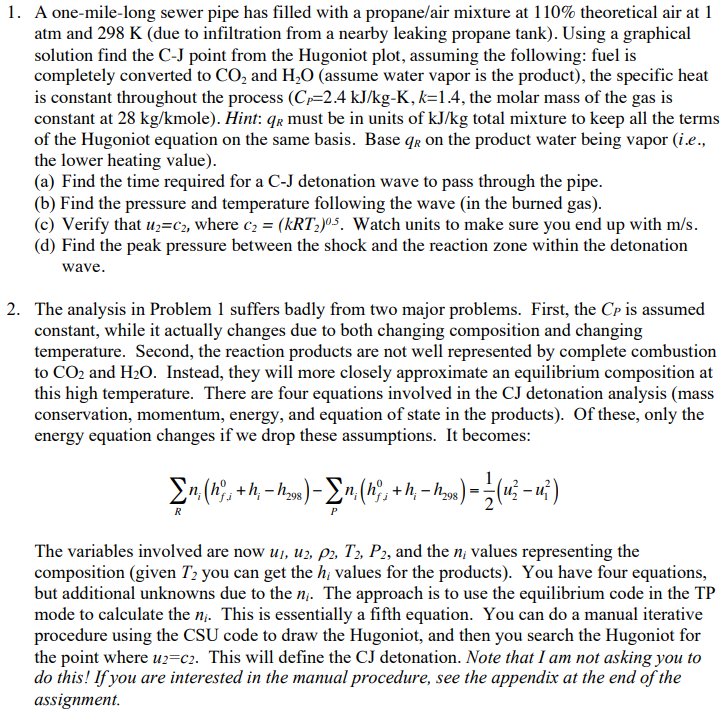


1. A one-mile-long sewer pipe has filled with a propane/air mixture at 110% theoretical air at 1 atm and 298K (due to infiltration from a nearby leaking propane tank). Using a graphical solution find the CJ point from the Hugoniot plot, assuming the following: fuel is completely converted to CO2 and H2O (assume water vapor is the product), the specific heat is constant throughout the process (CP=2.4kJ/kgK,k=1.4, the molar mass of the gas is constant at 28kg/kmole). Hint: qR must be in units of kJ/kg total mixture to keep all the terms of the Hugoniot equation on the same basis. Base qR on the product water being vapor (i.e., the lower heating value). (a) Find the time required for a CJ detonation wave to pass through the pipe. (b) Find the pressure and temperature following the wave (in the burned gas). (c) Verify that u2=c2, where c2=(kRT2)0.5. Watch units to make sure you end up with m/s. (d) Find the peak pressure between the shock and the reaction zone within the detonation wave. 2. The analysis in Problem 1 suffers badly from two major problems. First, the CP is assumed constant, while it actually changes due to both changing composition and changing temperature. Second, the reaction products are not well represented by complete combustion to CO2 and H2O. Instead, they will more closely approximate an equilibrium composition at this high temperature. There are four equations involved in the CJ detonation analysis (mass conservation, momentum, energy, and equation of state in the products). Of these, only the energy equation changes if we drop these assumptions. It becomes: Rni(hf,i0+hih298)Pni(hf,i0+hih298)=21(u22u12) The variables involved are now u1,u2,2,T2,P2, and the ni values representing the composition (given T2 you can get the hi values for the products). You have four equations, but additional unknowns due to the ni. The approach is to use the equilibrium code in the TP mode to calculate the ni. This is essentially a fifth equation. You can do a manual iterative procedure using the CSU code to draw the Hugoniot, and then you search the Hugoniot for the point where u2=c2. This will define the CJ detonation. Note that I am not asking you to do this! If you are interested in the manual procedure, see the appendix at the end of the assignment. This takes you to the on-line equilibrium calculator. Use this to solve the detonation problem specified in Problem 1. Find u1,P2, and T2, and compare the results with Problem 1. These results will not compare too well due to the issues noted above. The more accurate detonation will be weaker due to the more limited heat release for equilibrium compared to complete combustion. Note that the requested in the code is the fuel/air equivalence ratio, so this is the inverse of the we usually use (i.e., fuel lean will be
Step by Step Solution
There are 3 Steps involved in it

Get step-by-step solutions from verified subject matter experts
 Study Help