







Question: K- Compensation professionals are called upon to develop and adjust compensation policies to ensure competitiveness by hiring and retaining the best employees. Now more
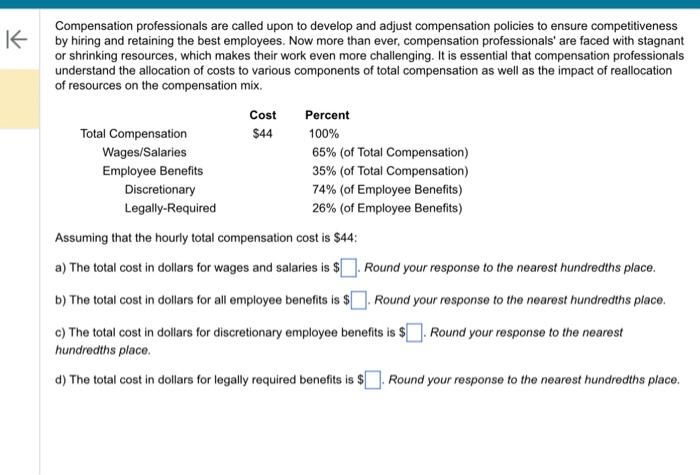
K- Compensation professionals are called upon to develop and adjust compensation policies to ensure competitiveness by hiring and retaining the best employees. Now more than ever, compensation professionals' are faced with stagnant or shrinking resources, which makes their work even more challenging. It is essential that compensation professionals understand the allocation of costs to various components of total compensation as well as the impact of reallocation of resources on the compensation mix. Total Compensation Wages/Salaries Employee Benefits Cost $44 Percent 100% 65% (of Total Compensation) 35% (of Total Compensation) 74% (of Employee Benefits) 26% (of Employee Benefits) Discretionary Legally-Required Assuming that the hourly total compensation cost is $44: a) The total cost in dollars for wages and salaries is $. Round your response to the nearest hundredths place. b) The total cost in dollars for all employee benefits is $. Round your response to the nearest hundredths place. c) The total cost in dollars for discretionary employee benefits is $. Round your response to the nearest hundredths place. d) The total cost in dollars for legally required benefits is $. Round your response to the nearest hundredths place.
Step by Step Solution
There are 3 Steps involved in it
a The total cost in dollars for wages and salaries can be calculated by multiplying the percentage 6... View full answer

Get step-by-step solutions from verified subject matter experts
 Study Help