







Question: KIND REQUEST NOT TO ATTEND THE QUESTION IF ONLY ONE QUESTION IS GOING TO BE ANSWERED. IM AWARE OF POLICIES. PLEASE MAKE FOR OTHERS WHO
 KIND REQUEST NOT TO ATTEND THE QUESTION IF ONLY ONE QUESTION IS GOING TO BE ANSWERED. IM AWARE OF POLICIES. PLEASE MAKE FOR OTHERS WHO CAN SOLVE ALL THE PARTS. WILL DISLIKE IF ONE QUESTION IS ANSWERED.
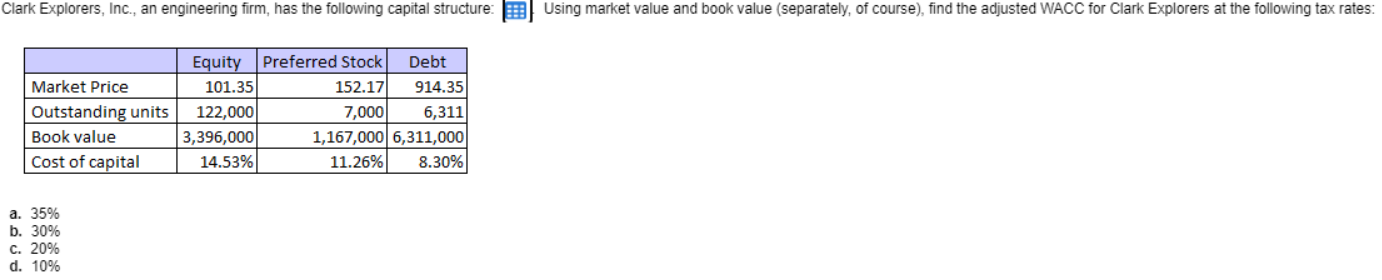
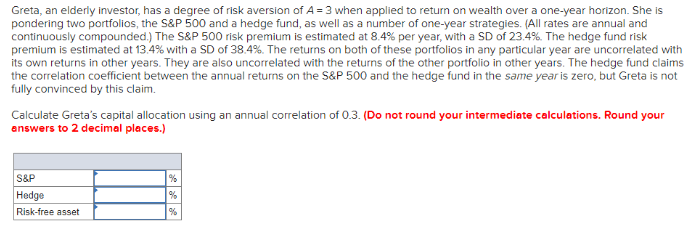
Clark Explorers, Inc., an engineering firm, has the following capital structure: Using market value and book value (separately, of course), find the adjusted WACC for Clark Explorers at the following tax rates: \begin{tabular}{|l|r|r|r|} \hline & \multicolumn{1}{|c|}{ Equity } & Preferred Stock & \multicolumn{1}{c|}{ Debt } \\ \hline Market Price & 101.35 & 152.17 & 914.35 \\ \hline Outstanding units & 122,000 & 7,000 & 6,311 \\ \hline Book value & 3,396,000 & 1,167,000 & 6,311,000 \\ \hline Cost of capital & 14.53% & 11.26% & 8.30% \\ \hline \end{tabular} a. 35% b. 30% c. 20% d. 10% Greta, an elderly investor, has a degree of risk aversion of A=3 when applied to return on wealth over a one-year horizon. She is pondering two portfolios, the S\&P 500 and a hedge fund, as well as a number of one-year strategies. (All rates are annual and continuously compounded.) The S\&P 500 risk premium is estimated at 8.4% per year, with a SD of 23.4%. The hedge fund risk premium is estimated at 13.4% with a SD of 38.4%. The returns on both of these portfolios in any particular year are uncorrelated with its own returns in other years. They are also uncorrelated with the returns of the other portfolio in other years. The hedge fund claims the correlation coefficient between the annual retums on the S\&P 500 and the hedge fund in the same year is zero, but Greta is not fully convinced by this claim. Calculate Greta's capital allocation using an annual correlation of 0.3. (Do not round your intermediate calculations. Round your answers to 2 decimal places.)
Step by Step Solution
There are 3 Steps involved in it

Get step-by-step solutions from verified subject matter experts
 Study Help