







Question: Kindly help me solve this question precisely Claims arising from a particular class of general insurance business can be classified into three mutually exclusive types:
Kindly help me solve this question precisely
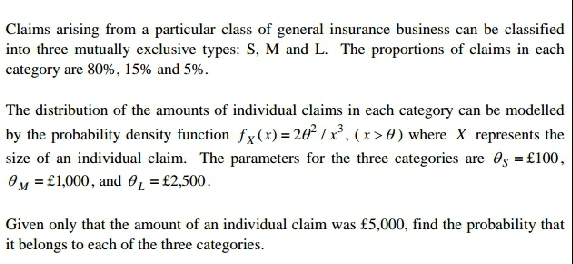
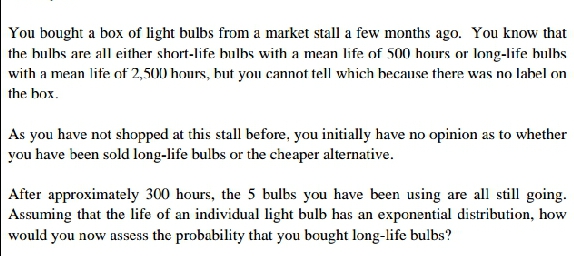
Claims arising from a particular class of general insurance business can be classified into three mutually exclusive types: S. M and L. The proportions of claims in each category are 80%, 15% and 5%. The distribution of the amounts of individual claims in each category can be modelled by the probability density function fo(x)=20-/ x*, (x > #) where X represents the size of an individual claim. The parameters for the three categories are 0, = $100, By = $1,000, and 07 = 12,500. Given only that the amount of an individual claim was f5,000, find the probability that it belongs to each of the three categories.Claims arising from a particular class of general insurance business can be classified into three mutually exclusive types: S. M and L. The proportions of claims in each category are 80%, 15% and 5%. The distribution of the amounts of individual claims in each category can be modelled by the probability density function fo(x)=20-/ x*, (x > #) where X represents the size of an individual claim. The parameters for the three categories are 0, = $100, By = $1,000, and 07 = 12,500. Given only that the amount of an individual claim was f5,000, find the probability that it belongs to each of the three categories.You bought a box of light bulbs from a market stall a few months ago. You know that the bulbs are all either short-life bulbs with a mean life of 500 hours or long-life bulbs with a mean life of 2,500) hours, but you cannot tell which because there was no label on the box. As you have not shopped at this stall before, you initially have no opinion as to whether you have been sold long-life bulbs or the cheaper alternative. After approximately 300 hours, the 5 bulbs you have been using are all still going. Assuming that the life of an individual light bulb has an exponential distribution, how would you now assess the probability that you bought long-life bulbs
Step by Step Solution
There are 3 Steps involved in it

Get step-by-step solutions from verified subject matter experts
 Study Help