







Question: kindly read this paper and write a complete summary of this paper besides that choose one issue discussed in the paper, then analyze how the
kindly read this paper and write a complete summary of this paper besides that choose one issue discussed in the paper, then analyze how the selected issue is conducted (from your working experience).
The summary should cover the whole paper and short answer is not acceptable. Please follw the reqirments
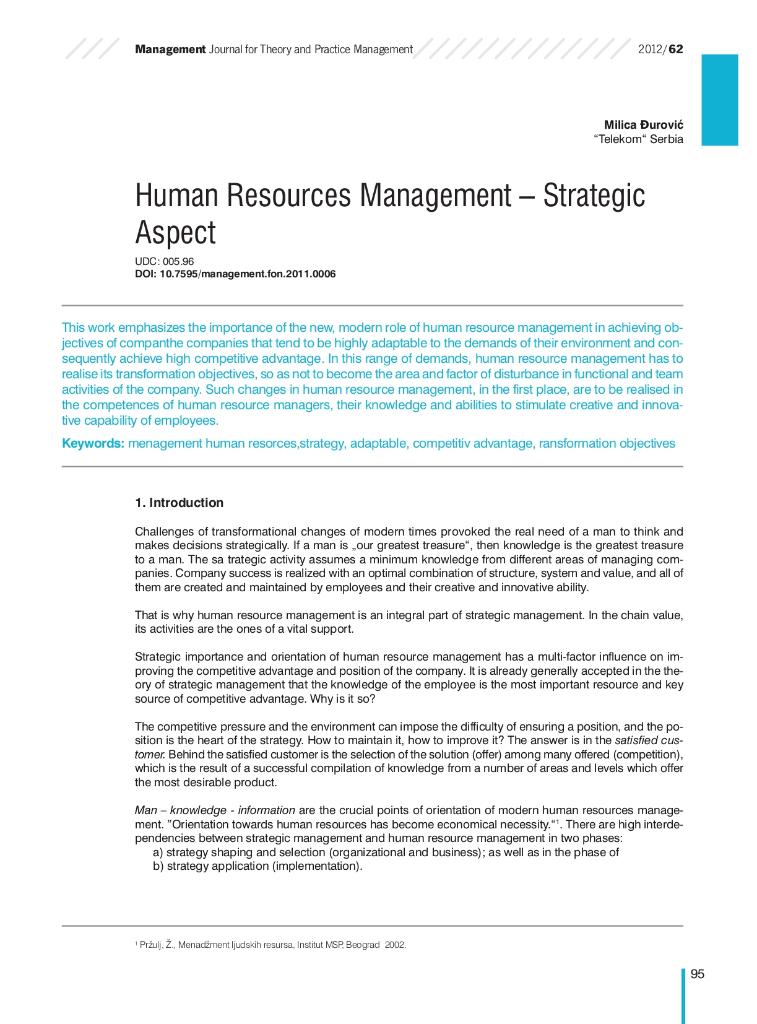
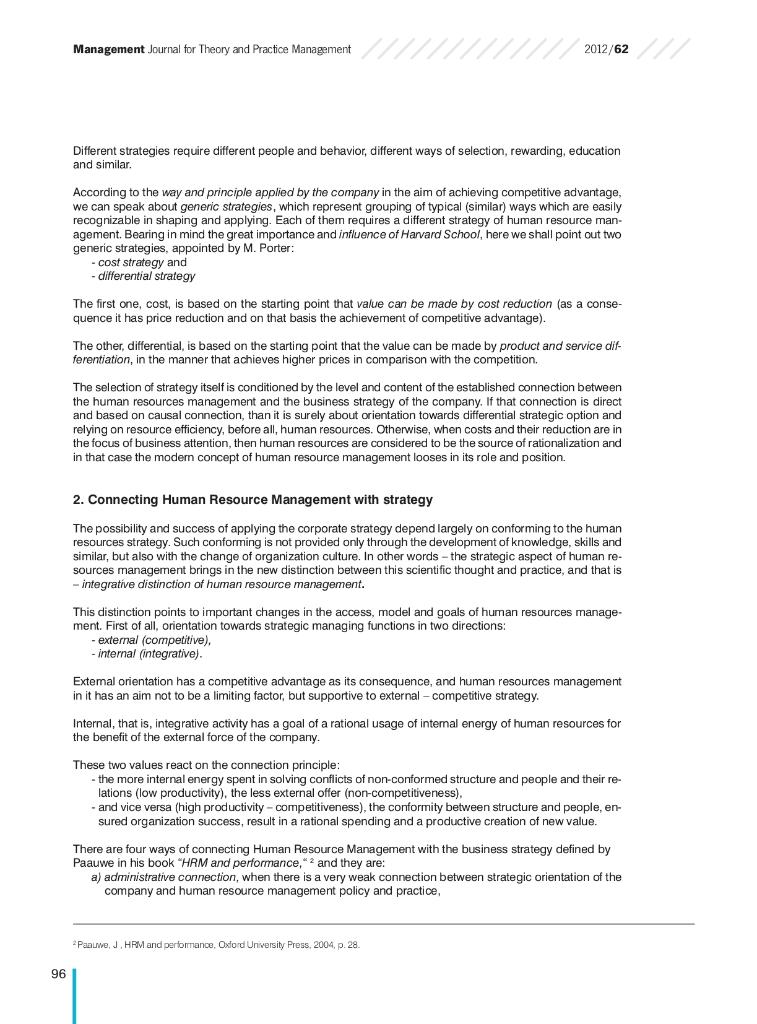
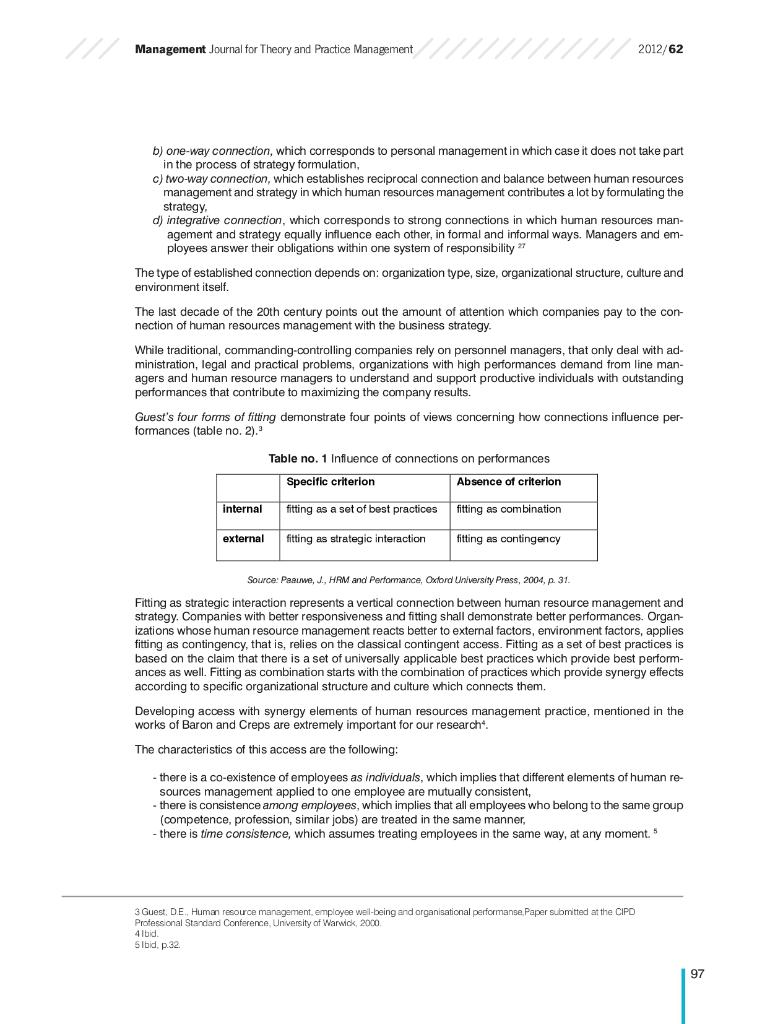
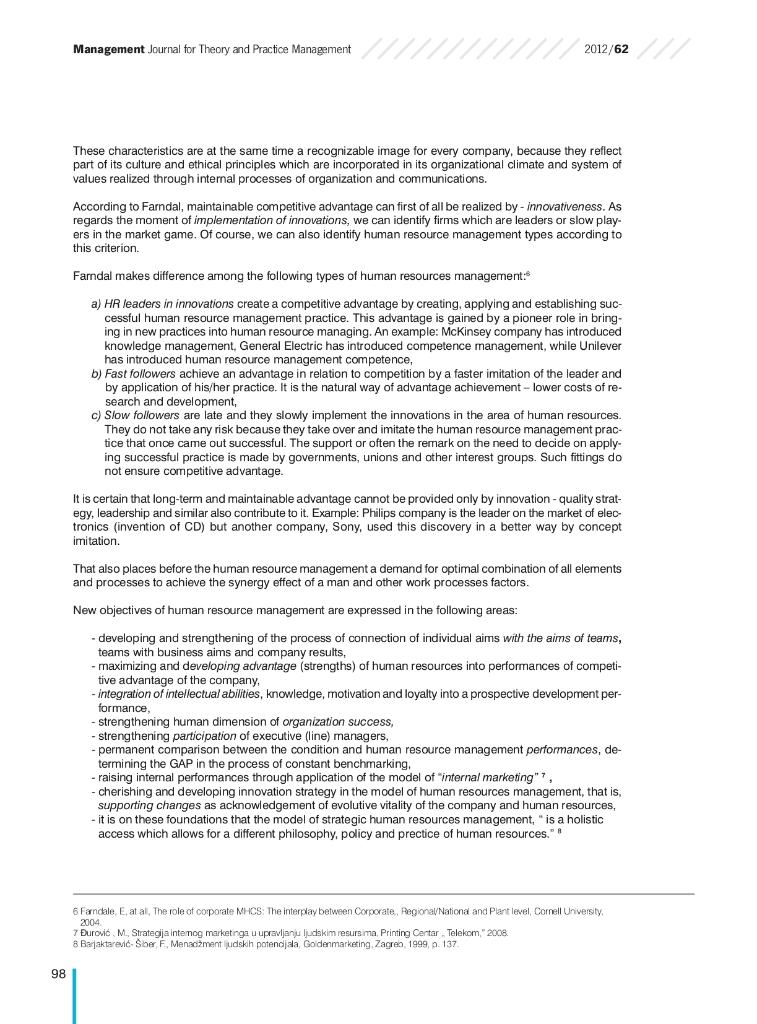
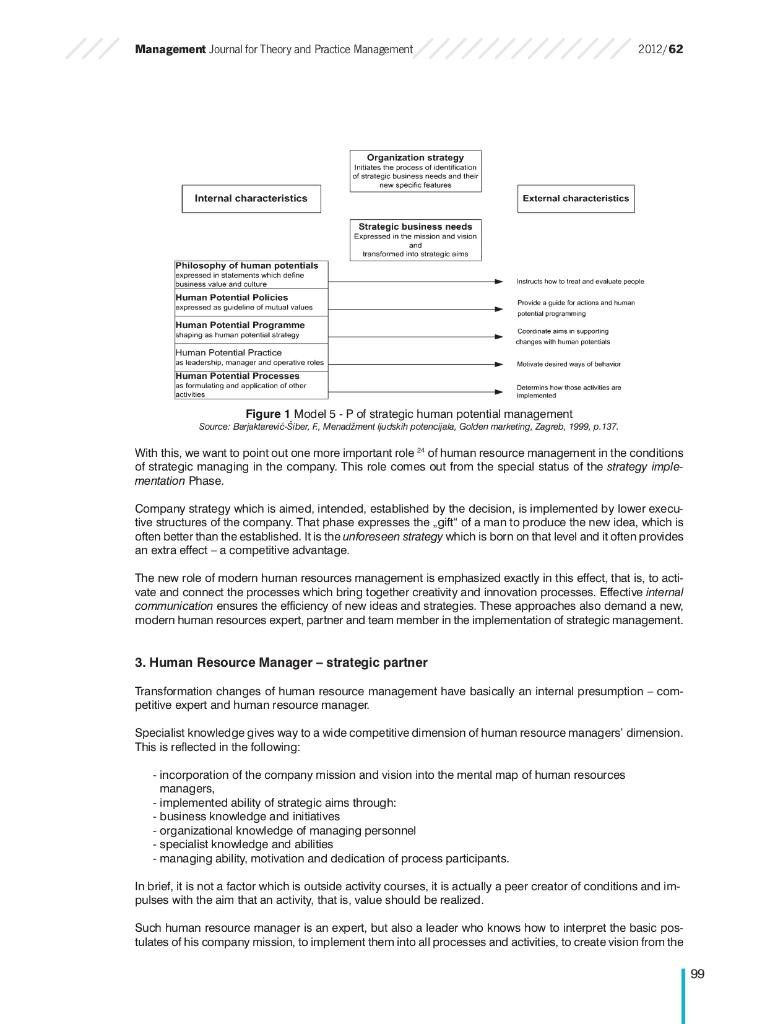
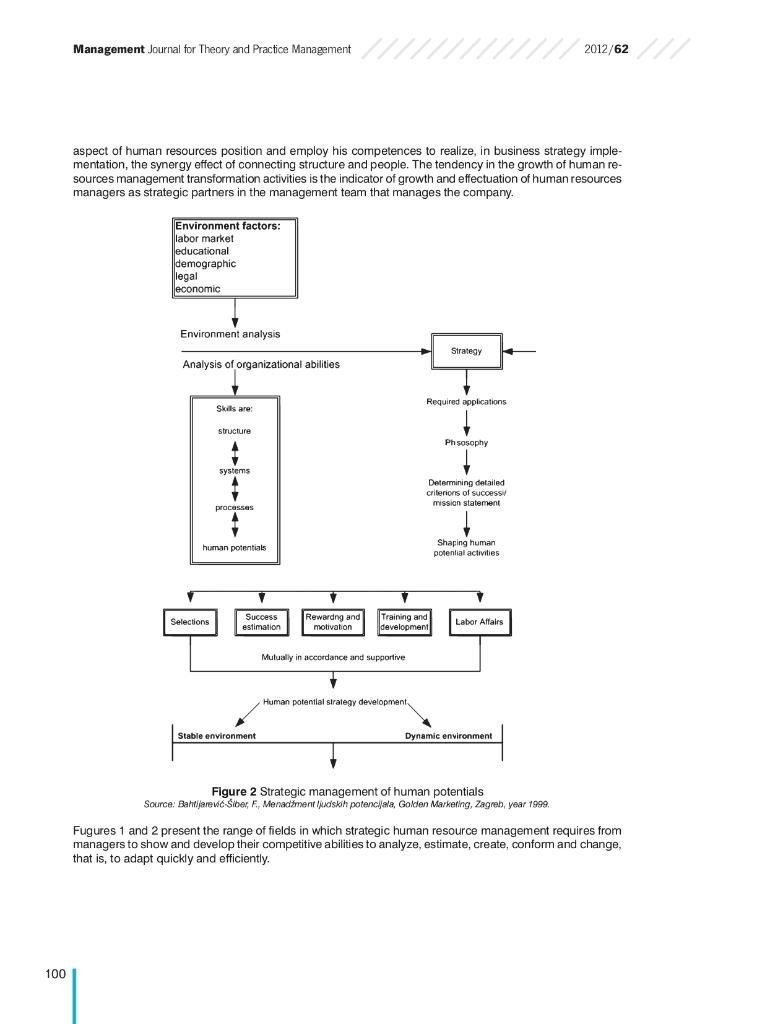
Human Resources Management - Strategic ASOECtUDC:005.96DOI:10.7595management.fon.2011.0006 This work emphasizes the importance of the new, modern role of human resource management in achieving objectives of companthe companies that tend to be highly adaptable to the demands of their environment and consequently achieve high competitive advantage. In this range of demands, human resource management has to realise its transformation objectives, so as not to become the area and factor of disturbance in functional and team activities of the company. Such changes in human resource management, in the first place, are to be realised in the competences of human resource managers, their knowledge and abilities to stimulate creative and innovative capability of employees. Keywords: menagement human resorces,strategy, adaptable, competitiv advantage, ransformation objectives 1. Introduction Challenges of transformational changes of modern times provoked the real need of a man to think and makes decisions strategically. If a man is "our greatest treasure", then knowledge is the greatest treasure to a man. The sa trategic activity assumes a minimum knowledge from different areas of managing companies. Company success is realized with an optimal combination of structure, system and value, and all of them are created and maintained by employees and their creative and innovative ability. That is why human resource management is an integral part of strategic management. In the chain value, its activities are the ones of a vital support. Strategic importance and orientation of human resource management has a multi-factor influence on improving the competitive advantage and position of the company. It is already generally accepted in the theory of strategic management that the knowledge of the employee is the most important resource and key source of competitive advantage. Why is it so? The competitive pressure and the environment can impose the difficulty of ensuring a position, and the position is the heart of the strategy. How to maintain it, how to improve it? The answer is in the satisfied customer. Behind the satisfied customer is the selection of the solution (offer) among many offered (competition), which is the result of a successful compilation of knowledge from a number of areas and levels which offer the most desirable product. Man - knowledge - information are the crucial points of orientation of modern human resources management. "Orientation towards human resources has become economical necessity."', There are high interdependencies between strategic management and human resource management in two phases: a) strategy shaping and selection (organizational and business); as well as in the phase of b) strategy application (implementation). I Prulj, Z.., Menadezment ljudskih resursa, Institut NSP. Beogad 2002. Different strategies require different people and behavior, different ways of selection, rewarding, education and similar. According to the way and principle applied by the company in the aim of achieving competitive advantage, we can speak about generic strategies, which represent grouping of typical (similar) ways which are easily recognizable in shaping and applying. Each of them requires a different strategy of human resource management. Bearing in mind the great importance and influence of Harvard School, here we shall point out two generic strategies, appointed by M. Porter: - cost strategy and - differential strategy The first one, cost, is based on the starting point that value can be made by cost reduction (as a consequence it has price reduction and on that basis the achievement of competitive advantage). The other, differential, is based on the starting point that the value can be made by product and service differentiation, in the manner that achieves higher prices in comparison with the competition. The selection of strategy itself is conditioned by the level and content of the established connection between the human resources management and the business strategy of the company. If that connection is direct and based on causal connection, than it is surely about orientation towards differential strategic option and relying on resource efficiency, before all, human resources. Otherwise, when costs and their reduction are in the focus of business attention, then human resources are considered to be the source of rationalization and in that case the modern concept of human resource management looses in its role and position. 2. Connecting Human Resource Management with strategy The possibility and success of applying the corporate strategy depend largely on conforming to the human resources strategy. Such conforming is not provided only through the development of knowledge, skills and similar, but also with the change of organization culture. In other words - the strategic aspect of human resources management brings in the new distinction between this scientific thought and practice, and that is - integrative distinction of human resource management. This distinction points to important changes in the access, model and goals of human resources management. First of all, orientation towards strategic managing functions in two directions: - external (competitive), - internal (integrative). Extemal orientation has a competitive advantage as its consequence, and human resources management in it has an aim not to be a limiting factor, but supportive to external - competitive strategy. Internal, that is, integrative activity has a goal of a rational usage of intemal energy of human resources for the benefit of the external force of the company. These two values react on the connection principle: - the more internal energy spent in solving conflicts of non-conformed structure and people and their relations (low productivity), the less external offer (non-competitiveness), - and vice versa (high productivity - competitiveness), the conformity between structure and people, ensured organization success, result in a rational spending and a productive creation of new value. There are four ways of connecting Human Resource Management with the business strategy defined by Paauwe in his book "HRM and performance, "2 and they are: a) administrative connection, when there is a very weak connection between strategic orientation of the company and human resource management policy and practice, b) one-way connection, which corresponds to personal management in which case it does not take part in the process of strategy formulation. c) two-way connection, which establishes reciprocal connection and balance between human resources management and strategy in which human resources management contributes a lot by formulating the strategy, d) integrative connection, which corresponds to strong connections in which human resources management and strategy equally influence each other, in formal and informal ways. Managers and employees answer their obligations within one system of responsibility 27 The type of established connection depends on: organization type, size, organizational structure, culture and environment itself. The last decade of the 20th century points out the amount of attention which companies pay to the connection of human resources management with the business strategy. While traditional, commanding-controlling companies rely on personnel managers, that only deal with administration, legal and practical problems, organizations with high performances demand from line managers and human resource managers to understand and support productive individuals with outstanding performances that contribute to maximizing the company results. Guest's four forms of fitting demonstrate four points of views concerning how connections influence performances (table no. 2). 3 Table no. 1 Influence of connections on performances Source: Paanme, J., HRM and Perfomance, Oxtord University Press, 2004, p 31. Fitting as strategic interaction represents a vertical connection between human resource management and strategy. Companies with better responsiveness and fitting shall demonstrate better performances. Organizations whose human resource management reacts better to external factors, environment factors, applies fitting as contingency, that is, relies on the dassical contingent access. Fitting as a set of best practices is based on the claim that there is a set of universally applicable best practices which provide best performances as well. Fitting as combination starts with the combination of practices which provide synergy effects according to specific organizational structure and culture which connects them. Developing access with synergy elements of human resources management practice, mentioned in the works of Baron and Creps are extremely important for our research4. The characteristics of this access are the following: - there is a co-existence of employees as individuals, which implies that different elements of human resources management applied to one employee are mutually consistent, - there is consistence among employees, which implies that all employees who belong to the same group (competence, profession, similar jobs) are treated in the same manner, - there is time consistence, which assumes treating employees in the same way, at any moment. 5 3 Guest, D.E., Human resource management, employse weil-being and organisational performanse, Paper submitted at the CIPD Protessional Standard Conference, Unversity af Warwick, 2000 4lbid. Slbid, p.32. These characteristics are at the same time a recognizable image for every company, because they reflect part of its culture and ethical principles which are incorporated in its organizational climate and system of values realized through internal processes of organization and communications. According to Farndal, maintainable competitive advantage can first of all be realized by - innovativeness. As regards the moment of implementation of innovations, we can identify firms which are leaders or slow players in the market game. Of course, we can also identify human resource management types according to this criterion. Farndal makes difference among the following types of human resources management: 6 a) HR leaders in innovations create a competitive advantage by creating, applying and establishing successful human resource management practice. This advantage is gained by a pioneer role in bringing in new practices into human resoure managing. An example: McKinsey company has introduced knowledge management, General Electric has introduced competence management, while Unilever has introduced human resource management competence, b) Fast followers achieve an advantage in relation to competition by a faster imitation of the leader and by application of his/her practice. It is the natural way of advantage achievement - lower costs of research and development, c) Slow followers are late and they slowly implement the innovations in the area of human resources. They do not take any risk because they take over and imitate the human resource management practice that once came out successful. The support or often the remark on the need to decide on applying successful practice is made by governments, unions and other interest groups. Such fittings do not ensure competitive advantage. It is certain that long-term and maintainable advantage cannot be provided only by innovation-quality strategy, leadership and similar also contribute to it. Example: Philips company is the leader on the market of electronics (invention of CD) but another company, Sony, used this discovery in a better way by concept imitation. That also places before the human resource management a demand for optimal combination of all elements and processes to achieve the synergy effect of a man and other work processes factors. New objectives of human resource management are expressed in the following areas: - developing and strengthening of the process of connection of individual aims with the aims of teams, teams with business aims and company results, - maximizing and developing advantage (strengths) of human resources into performances of competitive advantage of the company, - integration of intellectual abilities, knowledge, motivation and loyalty into a prospective development performance, - strengthening human dimension of organization success, - strengthening participation of executive (line) managers, - permanent comparison between the condition and human resource management performances, determining the GAP in the process of constant benchmarking, - raising internal performances through application of the model of "internal marketing" 7 , - cherishing and developing innovation strategy in the model of human resources management, that is, supporting changes as acknowledgement of evolutive vitality of the company and human resources, - it is on these foundations that the model of strategic human resources management, " is a holistic access which allows for a different philosophy, policy and prectice of human resources. . 6 Fandale, E, at al, The role of coporate MHCS: The interplay between Corporate, RegionalNationd and Plant level, Cornell Uriversity, 2004. 7 Eurowic, M. Strategja intenog marketnga u upravlianyu ljudskim resursima, Printing Centar . Telekom," 2006. 8 Barjaktaredc- Sber, F, Menwozment judskih potencjia, Goidenmarketing, Zagreo, 1999,, 137 Management Journal for Theory and Practice Management 2012/62 Figure 1 Model 5 - P of strategic human potential management Source: Barjautderevis sibor, E, Menadment fuucskih podencijale, Golden marheting, Zagreb, 1999, p.137, With this, we want to point out one more important role 24 of human resource management in the conditions of strategic managing in the company. This role comes out from the special status of the strategy implementation Phase. Company strategy which is aimed, intended, established by the decision, is implemented by lower executive structures of the company. That phase expresses the "gift" of a man to produce the new idea, which is often better than the established. It is the unforeseen strategy which is born on that level and it often provides an extra effect - a competitive advantage. The new role of modern human resources management is emphasized exactly in this effect, that is, to activate and connect the processes which bring together creativity and innovation processes. Effective internal communication ensures the efficiency of new ideas and strategies. These approaches also demand a new, modern human resources expert, partner and team member in the implementation of strategic management. 3. Human Resource Manager - strategic partner Transformation changes of human resource management have basically an internal presumption - competitive expert and human resource manager. Specialist knowledge gives way to a wide competitive dimension of human resource managers' dimension. This is reflected in the following: - incorporation of the company mission and vision into the mental map of human resources managers, - implemented ability of strategic aims through: - business knowledge and initiatives - organizational knowledge of managing personnel - specialist knowledge and abilities - managing ability, motivation and dedication of process participants. In brief, it is not a factor which is outside activity courses, it is actually a peer creator of conditions and impulses with the aim that an activity, that is, value should be realized. Such human resource manager is an expert, but also a leader who knows how to interpret the basic postulates of his company mission, to implement them into all processes and activities, to create vision from the aspect of human resources position and employ his competences to realize, in business strategy implementation, the synergy effect of connecting structure and people. The tendency in the growth of human resources management transformation activities is the indicator of growth and effectuation of human resources managers as strategic partners in the management team that manages the company. Figure 2 Strategic management of human potentials Fugures 1 and 2 present the range of fields in which strategic human resource management requires from managers to show and develop their competitive abilities to analyze, estimate, create, conform and change, that is, to adapt quickly and efficiently. Management Journal for Theory and Practice Management 2012/62 Conslusion In accordance with the abovementioned, the modern role of human resources management is recognized in the following range: newly defined aims which this scientific discipline, and practice as well, appoint as direction of relevance, redesigned processes by which it implements its activities and of course, new demands in the "palette" of managerial competencies of its experts. The basic newly established goals have to be in accordance with the strategic vision and aims of the company, which are as such established in an equivalent involvement of all functional units of the company, that is, the human resources function is no longer the receiver of orders, but an qual participant in making strategic decisions. That, of course, requires new characteristics and structure of processes which are implemented in human resource management. It is about greater participation of transformation processes and less, traditional, administrative processes. Such requests demand not only the development and changes within the human resources management practice itself, but also in its holders and promoters, human resource managers. The indicators of success of such practice and concepts of human resource management are seen in the degree of integrative effect which is fulfilled among the aims of the company and its human resource goals, as well as innovative effect which is acknowledged by a competitive position of the company. REFERENCE [1] Prulj, ., Menadment ljudskih resursa, Institut MSP, Beograd 2002. [2] Paauwe, J. HRM and performance, Oxford University Press, 2004, p. 28. [3] Guest, D.E., Human resource management, employee well-being and organisational performanCe"Paper given at the CIPD Professional Standard Conference, University of Warwick, 2000 [4] Farndale, E, at all, The role of corporate MHCS: The interplay between Corporate,, Regional/National and Plant level, Comell University, 2004. [5] urovi , M., Strategija internog marketinga u upravijanju ljudskim resursima, Printing Centar " Telekom, "2008. [6] Bahtijarevi- iber, F,, Menadment ljudskih potencijala, Golden Marketing, Zagreb, 1999, p. 137 Receieved: 08. 2011. Accepted: 03. 2012. About the Author Milica Djurovi "Telekom" Srbija e-mail: milicaci@telekomirs Dr Milica Djurovi took her academic degree at the Faculty of Economics of Belgrade, Department in Kragujevac. In 2001 she completed her master studies at the Faculty of Management aBracia Kari" in Belgrade. She did her PhD thesis, "Development of Human Resource Management in Serbia" at the Alpha University in 2010. Currently she works as special aide of the Director General for the human resources area. As a scientific researcher she has published a large number of reports and articles in journals and participated in numerous conferences and symposia at home and abroad. She was also member of project teams and team leader in the company she works with. She is the author of two monographs: "Internal Marketing Strategy in Human Resource Management" and "Development of Human Resource Management in Serbia - Indicators
Step by Step Solution
There are 3 Steps involved in it

Get step-by-step solutions from verified subject matter experts
 Study Help