







Question: K-means clustering is an iterative algorithm. What triggers an end to the iterations? When: There is no significant change of centroid values between each iteration.
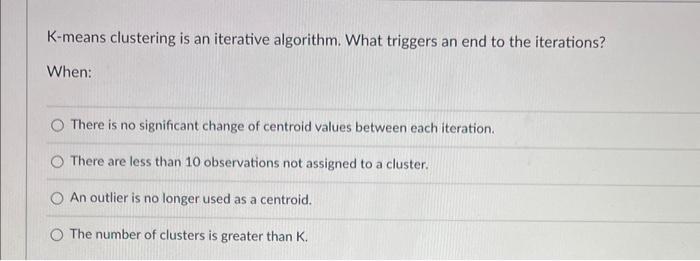
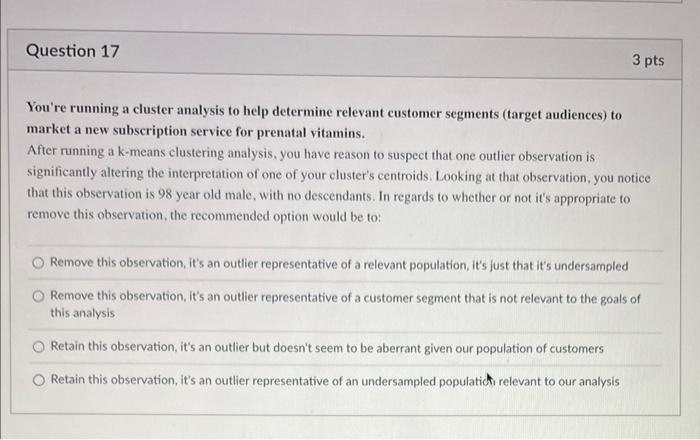
K-means clustering is an iterative algorithm. What triggers an end to the iterations? When: There is no significant change of centroid values between each iteration. There are less than 10 observations not assigned to a cluster. An outlier is no longer used as a centroid. The number of clusters is greater than K. You're running a cluster analysis to help determine relevant customer segments (target audiences) to market a new subscription service for prenatal vitamins. After running a k-means clustering analysis, you have reason to suspect that one outlier observation is significantly altering the interpretation of one of your cluster's centroids. Looking at that observation, you notice that this observation is 98 year old male, with no descendants. In regards to whether or not it's appropriate to remove this observation, the recommended option would be to: Remove this observation, it's an outlier representative of a relevant population, it's just that it's undersampled Remove this observation, it's an outlier representative of a customer segment that is not relevant to the goals of this analysis Retain this observation, it's an outlier but doesn't seem to be aberrant given our population of customers Retain this observation, it's an outlier representative of an undersampled populaticti relevant to our analysis
Step by Step Solution
There are 3 Steps involved in it

Get step-by-step solutions from verified subject matter experts
 Study Help