Question: l need help to develop a Financial Plan. Please read the article titled Everyone should learn the entrepreneurial method by Sarasvathy (2012), which refers to
l need help to develop a Financial Plan.
Please read the article titled "Everyone should learn the entrepreneurial method" by Sarasvathy (2012), which refers to the notion of "affordable loss" (https://hbr.org/2012/03/everyone-should-learn-the-entr)
Chapter 10 summary:
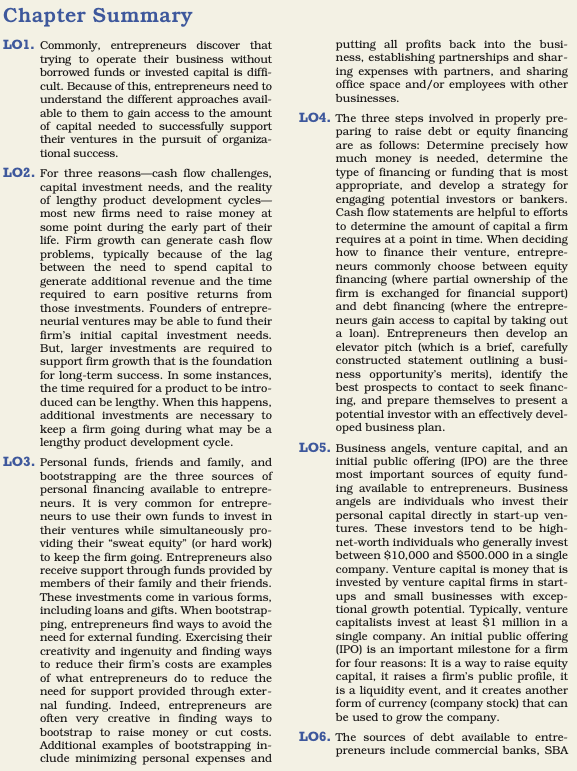
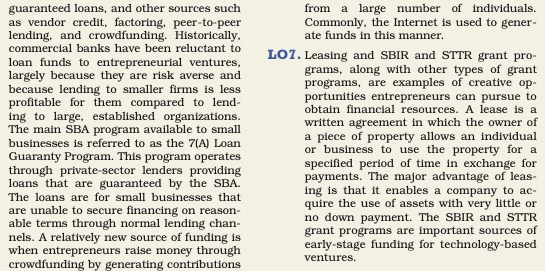
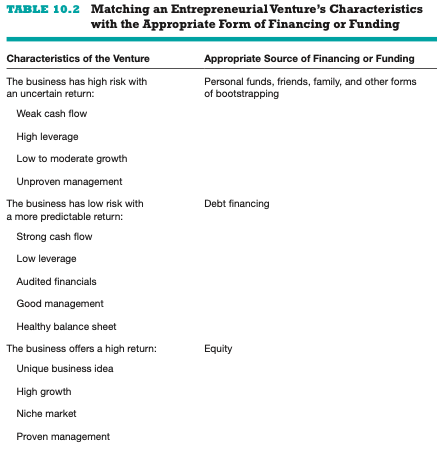
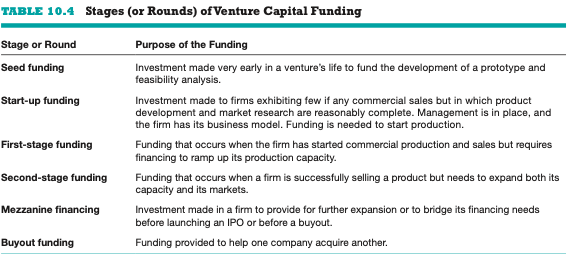
Chapter Summary LOl. Commonly, entrepreneurs discover that trying to operate their business without borrowed funds or invested capital is diffi- cult. Because of this, entrepreneurs need to understand the different approaches avail- able to them to gain access to the amount of capital needed to successfully support their ventures in the pursuit of organiza- tional success. For three reasonscash flow challenges, capital investment needs, and the reality of lengthy product development cycles most new firms need to raise money at some point during the early part of their life. Firm growth can generate cash flow problems, typically because of the lag between the need to spend capital to generate additional revenue and the time required to earn positive returns from those investments. Founders of entrepre- neurial ventures may be able to fund their firm's initial capital investment needs. But, larger investments are required to support firm growth that is the foundation for long-term success. In some instances, the time required for a product to be intro- duced can be lengthy. When this happens. additional investments are necessary to keep a firm going during what may be a lengthy product development cycle. . Personal funds, friends and family, and bootstrapping are the three sources of personal financing available to entrepre- neurs. It is very common for entrepre- neurs to use their own funds to invest in their ventures while simultaneously pro- viding their "sweat equity\" (or hard work) to keep the firm going. Entrepreneurs also receive support through funds provided by members of their family and their friends. These investments come in various forms, including loans and gifts. When bootstrap- ping, entrepreneurs find ways to avoid the need for external funding. Exercising their creativity and ingenuity and finding ways to reduce their firm's costs are examples of what entrepreneurs do to reduce the need for support provided through exter- nal funding. Indeed. entrepreneurs are often very creative in finding ways to bootstrap to raise money or cut costs. Additional examples of bootstrapping in- clude minimizing personal expenses and LO4. LOE. putting all profits back into the busi- ness, establishing partnerships and shar- ing expenses with partners, and sharing office space and/or employees with other businesses. The three steps involved in properly pre- paring to raise debt or equity financing are as follows: Determine precisely how much money is needed, determine the type of financing or funding that is most appropriate, and develop a strategy for engaging potential investors or bankers. Cash flow statements are helpful to efforts to determine the amount of capital a firm requires at a point in time. When deciding how to finance their venture. entrepre- neurs commaonly choose between equity financing (where partial ownership of the firm is exchanged for financial support) and debt financing (where the entrepre- neurs gain access to capital by taking out a loan). Entrepreneurs then develop an elevator pitch (which is a brief, carefully constructed statement outlining a busi- ness opportunity's merits), identify the best prospects to contact to seek financ- ing, and prepare themselves to present a potential investor with an effectively devel- oped business plan. . Business angels, venture capital, and an initial public offering (IPO) are the three most important sources of equity fund- ing available to entrepreneurs. Business angels are individuals who invest their personal capital directly in start-up ven- tures. These investors tend to be high- net-worth individuals who generally invest between $10,000 and $500.000 in a single company. Venture capital is money that is invested by venture capital firms in start- ups and small businesses with excep- tional growth potential. Typically, venture capitalists invest at least $1 million in a single company. An initial public offering (IPO) is an important milestone for a firm for four reasons: It is a way to raise equity capital, it raises a firm's public profile, it is a liquidity event, and it creates another form of currency (company stock) that can be used to grow the company. The sources of debt available to entre- preneurs include commercial banks, SBA guaranteed loans, and other sources such as vendor credit, factoring, peer-to-peer lending, and crowdfunding. Historically, commercial banks have been reluctant to loan funds to entirepreneurial ventures, largely because they are risk averse and because lending to smaller firms is less profitable for them compared to lend- ing to large, established organizations. The main SBA program available to small businesses is referred to as the 7[A) Loan Guaranty Program. This program operates through private-sector lenders providing loans that are guaranteed by the SBA. The loans are for small businesses that are unable to secure financing on reason- able terms through normal lending chan- nels. A relatively new source of funding is when entrepreneurs raise money through crowdiunding by generating contributions LOI. from a large number of individuals. Commonly, the Internet is used to gener- ate funds in this manner. Leasing and SBIR and STTR grant pro- grams, along with other types of grant programs, are examples of creative op- portunities entrepreneurs can pursue to obtain financial resources. A lease is a written agreement in which the owner of a plece of property allows an individual or business to use the property for a specified period of time in exchange for payments. The major advantage of leas- ing is that it enables a company to ac- quire the use of assets with very little or no down payment. The SBIR and STTR grant programs are important sources of early-stage funding for technology-based ventures. TABLE 10.2 Matching an Entrepreneurial Venture's Characteristics with the Appropriate Form of Financing or Funding Characteristics of the Venture Appropriate Source of Financing or Funding The business has high risk with Personal funds, friends, family, and other forms an uncertain return: of bootstrapping Weak cash flow High leverage Low to moderate growth Unproven management The business has low risk with Debt financing a more predictable return: Strong cash flow Low leverage Audited financials Good management Healthy balance sheet The business offers a high return: Equity Unique business idea High growth Niche market Proven managementTABLE 10.4 Stages (or Rounds) of Venture Capital Funding Stage or Round Purpose of the Funding Seed funding Investment made very early in a venture's life to fund the development of a prototype and feasibility analysis. Start-up funding Investment made to firms exhibiting few if any commercial sales but in which product development and market research are reasonably complete. Management is in place, and the firm has its business model. Funding is needed to start production. First-stage funding Funding that occurs when the firm has started commercial production and sales but requires financing to ramp up its production capacity. Second-stage funding Funding that occurs when a firm is successfully selling a product but needs to expand both its capacity and its markets. Mezzanine financing Investment made in a firm to provide for further expansion or to bridge its financing needs before launching an IPO or before a buyout. Buyout funding Funding provided to help one company acquire another
Step by Step Solution
There are 3 Steps involved in it
1 Expert Approved Answer
Step: 1 Unlock
Question Has Been Solved by an Expert!
Get step-by-step solutions from verified subject matter experts
Step: 2 Unlock
Step: 3 Unlock
Students Have Also Explored These Related Finance Questions!









 Study Help