







Question: Lab 6: Capacitors Online Version This lab uses the Capacitor Lab: Basics simulation from PhET Interactive Simulations at University of Colorado Boulder, under the CC-BY
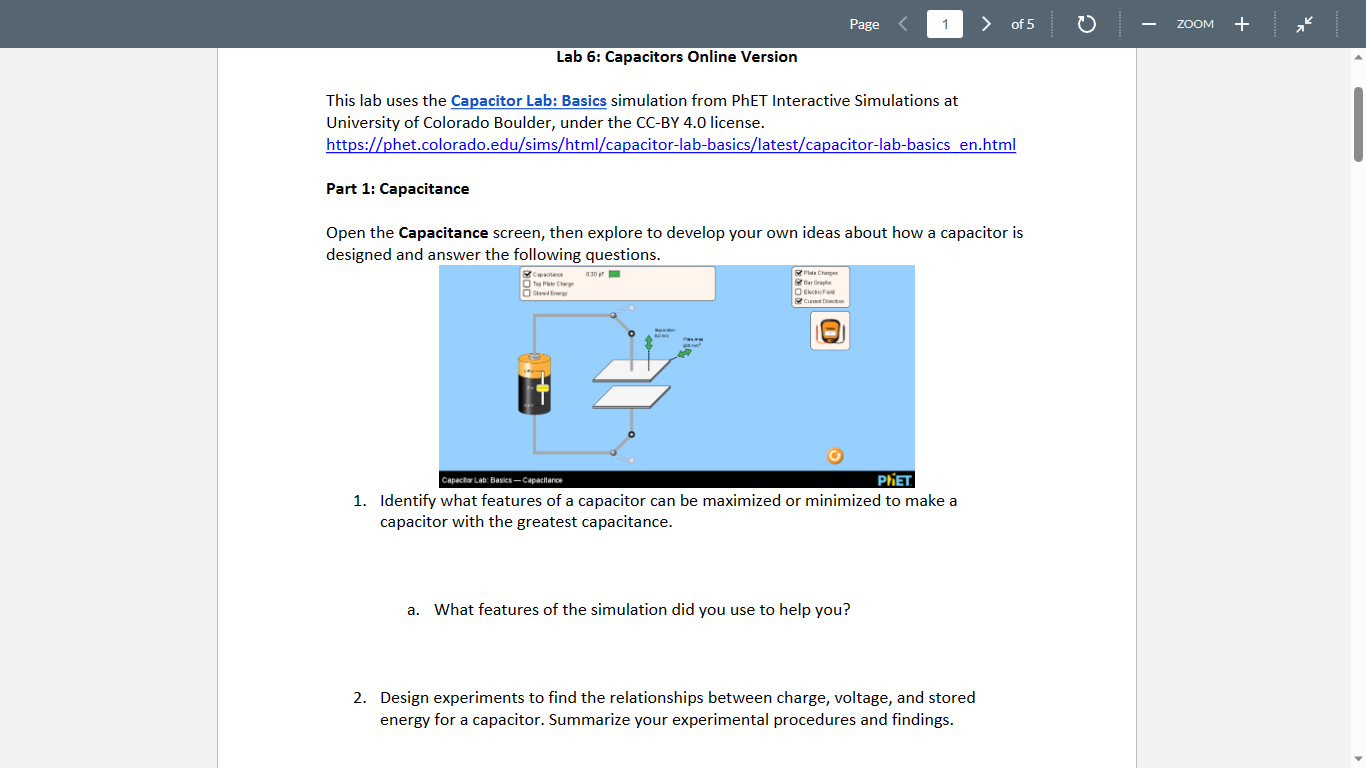
Lab 6: Capacitors Online Version This lab uses the Capacitor Lab: Basics simulation from PhET Interactive Simulations at University of Colorado Boulder, under the CC-BY 4.0 license. https://phet.colorado.edu/sims/html/capacitor-lab-basics/latest/capacitor-lab-basics_en.html Part 1: Capacitance Open the Capacitance screen, then explore to develop your own ideas about how a capacitor is designed and answer the following questions. 1. Identify what features of a capacitor can be maximized or minimized to make a capacitor with the greatest capacitance. a. What features of the simulation did you use to help you? 2. Design experiments to find the relationships between charge, voltage, and stored energy for a capacitor. Summarize your experimental procedures and findings. a. What features of the simulation did you use to help you? 3. If you wanted to design a capacitor system to store the greatest energy, what would you use?
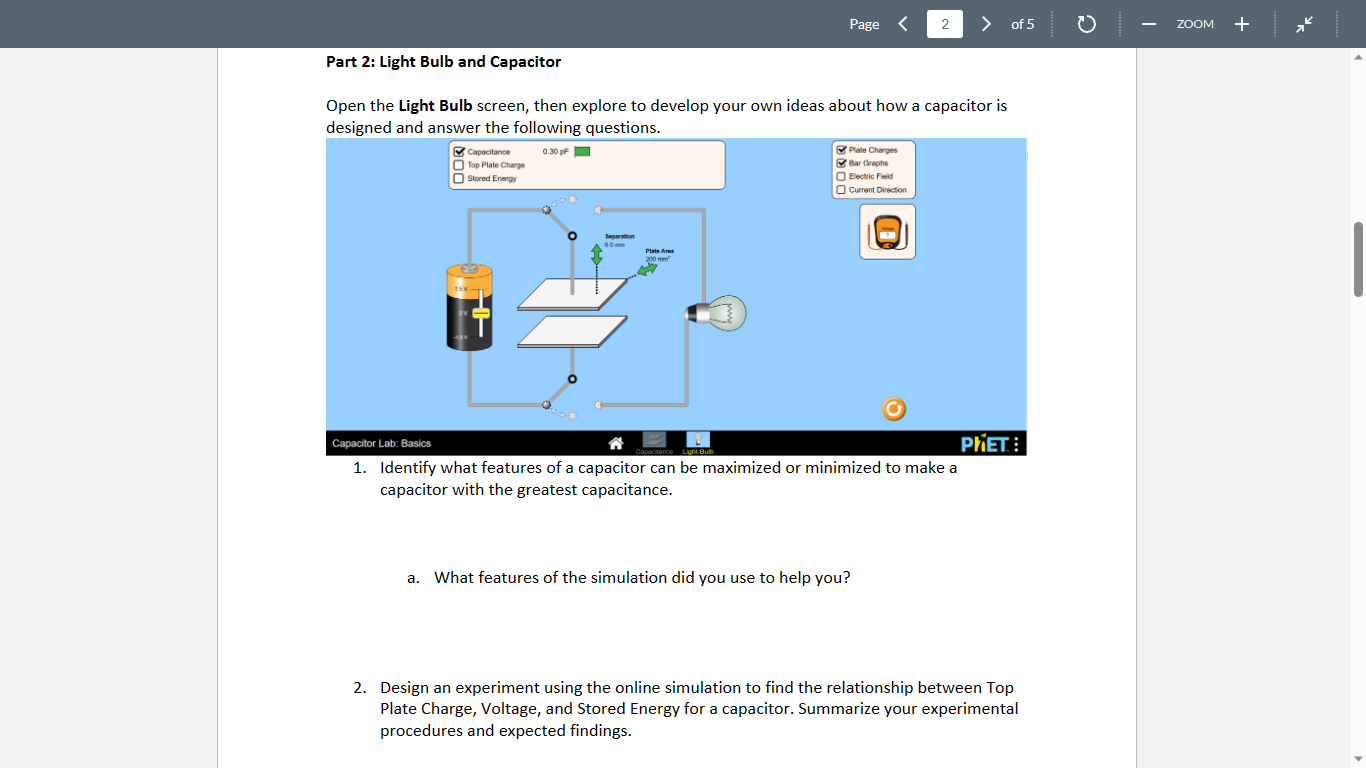
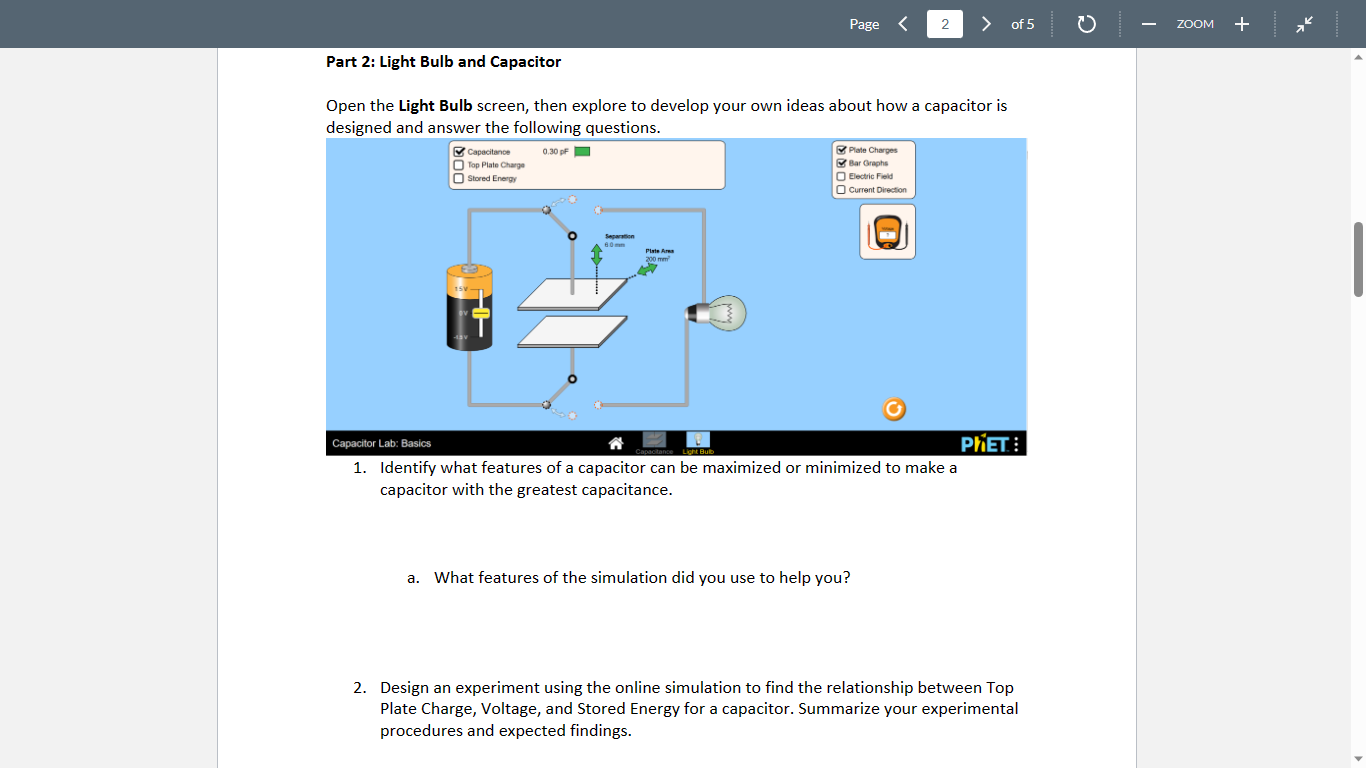
2 Part 2: Light Bulb and Capacitor Open the Light Bulb screen, then explore to develop your own ideas about how a capacitor is designed and answer the following questions. 1. Identify what features of a capacitor can be maximized or minimized to make a capacitor with the greatest capacitance. a. What features of the simulation did you use to help you? 2. Design an experiment using the online simulation to find the relationship between Top Plate Charge, Voltage, and Stored Energy for a capacitor. Summarize your experimental procedures and expected findings. 3. If you wanted to design a capacitor system to store the greatest energy, what would you use?
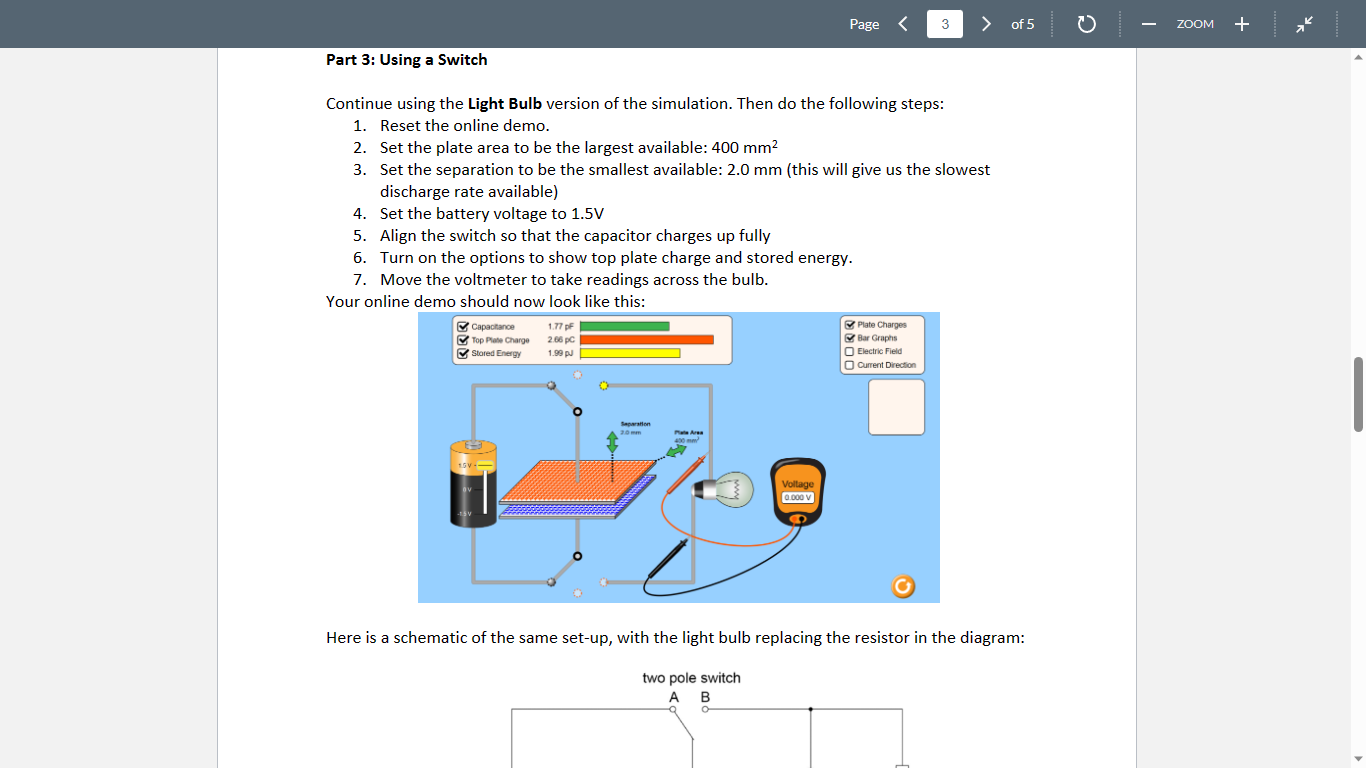
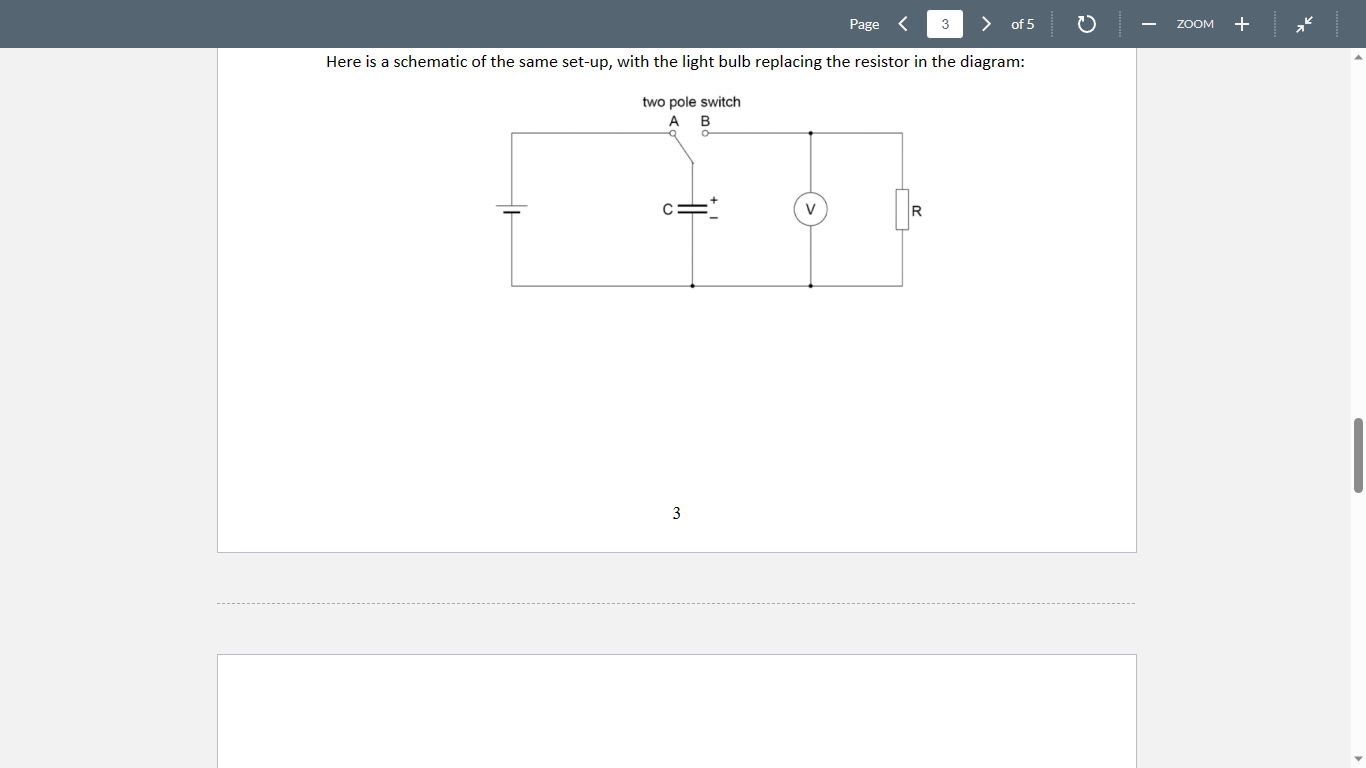
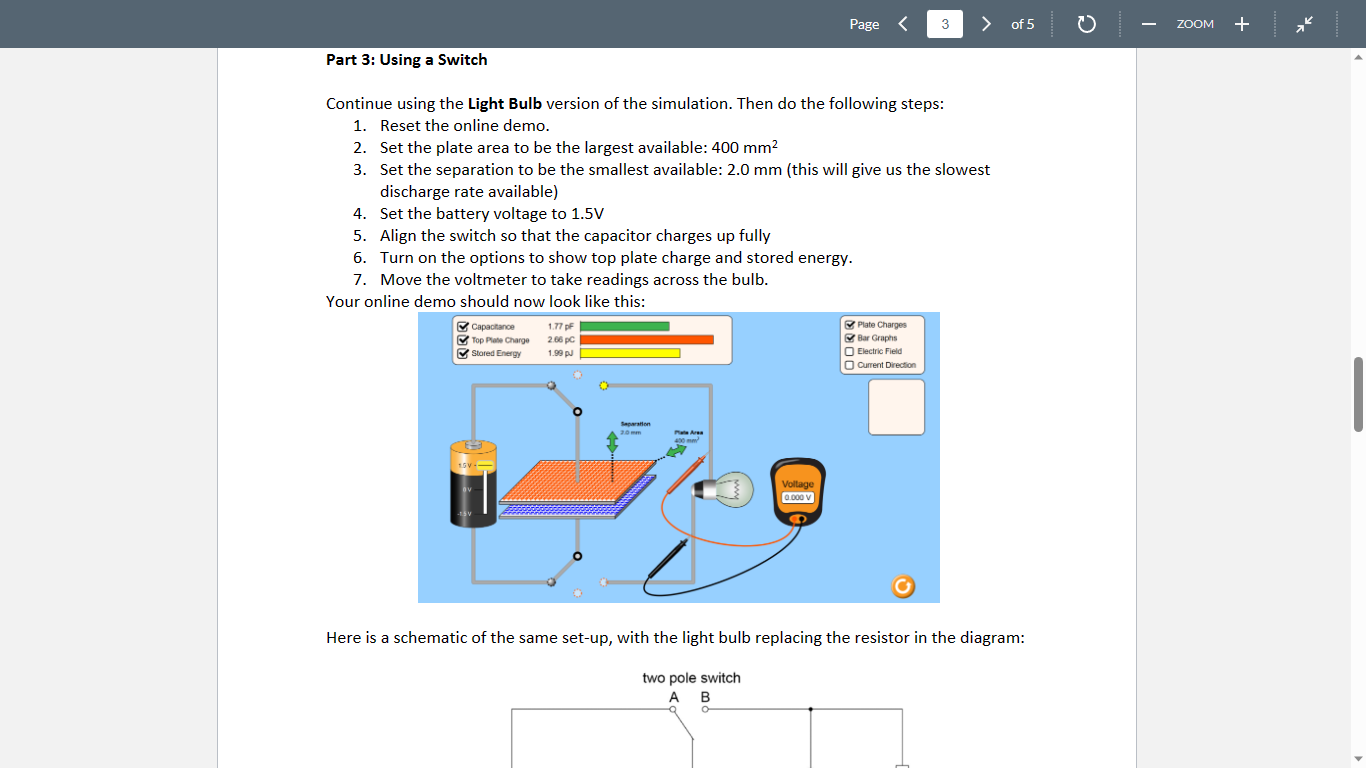
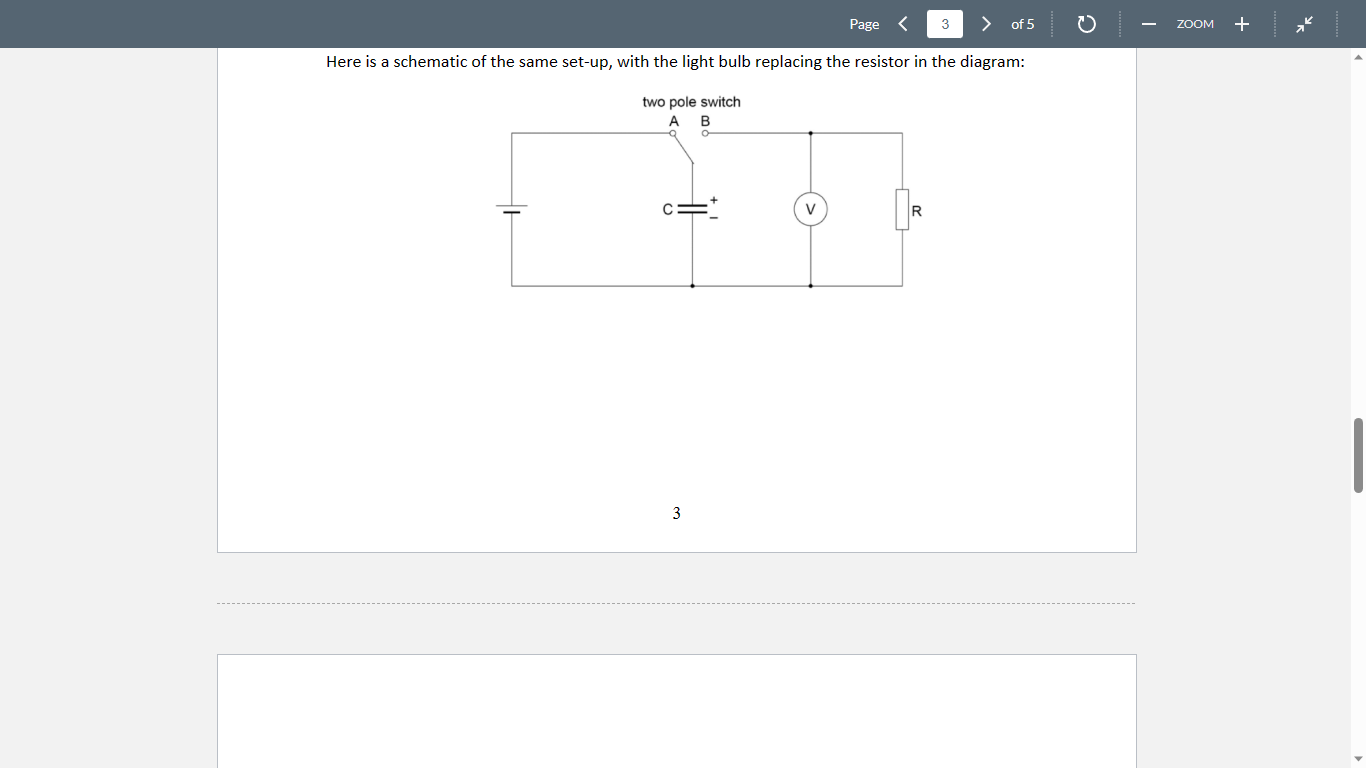
3 Part 3: Using a Switch Continue using the Light Bulb version of the simulation. Then do the following steps: 1. Reset the online demo. 2. Set the plate area to be the largest available: 400 mm2 3. Set the separation to be the smallest available: 2.0 mm (this will give us the slowest discharge rate available) 4. Set the battery voltage to 1.5V 5. Align the switch so that the capacitor charges up fully 6. Turn on the options to show top plate charge and stored energy. 7. Move the voltmeter to take readings across the bulb. Your online demo should now look like this: Here is a schematic of the same set-up, with the light bulb replacing the resistor in the diagram:
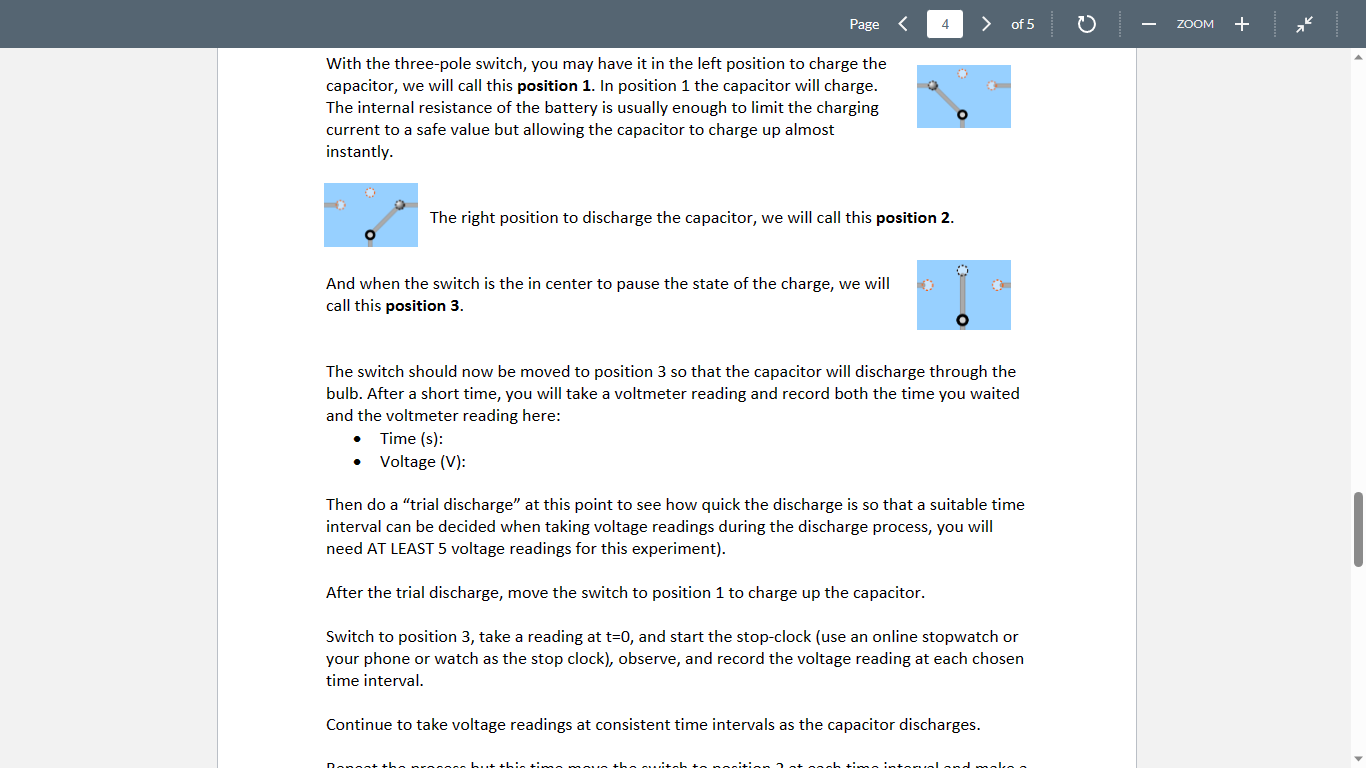
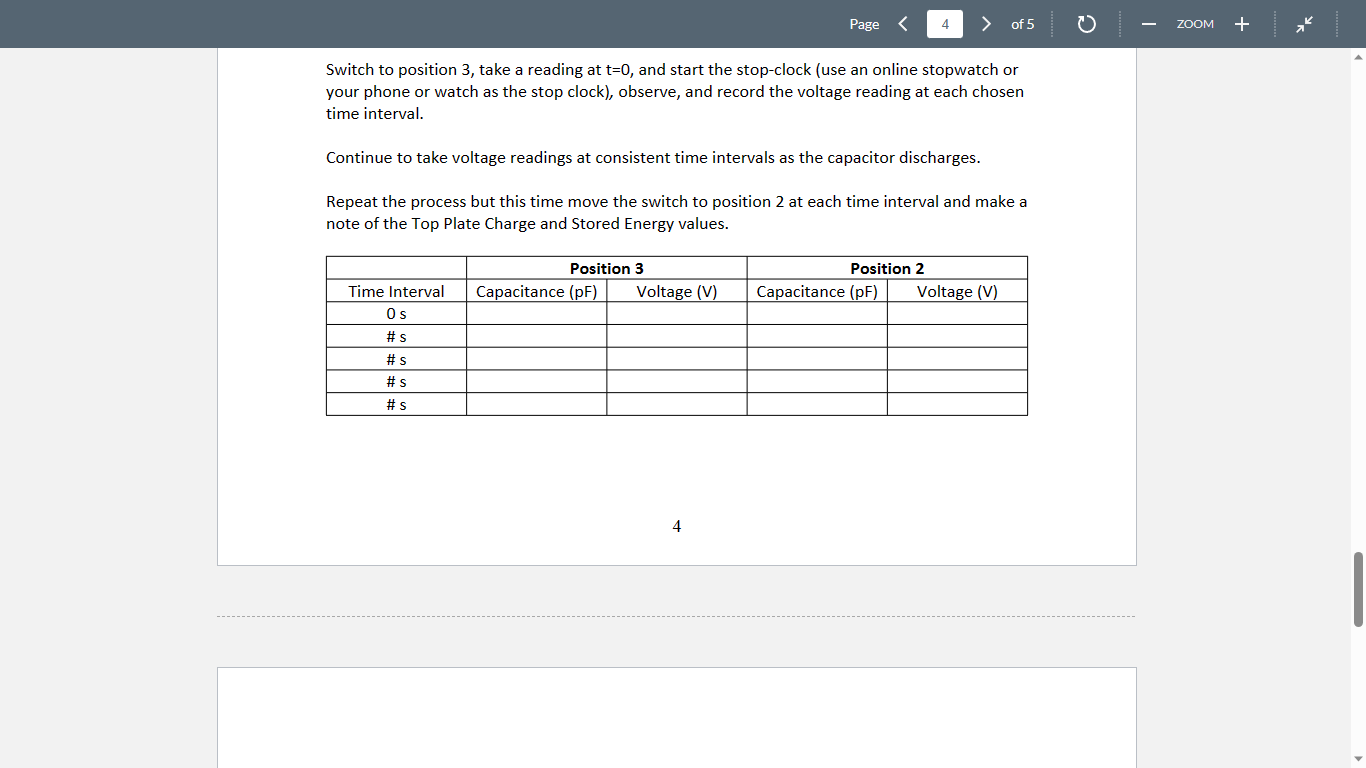
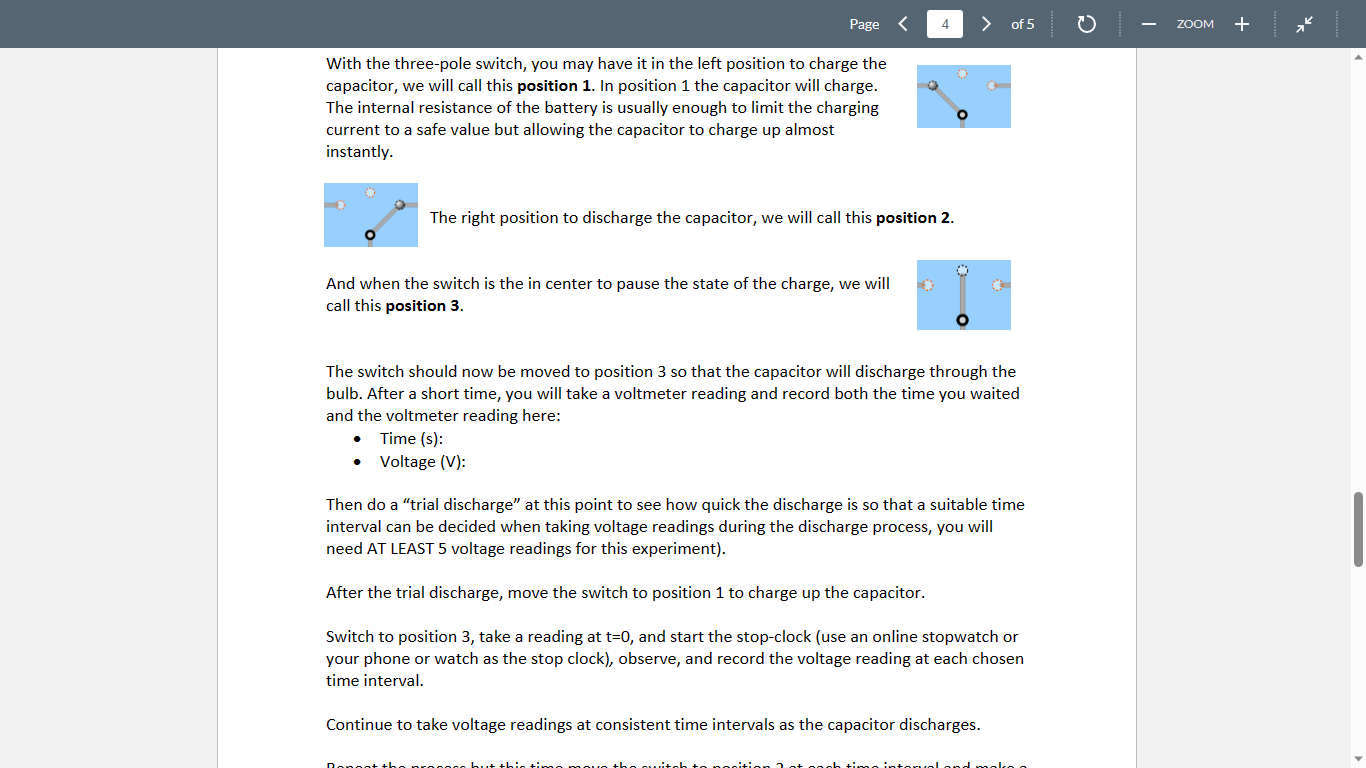
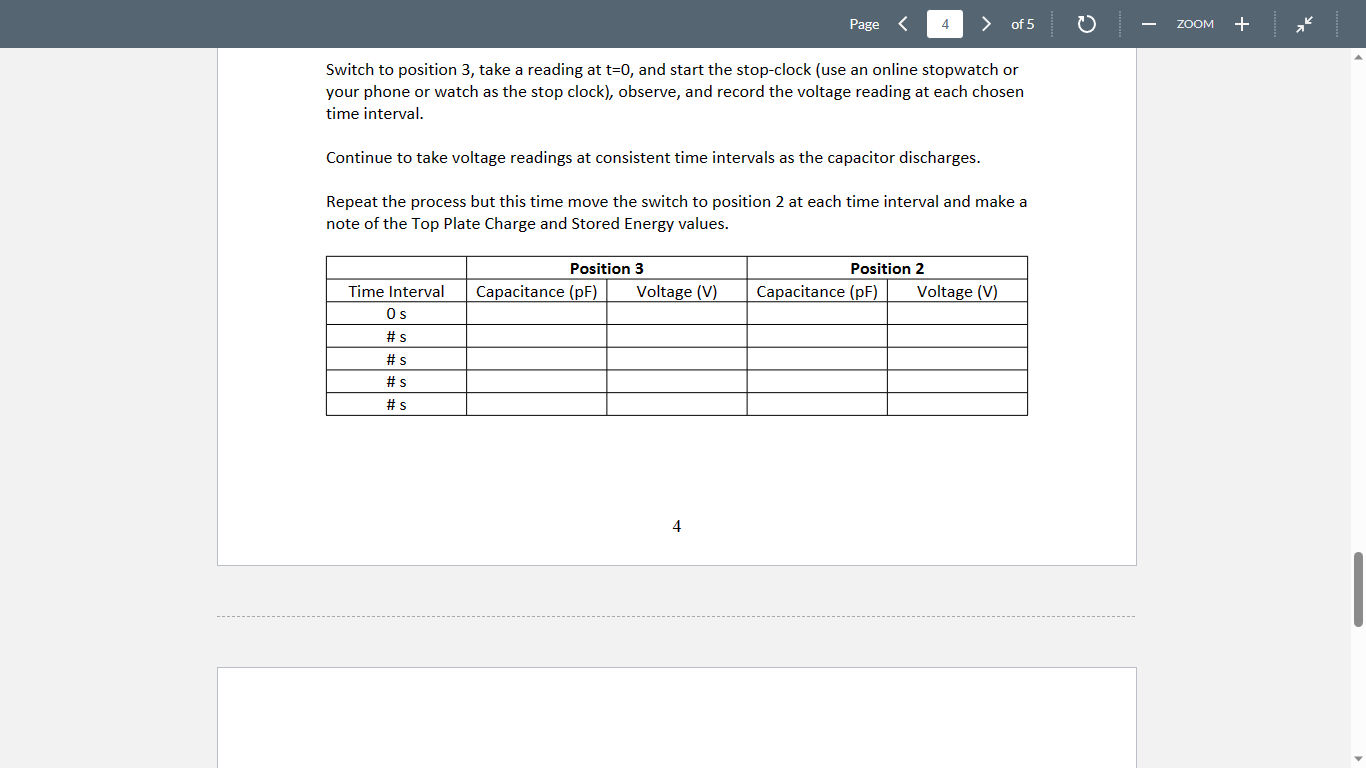
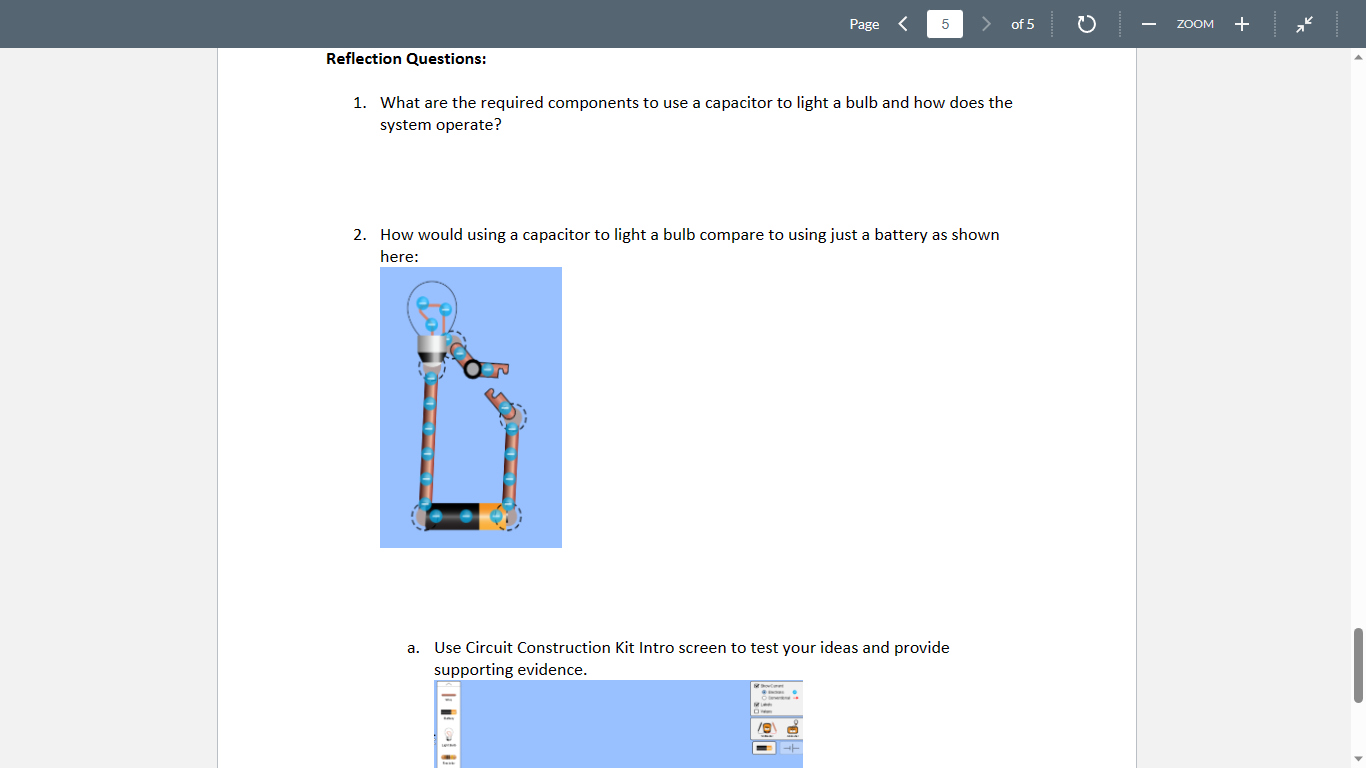
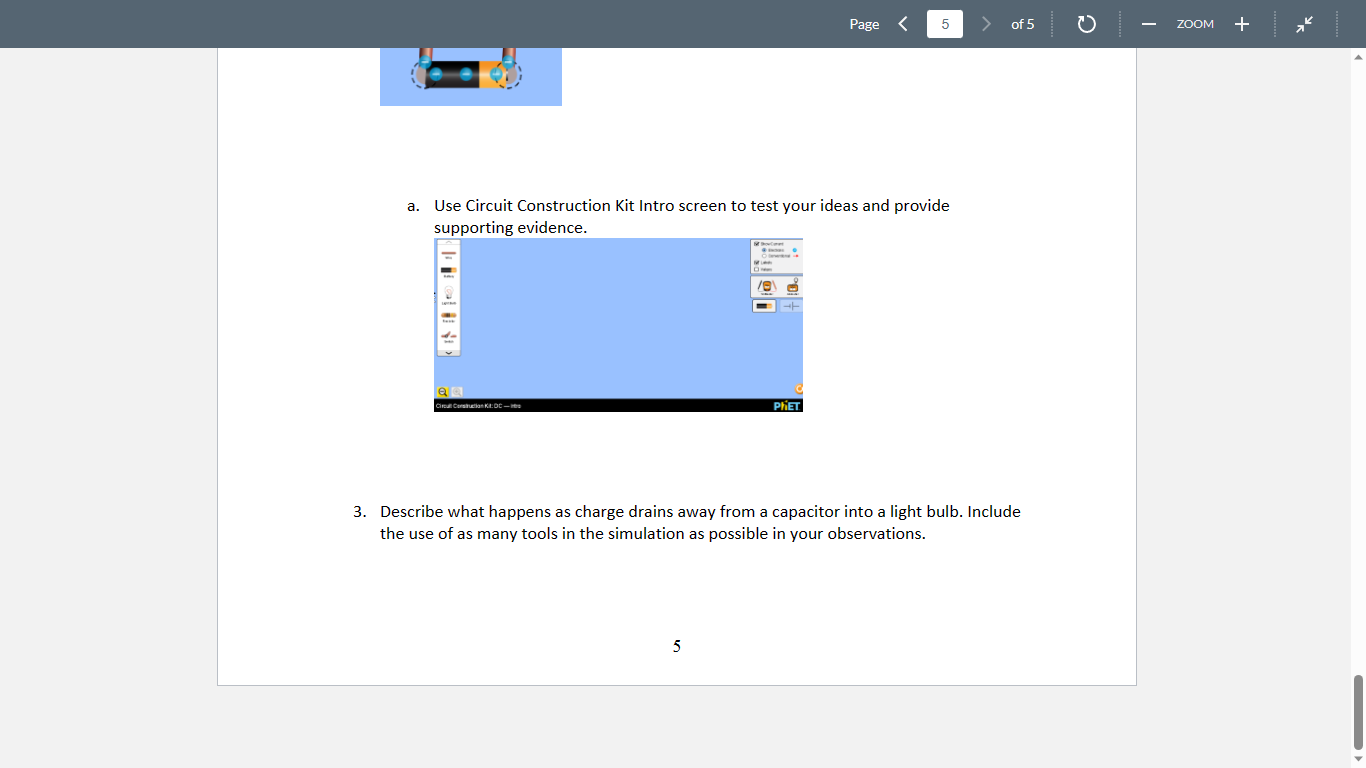
4 With the three-pole switch, you may have it in the left position to charge the capacitor, we will call this position 1. In position 1 the capacitor will charge. The internal resistance of the battery is usually enough to limit the charging current to a safe value but allowing the capacitor to charge up almost instantly. The right position to discharge the capacitor, we will call this position 2. And when the switch is the in center to pause the state of the charge, we will call this position 3. The switch should now be moved to position 3 so that the capacitor will discharge through the bulb. After a short time, you will take a voltmeter reading and record both the time you waited and the voltmeter reading here: ? Time (s): ? Voltage (V): Then a "trial discharge" at this point to see how quick the discharge is so that a suitable time interval can be decided when taking voltage readings during the discharge process, you will need AT LEAST 5 voltage readings for this experiment). After the trial discharge, move the switch to position 1 to charge up the capacitor. Switch to position 3, take a reading at t=0, and start the stop-clock (use an online stopwatch or your phone or watch as the stop clock), observe, and record the voltage reading at each chosen time interval. Continue to take voltage readings at consistent time intervals as the capacitor discharges. Repeat the process but this time move the switch to position 2 at each time interval and make a note of the Top Plate Charge and Stored Energy values. Position 3 Position 2 Time Interval Capacitance (pF) Voltage (V) Capacitance (pF) Voltage (V) 0 s # s # s # s # s
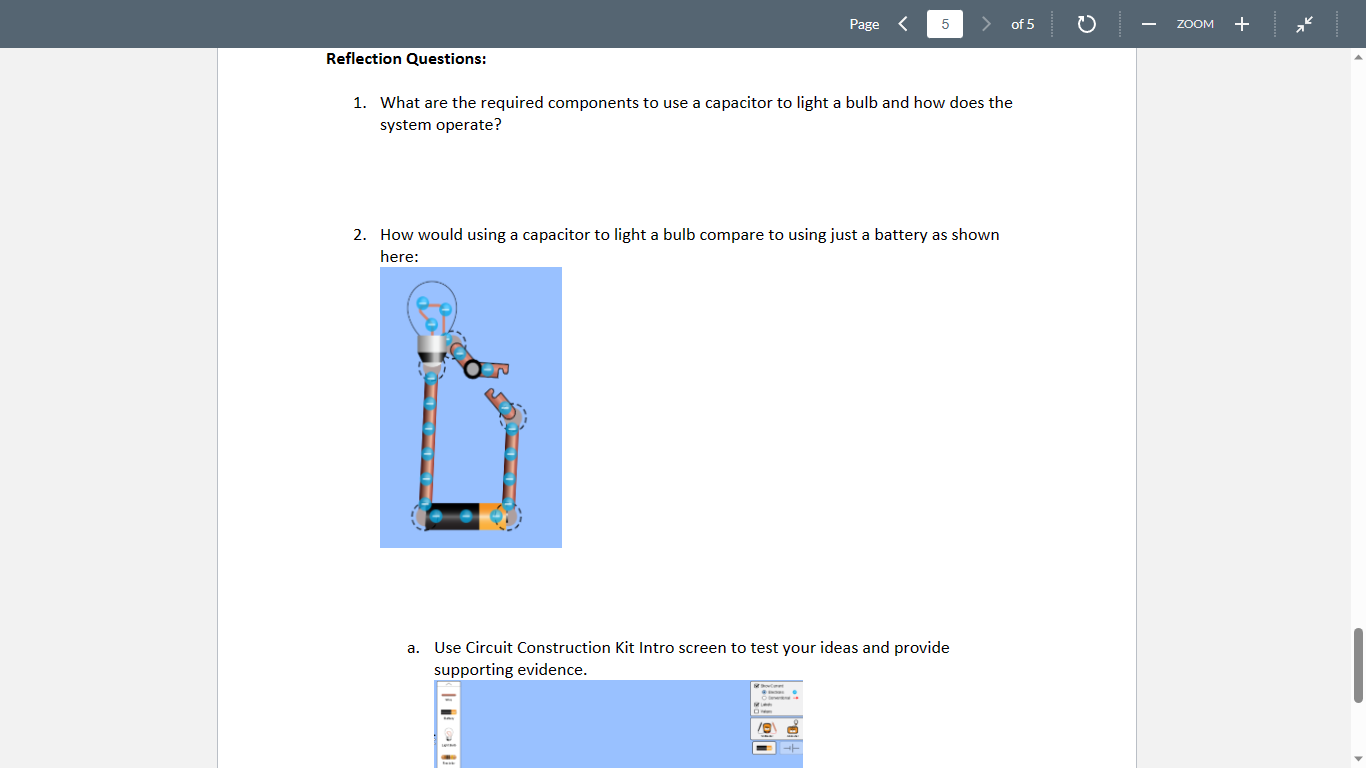
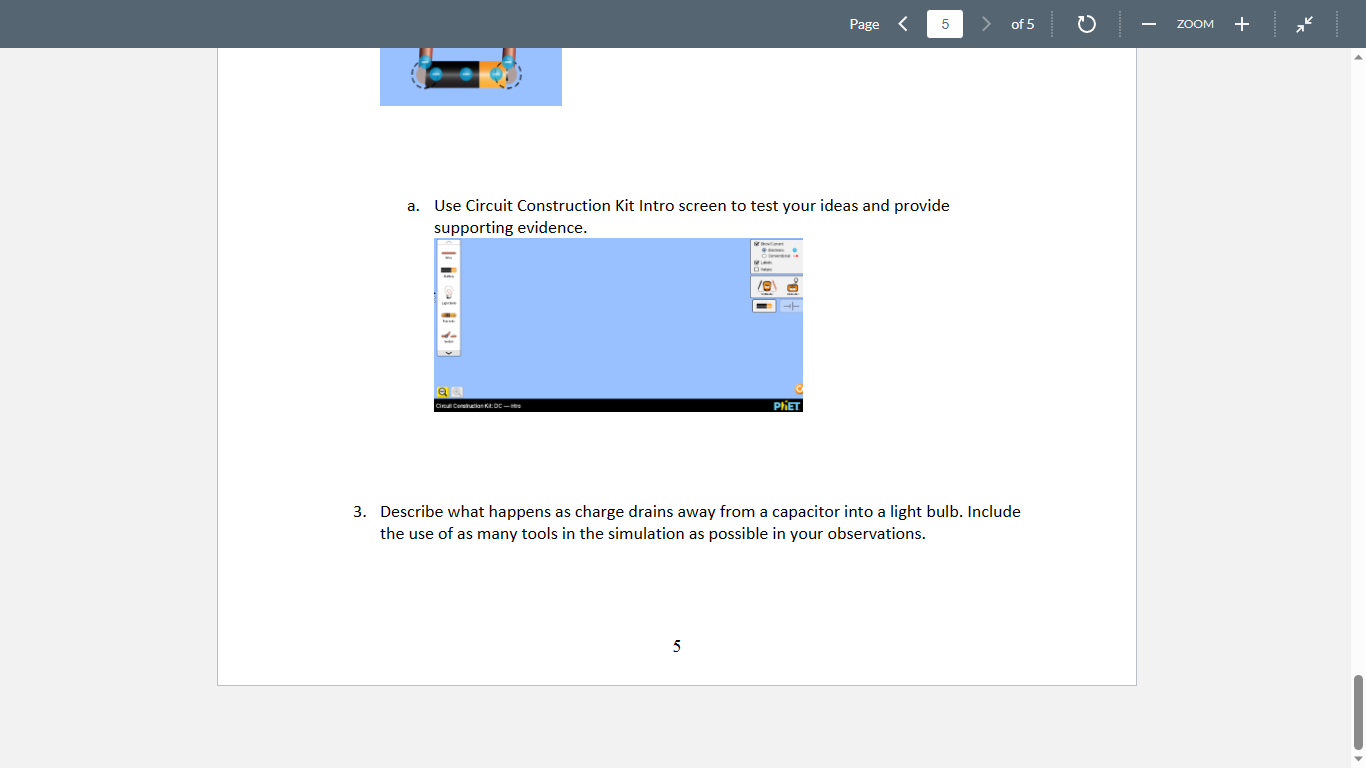
5 Reflection Questions: 1. What are the required components to use a capacitor to light a bulb and how does the system operate? 2. How would using a capacitor to light a bulb compare to using just a battery as shown here: a. Use Circuit Construction Kit Intro screen to test your ideas and provide supporting evidence. 3. Describe what happens as charge drains away from a capacitor into a light bulb. Include the use of as many tools in the simulation as possible in your observations.
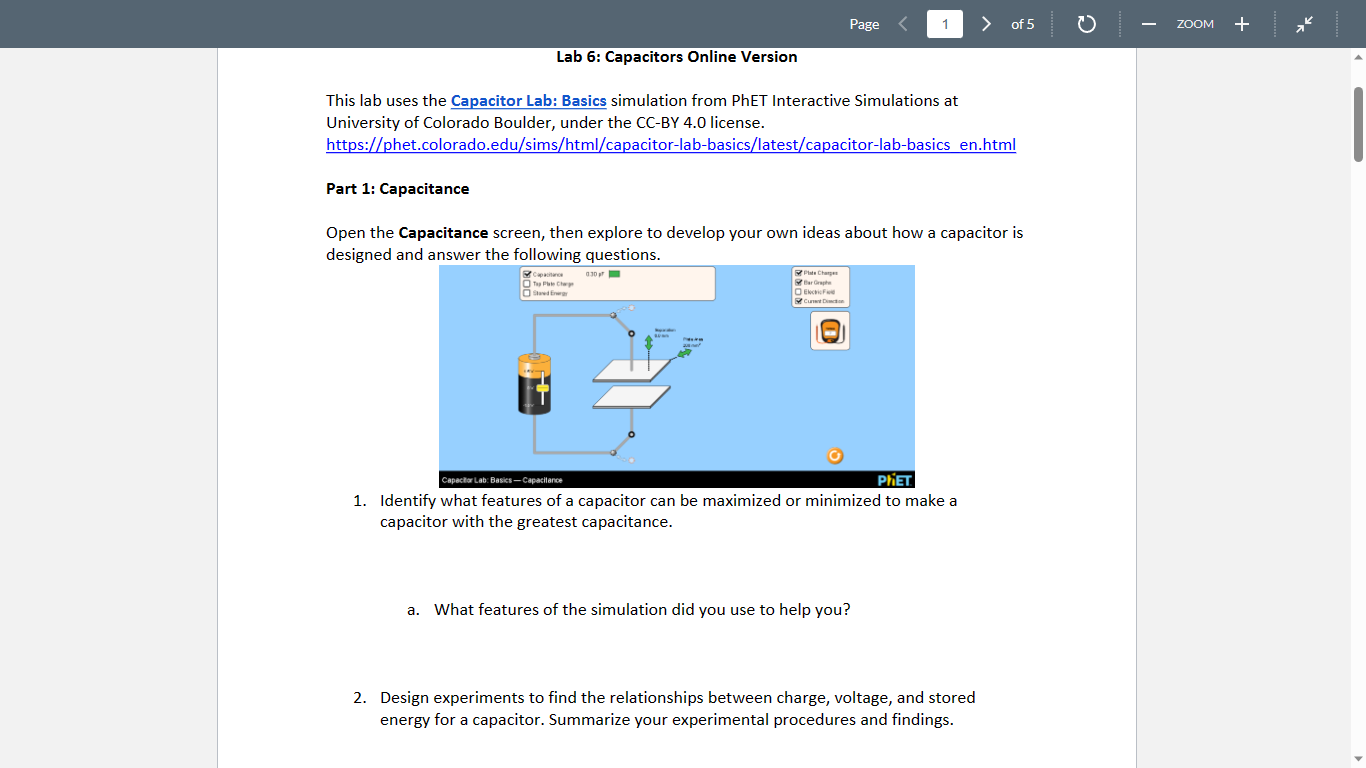
Page 1 of 5 ZOOM + Lab 6: Capacitors Online Version This lab uses the Capacitor Lab: Basics simulation from PhET Interactive Simulations at University of Colorado Boulder, under the CC-BY 4.0 license. https://phet.colorado.edu/sims/html/capacitor-lab-basics/latest/capacitor-lab-basics en.html Part 1: Capacitance Open the Capacitance screen, then explore to develop your own ideas about how a capacitor is designed and answer the following questions. Plots Charges Top Puke Clap of Current Dometion O Capactor Lab: Basics - Capacitance PHET 1. Identify what features of a capacitor can be maximized or minimized to make a capacitor with the greatest capacitance. a. What features of the simulation did you use to help you? 2. Design experiments to find the relationships between charge, voltage, and stored energy for a capacitor. Summarize your experimental procedures and findings.Page 1 of 5 ZOOM 2. Design experiments to find the relationships between charge, voltage, and stored energy for a capacitor. Summarize your experimental procedures and findings. a. What features of the simulation did you use to help you? 3. If you wanted to design a capacitor system to store the greatest energy, what would you use? Part 2: Light Bulb and Capacitor Open the Light Bulb screen, then explore to develop your own ideas about how a capacitor isPage 2 of 5 ZOOM Part 2: Light Bulb and Capacitor Open the Light Bulb screen, then explore to develop your own ideas about how a capacitor is designed and answer the following questions. Capacitance 0.30 PF Plate Charges Top Plate Charge Bar Graphs Stored Energy Electric Field Current Direction 15V - Capacitor Lab: Basics PHET : 1. Identify what features of a capacitor can be maximized or minimized to make a capacitor with the greatest capacitance. a. What features of the simulation did you use to help you? 2. Design an experiment using the online simulation to find the relationship between Top Plate Charge, Voltage, and Stored Energy for a capacitor. Summarize your experimental procedures and expected findings.Page 2 of 5 ZOOM 2. Design an experiment using the online simulation to find the relationship between Top Plate Charge, Voltage, and Stored Energy for a capacitor. Summarize your experimental procedures and expected findings. 3. If you wanted to design a capacitor system to store the greatest energy, what would you use? 2 Part 3: Using a SwitchofS O ZOOM + Part 3: Using 3 Switch Continue using the Light Bulb version of the simulation. Then do the following steps: 1. Reset the online demo. 2. Set the plate area to be the largest available: 400 mm2 3. Set the separation to be the smallest available: 2.0 mm {this will give us the slowest discharge rate available} Set the battery voltage to 1.5V Align the switch so that the capacitor charges up fully Turn on the options to show top plate charge and stored energy. 7. Move the voltmeter to take readings across the bulb. Your online demo should now look like this: 9'5\"? B rum mm 8' n- rum: 0 [mm mm D cam now Here is a schematic of the same setup, with the light bulb replacing the resistor in the diagram: two pole switch A B r. Page 3 of 5 ZOOM Here is a schematic of the same set-up, with the light bulb replacing the resistor in the diagram: two pole switch A B CE R 3Page ofS O ZOOM + With the threeepole switch, you may have it in the left position to charge the capacitor, we will call this position 1. In position 1 the capacitor will charge.
Step by Step Solution
There are 3 Steps involved in it

Get step-by-step solutions from verified subject matter experts
 Study Help