Question: Learning Goals /Outcomes Upon completion of this module, you will be able to: . Explain the importance of Time Management as a factor towards personal,
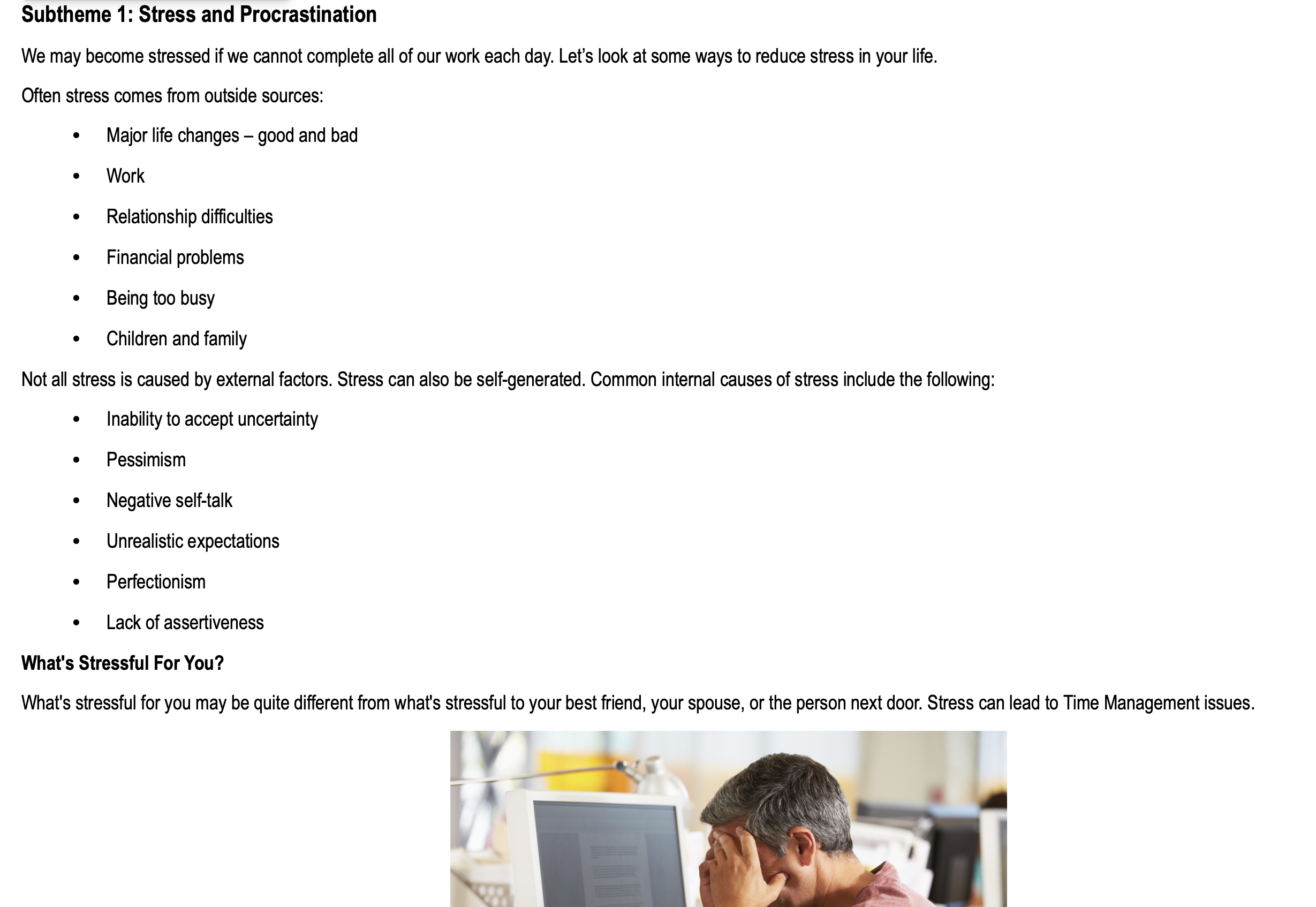
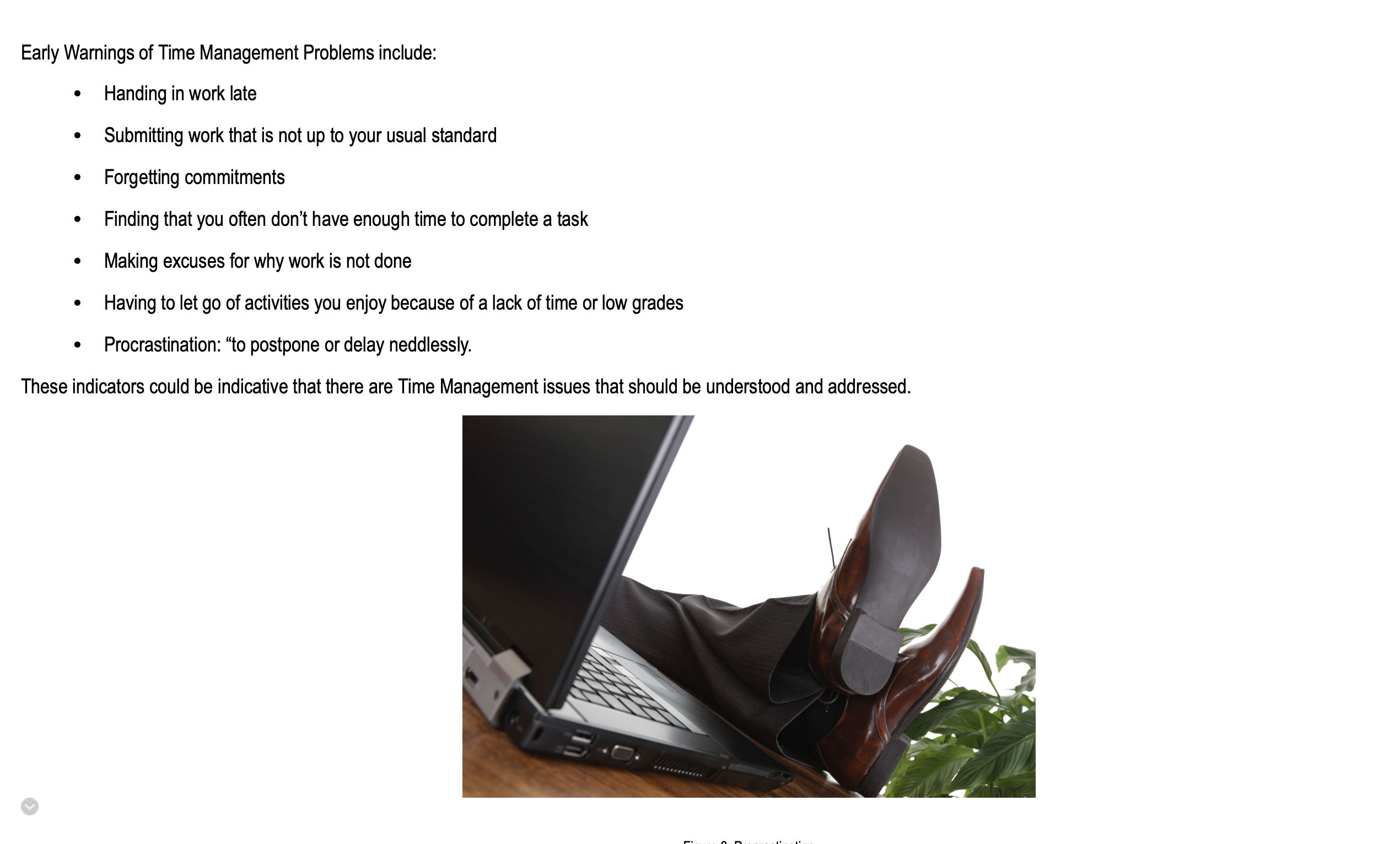
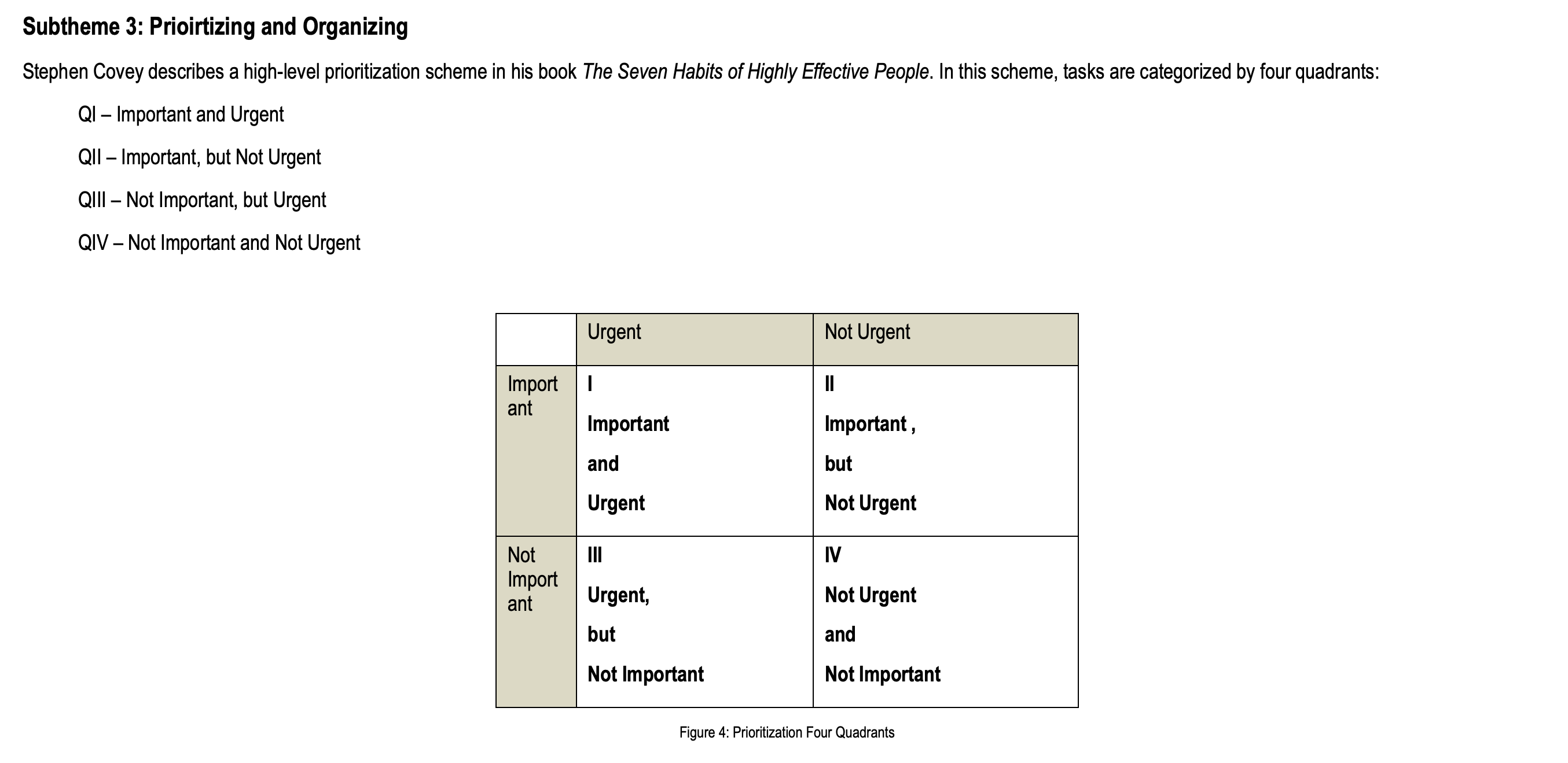
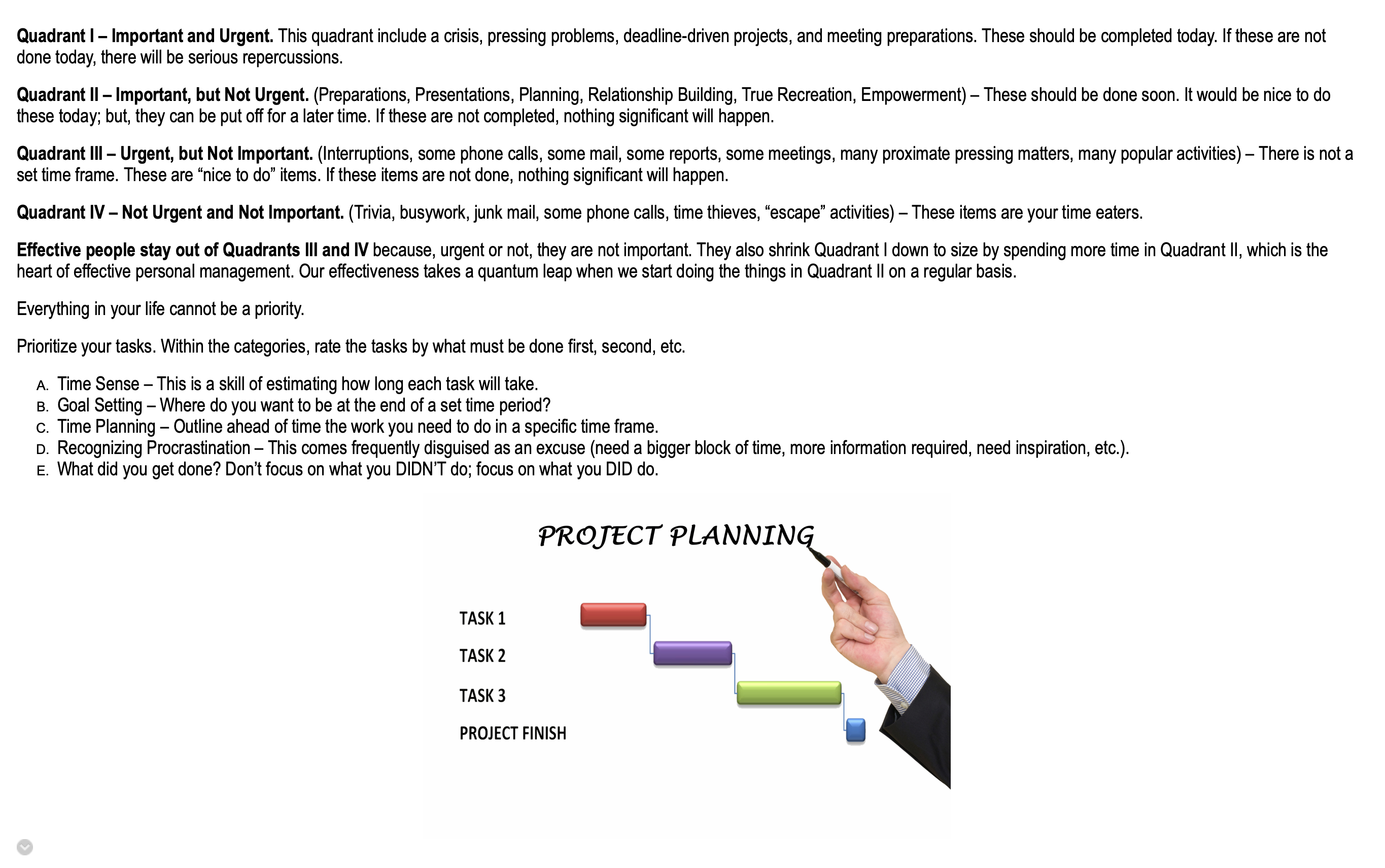
Learning Goals /Outcomes Upon completion of this module, you will be able to: . Explain the importance of Time Management as a factor towards personal, managerial and organizational success. . Recognize the importance of Time Management as part of your managerial life long learning process. . Identify Management techniques for the time management. . Explain the concept procrastination and its relation with time management. . List critical factors that could impact time management. a b~ WM Lesson 8.1: Time Management Time management is the process of planning and exercising conscious control over the amount of time spent on specific activities, especially to increase productivity. Time management may be aided by a range of skills, tools, and techniques used to manage time when accomplishing specific tasks, projects, and goals complying with a due date. This module introduces key aspects that should be recongized, identified and worked to continuously improve our time management skills. We all know there is a set amount of hours in each day to get our work done. We all also know that there are certain people or things that can steal minutes and even hours from your day - that take you away from your work. These time stealers can take many forms like too many meetings, no opportunities for delegation, telephone interruptions, demands from others, procrastination, or poor follow-up. You can control some time eaters, and cannot control others. Examine your day and identify the time eaters that you can control. Work to eliminate them to make each minute count. Ask yourself: Can | control this time eater? If I can control it, what will I gain if | eliminate or reduce it? . What steps will | need to take to eliminate this time eater? - How will I know when | am starting to see results? Another way to use your time more effectively is to accept the events in your life that you cannot control. Focus your energies on the events at work that you can control. Subtheme 1: Stress and Procrastination We may become stressed if we cannot complete all of our work each day. Let's look at some ways to reduce stress in your life. Often stress comes from outside sources: e Major life changes - good and bad e Work Relationship difficulties Financial problems Being too busy e Children and family Not all stress is caused by external factors. Stress can also be self-generated. Common internal causes of stress include the following: Inability to accept uncertainty e Pessimism Negative self-talk Unrealistic expectations e Perfectionism e Lack of assertiveness What's Stressful For You? What's stressful for you may be quite different from what's stressful to your best friend, your spouse, or the person next door. Stress can lead to Time Management issues. | X ~ Early Warnings of Time Management Problems include: Handing in work late Submitting work that is not up to your usual standard Forgetting commitments Finding that you often don't have enough time to complete a task e Making excuses for why work is not done Having to let go of activities you enjoy because of a lack of time or low grades Procrastination: \"to postpone or delay neddlessly. These indicators could be indicative that there are Time Management issues that should be understood and addressed. Subtheme 2: Reducing Stress and Improving Time Management Below please find some key points towards reducing stress and conquering time management. Time Management - Schedule (but don't over-schedule), list, and prioritize tasks. Plan each day. Planning your day can help you accomplish more and feel more in control of your life. Write a to-do list, putting the most important tasks at the top. Keep a schedule of your daily activities to minimize conflicts and last-minute rushes. Prioritize your tasks. Time-consuming, but relatively unimportant tasks can consume a lot of your day. Prioritizing tasks will ensure that you spend your time and energy on those that are truly important to you. Say no to nonessential tasks. Consider your goals and schedule before agreeing to take on additional work. Take the time you need to do a quality job. Doing work right the first time may take more time up front, but errors usually result in time spent making corrections, which takes more time overall. Practice the 10-minute rule. Work on a dreaded task for 10 minutes each day. Once you get started, you may find you can finish it. Evaluate how you're spending your time. Keep a diary of everything you do for three days to determine how you're spending your time. Look for time that can be used more wisely. For example, could you take a bus or train to work and use the commute to catch up on reading? If so, you could free up some time to exercise or spend with family or friends. Take a break when needed. Too much stress can derail your attempts at getting organized. When you need a break, take one. Take a walk. Do some quick stretches at your workstation. Take a day of vacation to rest and re-energize. Organization Make a place for work and personal tasks in your schedule. Plan daily for short-term goals and plan weekly or longer for larger goals. Organize your physical space. There's a direct relationship between clutter and stress; more of one causes more of the other. When you are surrounded by piles, it's hard to relax, to feel at peace, to be contented with your living or working environment. Delegate Are there some things you can delegate? Subtheme 3: Prioirtizing and Organizing Stephen Covey describes a high-level prioritization scheme in his book The Seven Habits of Highly Effective People. In this scheme, tasks are categorized by four quadrants: QI - Important and Urgent QIl - Important, but Not Urgent QI - Not Important, but Urgent QIV - Not Important and Not Urgent Urgent Not Urgent Import | | Il ant Important Important , and but Urgent Not Urgent Not 1l v Import :r:f 2 Urgent, Not Urgent but and Not Important Not Important Figure 4: Prioritization Four Quadrants Quadrant | - Important and Urgent. This quadrant include a crisis, pressing problems, deadline-driven projects, and meeting preparations. These should be completed today. If these are not done today, there will be serious repercussions. Quadrant Il - Important, but Not Urgent. (Preparations, Presentations, Planning, Relationship Building, True Recreation, Empowerment) These should be done soon. It would be nice to do these today; but, they can be put off for a later time. If these are not completed, nothing significant will happen. Quadrant Ill - Urgent, but Not Important. (Interruptions, some phone calls, some mail, some reports, some meetings, many proximate pressing matters, many popular activities) There is not a set time frame. These are \"nice to do\" items. If these items are not done, nothing significant will happen. Quadrant IV - Not Urgent and Not Important. (Trivia, busywork, junk mail, some phone calls, time thieves, \"escape\" activities) These items are your time eaters. Effective people stay out of Quadrants Ill and IV because, urgent or not, they are not important. They also shrink Quadrant | down to size by spending more time in Quadrant I, which is the heart of effective personal management. Our effectiveness takes a quantum leap when we start doing the things in Quadrant Il on a regular basis. Everything in your life cannot be a priority. Prioritize your tasks. Within the categories, rate the tasks by what must be done first, second, etc. A. Time Sense - This is a skill of estimating how long each task will take. B. Goal Setting Where do you want to be at the end of a set time period? c. Time Planning Outline ahead of time the work you need to do in a specific time frame. D. Recognizing Procrastination This comes frequently disguised as an excuse (need a bigger block of time, more information required, need inspiration, etc.). . What did you get done? Don't focus on what you DIDN'T do; focus on what you DID do. PROJECT PLANNING\\ TASK 1 ] 1 \\k TASK 2 N TASK 3 PROJECT FINISH Subtheme 4: Get Rid of Time Wasters Get Rid of Time Wasters . Leaving tasks unfinished . Inadequate staff . Socializing . Confused responsibility or authority Poor communication Inadequate controls and progress reports Incomplete information Travel Management by crisis Telephone interruptions Inadequate planning Drop-in visitors Ineffective delegation Personal disorganization Lack of self-discipline Inability to say no Procrastination Meetings Paperwork Learn to say \"NO\" . Why is it so hard? Most of us have been taught that \"no\" is disrespectful and even insulting. - We tend to value other people's time more highly than our own. . We have a need to cooperate and a desire to be liked. . There are often unconscious concemns of being thought of as lazy or selfish. - How do you say it? o \"I can't do it right now, but | can fit it in later.\" \"| am not the best qualified person for that job, how about asking...\" \"| just don't have any room in my schedule for the next few weeks.\" \"| can't focus on that right now.\" \"| have made a commitment to complete my current project/task ahead of any other.\" \"Normally | would say yes, but I've had a few things come up unexpectedly and | have to deal with those first.\" \"| would rather say no than end up doing a second rate job for you.\" o o o o o o [/1Conclusion To conclude, all of us have significant tasks that occur more or less regularly. Who decides when you do these things, at what hour of the day? You do. Now add to that the idea of your personal energy cycle. Most of us have certain times of the day when we're more energetic, mentally fresher, and other times when we're less effective. Many people have an energy \"dip\" right after lunch (Siestal). Study yourself for a few days. Are you a slow starter, or do you do your best work first thing in the morning? Plot your own energy cycle, and plan your day around it. Schedule your key tasks for your best working times, and work on those tasks at the same time each day. Recognize that time management is critical for your long-life career growth, it will also be important to manage and mentor your resources
Step by Step Solution
There are 3 Steps involved in it
1 Expert Approved Answer
Step: 1 Unlock
Question Has Been Solved by an Expert!
Get step-by-step solutions from verified subject matter experts
Step: 2 Unlock
Step: 3 Unlock
Students Have Also Explored These Related General Management Questions!