



Question: Let a, b be constants. The differential equation .Have the solution x'(t) = ax(t) + b Where xT = x (T) is a constant. *(t)
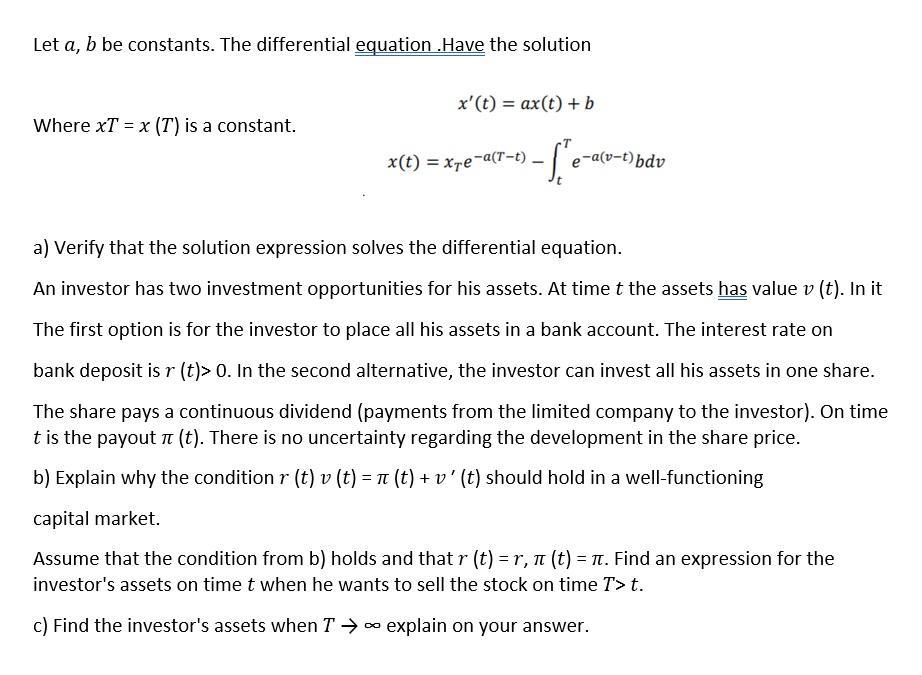
Let a, b be constants. The differential equation .Have the solution x'(t) = ax(t) + b Where xT = x (T) is a constant. *(t) = xme=a[T-6). - e-a(v-t)bdv a) Verify that the solution expression solves the differential equation. An investor has two investment opportunities for his assets. At time t the assets has value v (t). In it The first option is for the investor to place all his assets in a bank account. The interest rate on bank deposit is r (t)> 0. In the second alternative, the investor can invest all his assets in one share. The share pays a continuous dividend (payments from the limited company to the investor). On time t is the payout n (t). There is no uncertainty regarding the development in the share price. b) Explain why the condition r (t) v (t) = a (t) + v' (t) should hold in a well-functioning capital market. Assume that the condition from b) holds and that r (t) = r, n (t) = 11. Find an expression for the investor's assets on time t when he wants to sell the stock on time T>t. c) Find the investor's assets when T explain on your answer. Let a, b be constants. The differential equation .Have the solution x'(t) = ax(t) + b Where xT = x (T) is a constant. *(t) = xme=a[T-6). - e-a(v-t)bdv a) Verify that the solution expression solves the differential equation. An investor has two investment opportunities for his assets. At time t the assets has value v (t). In it The first option is for the investor to place all his assets in a bank account. The interest rate on bank deposit is r (t)> 0. In the second alternative, the investor can invest all his assets in one share. The share pays a continuous dividend (payments from the limited company to the investor). On time t is the payout n (t). There is no uncertainty regarding the development in the share price. b) Explain why the condition r (t) v (t) = a (t) + v' (t) should hold in a well-functioning capital market. Assume that the condition from b) holds and that r (t) = r, n (t) = 11. Find an expression for the investor's assets on time t when he wants to sell the stock on time T>t. c) Find the investor's assets when T explain on your
Step by Step Solution
There are 3 Steps involved in it

Get step-by-step solutions from verified subject matter experts