Question: Let C be the parametrizatio y(t) = (cost + tsint, sint - tcost) for t E (0, 00). (a) Use the formula in Q.2 of
Let C be the parametrizatio y(t) = (cost + tsint,Let C be the parametrizatio y(t) = (cost + tsint,Let C be the parametrizatio y(t) = (cost + tsint,Let C be the parametrizatio y(t) = (cost + tsint,
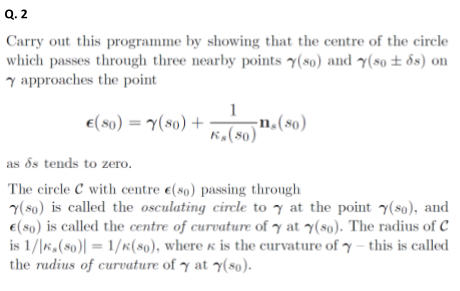
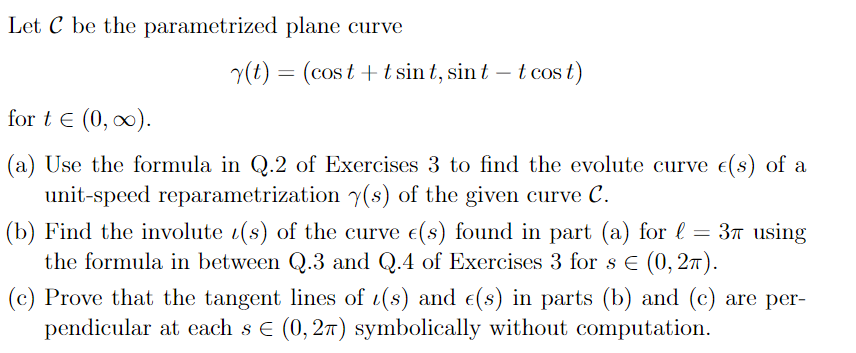
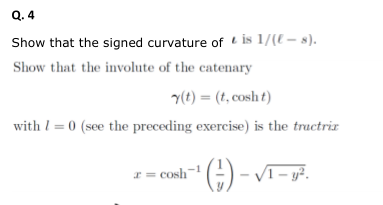
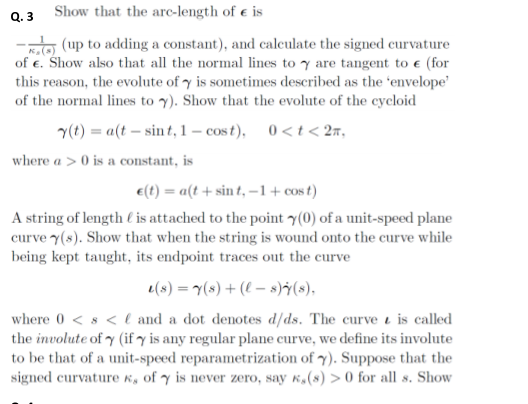
Let C be the parametrizatio y(t) = (cost + tsint, sint - tcost) for t E (0, 00). (a) Use the formula in Q.2 of Exercises 3 to find the evolute curve e(s) of a unit-speed reparametrization y(s) of the given curve C. (b) Find the involute (s) of the curve e(s) found in part (a) for & = 37 using the formula in between Q.3 and Q.4 of Exercises 3 for s E (0, 21). (c) Prove that the tangent lines of (s) and e(s) in parts (b) and (c) are per- pendicular at each s E (0, 2x) symbolically without computation.Q. 4 Show that the signed curvature of { is 1/(( - s). Show that the involute of the catenary y(t) = (t, cosht) with / = 0 (see the preceding exercise) is the tructric = cosh " (!) - VI-Q.3 Show that the arc-length of e is (up to adding a constant), and calculate the signed curvature of e. Show also that all the normal lines to y are tangent to e (for this reason, the evolute of y is sometimes described as the 'envelope' of the normal lines to y). Show that the evolute of the cycloid y(t) = a(t - sint, 1 - cost), 0 0 is a constant, is E(t) = a(t + sint, -1 + cost) A string of length / is attached to the point y(0) of a unit-speed plane curve y(s). Show that when the string is wound onto the curve while being kept taught, its endpoint traces out the curve 1(8) = 7(8) + (1 - 8)7(s). where 0 0 for all s. ShowQ. 2 Carry out this programme by showing that the centre of the circle which passes through three nearby points y(so) and y(so 1 6s) on y approaches the point E(So) = Y(80) + Ks (SO n, (80) as os tends to zero. The circle C with centre c(so) passing through y(so) is called the osculating circle to y at the point y(so), and E(so) is called the centre of curvature of y at y(so). The radius of C is 1/|K.(so)| = 1/k(so), where & is the curvature of y - this is called the radius of curvature of y at y(so)
Step by Step Solution

There are 3 Steps involved in it

1 Expert Approved Answer
Step: 1 Unlock blur-text-image
Question Has Been Solved by an Expert!

Get step-by-step solutions from verified subject matter experts

Step: 2 Unlock
Step: 3 Unlock

Students Have Also Explored These Related Mathematics Questions!