







Question: Let E and H be two vectors assumed to have continuous partial derivatives (of second order at least) with respect to position and time.
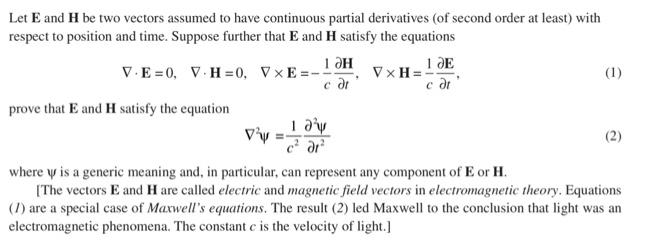
Let E and H be two vectors assumed to have continuous partial derivatives (of second order at least) with respect to position and time. Suppose further that E and H satisfy the equations 1 JE VxH= V.E = 0, V H =0, VxE: (1) c dt prove that E and H satisfy the equation V'v (2) where y is a generic meaning and, in particular, can represent any component of E or H. (The vectors E and H are called electric and magnetic field vectors in electromagnetic theory. Equations (1) are a special case of Maxwell's equations. The result (2) led Maxwell to the conclusion that light was an electromagnetic phenomena. The constant c is the velocity of light.]
Step by Step Solution
3.39 Rating (155 Votes )
There are 3 Steps involved in it
To prove that the electric field mathbfE and the magnetic field mathbfH satisfy the wave equation gi... View full answer

Get step-by-step solutions from verified subject matter experts
Document Format (2 attachments)

606ad568634ec_49006.pdf
180 KBs PDF File

606ad568634ec_49006.docx
120 KBs Word File
 Study Help