







Question: Let G be a solid whose surface a is oriented outward by the unit normal n, and let F(x, y, 2) denote a vector field
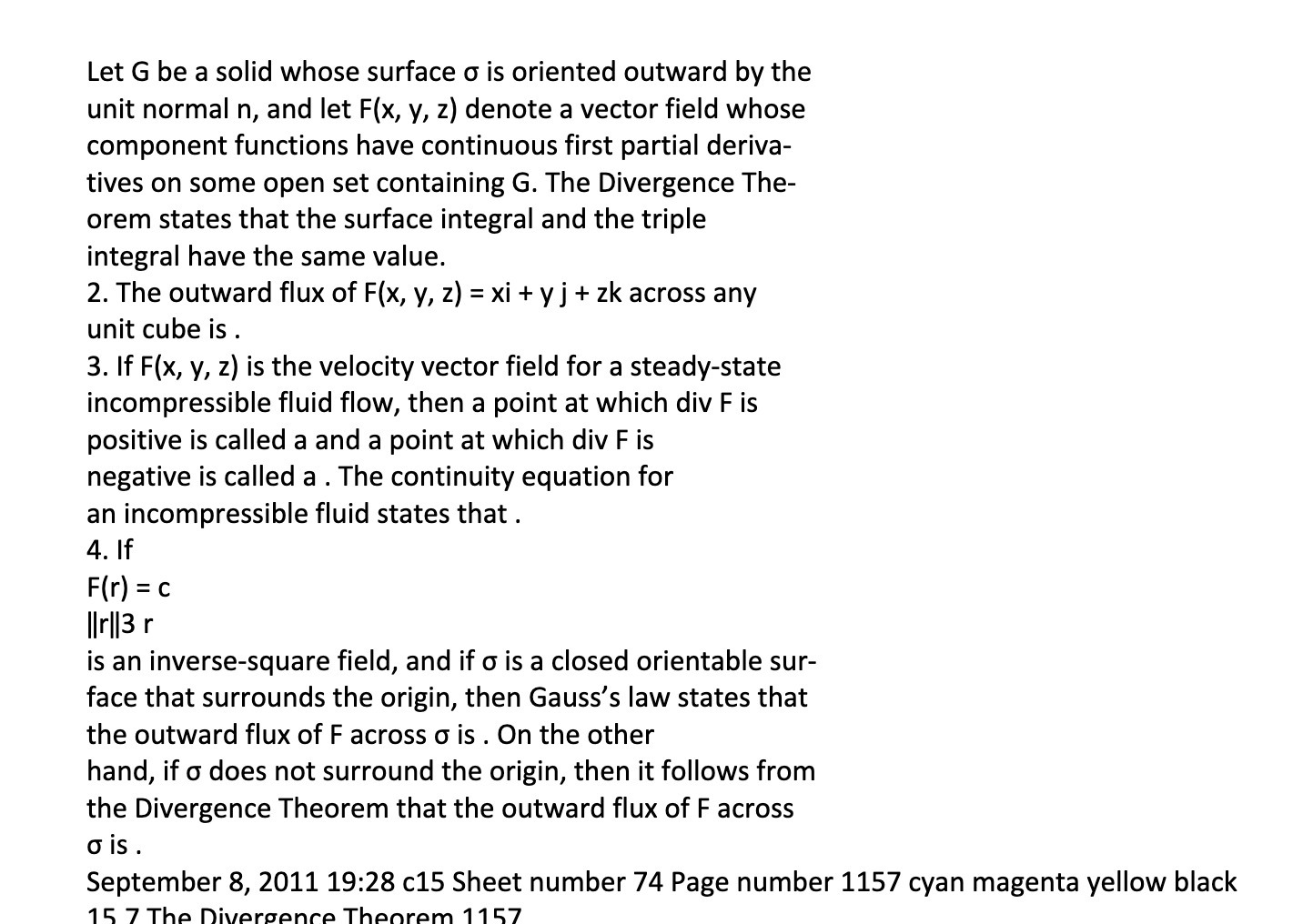
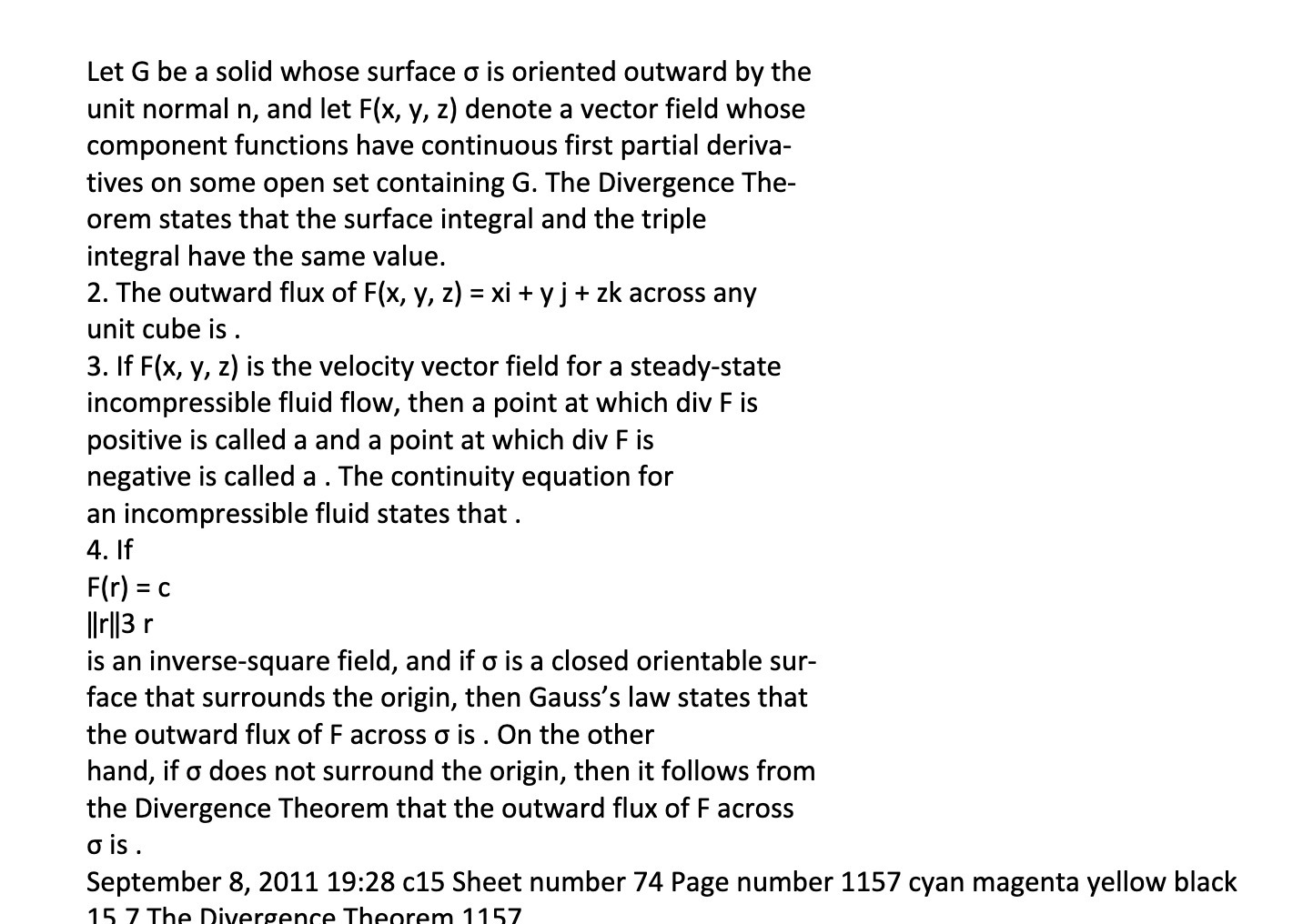
Let G be a solid whose surface a is oriented outward by the unit normal n, and let F(x, y, 2) denote a vector field whose component functions have continuous first partial deriva- tives on some open set containing G. The Divergence The- orem states that the surface integral and the triple integral have the same value. 2. The outward flux of F(x, y, z) = xi + yj + zk across any unit cube is . 3. If F(x, y, z) is the velocity vector field for a steady-state incompressible fluid flow, then a point at which div F is positive is called a and a point at which div F is negative is called a . The continuity equation for an incompressible fluid states that . 4. If F(r) = c ||r||3 r is an inverse-square field, and if a is a closed orientable sur- face that surrounds the origin, then Gauss's law states that the outward flux of F across a is . On the other hand, if 0 does not surround the origin, then it follows from the Divergence Theorem that the outward flux of F across 0 is . September 8, 2011 19:28 c15 Sheet number 74 Page number 1157 cyan magenta yellow black '1 '2 7 Thin Diuprapnrp Thpnrpm 'l 1 E7
Step by Step Solution
There are 3 Steps involved in it

Get step-by-step solutions from verified subject matter experts
 Study Help