







Question: Let G be the graph below. A B H I C (b) What is the chromatic number of G? Explain. (c) What is the
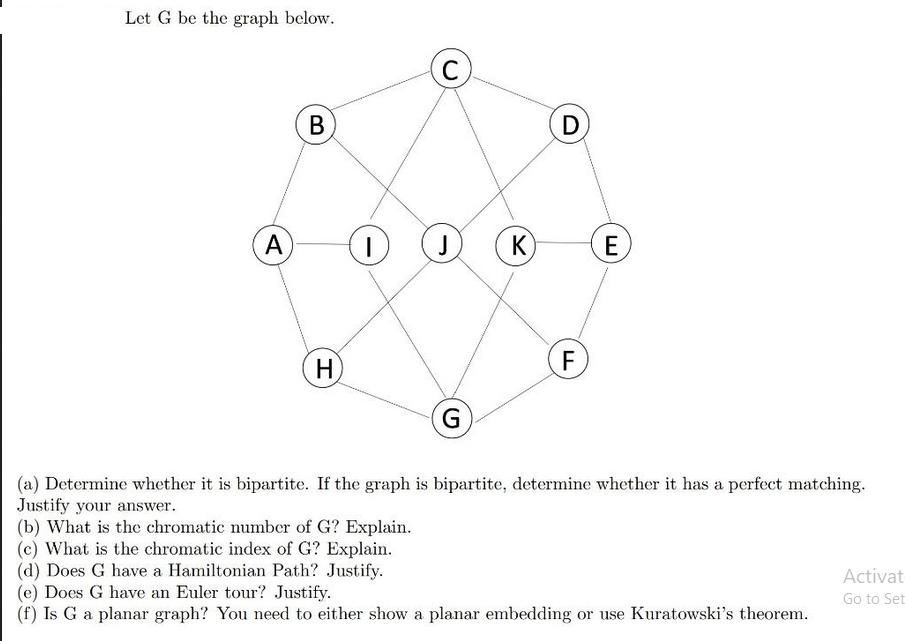
Let G be the graph below. A B H I C (b) What is the chromatic number of G? Explain. (c) What is the chromatic index of G? Explain. J K G D FL E (a) Determine whether it is bipartite. If the graph is bipartite, determine whether it has a perfect matching. Justify your answer. (d) Does G have a Hamiltonian Path? Justify. (e) Does G have an Euler tour? Justify. (f) Is G a planar graph? You need to either show a planar embedding or use Kuratowski's theorem. Activat Go to Set
Step by Step Solution
There are 3 Steps involved in it
Based on the provided image it appears that the graph G is not bipartite A graph is bipartite if it is possible to separate its set of vertices into t... View full answer

Get step-by-step solutions from verified subject matter experts
 Study Help