







Question: Let = (Gen, Enc, Dec) over message space M with keyspace K and ciphertext space C be an encryp- tion scheme that achieves perfect secrecy.
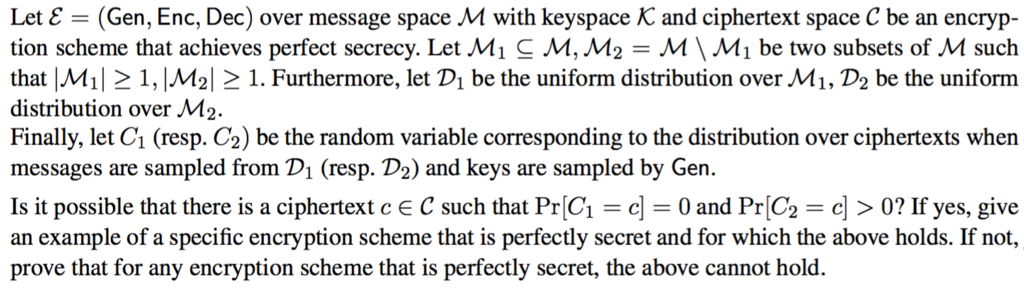
Let = (Gen, Enc, Dec) over message space M with keyspace K and ciphertext space C be an encryp- tion scheme that achieves perfect secrecy. Let Mi M,M2 = M \ Mi be two subsets of M such that |M|| > 1, 1M21 1. Furthermore, let D1 be the uniform distribution over Mi, D2 be the uniform distribution over M2, Finally, let C1 (resp. C2) be the random variable corresponding to the distribution over ciphertexts when messages are sampled from Di (resp. Da) and keys are sampled by Gen. Is it possible that there is a ciphertext c E such that Pr[C,-c] 0 and PrC2 0? If yes, give an example of a specific encryption scheme that is perfectly secret and for which the above holds. If not, prove that for any encryption scheme that is perfectly secret, the above cannot hold. Let = (Gen, Enc, Dec) over message space M with keyspace K and ciphertext space C be an encryp- tion scheme that achieves perfect secrecy. Let Mi M,M2 = M \ Mi be two subsets of M such that |M|| > 1, 1M21 1. Furthermore, let D1 be the uniform distribution over Mi, D2 be the uniform distribution over M2, Finally, let C1 (resp. C2) be the random variable corresponding to the distribution over ciphertexts when messages are sampled from Di (resp. Da) and keys are sampled by Gen. Is it possible that there is a ciphertext c E such that Pr[C,-c] 0 and PrC2 0? If yes, give an example of a specific encryption scheme that is perfectly secret and for which the above holds. If not, prove that for any encryption scheme that is perfectly secret, the above cannot hold
Step by Step Solution
There are 3 Steps involved in it

Get step-by-step solutions from verified subject matter experts
 Study Help