







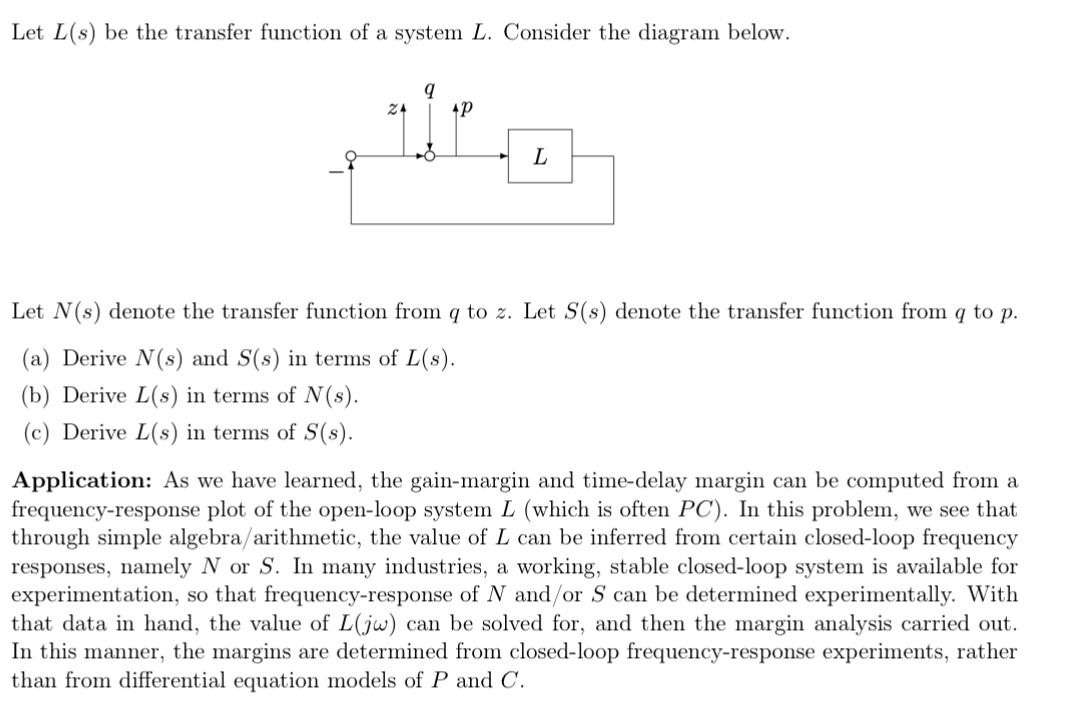
Question: Let L ( s ) be the transfer function of a system L . Consider the diagram below. Let N ( s ) denote the
Let be the transfer function of a system Consider the diagram below.
Let denote the transfer function from to Let denote the transfer function from to
a Derive and in terms of
b Derive in terms of
c Derive in terms of
Application: As we have learned, the gainmargin and timedelay margin can be computed from a frequencyresponse plot of the openloop system which is often In this problem, we see that through simple algebraarithmetic the value of can be inferred from certain closedloop frequency responses, namely or In many industries, a working, stable closedloop system is available for experimentation, so that frequencyresponse of andor can be determined experimentally. With that data in hand, the value of can be solved for, and then the margin analysis carried out. In this manner, the margins are determined from closedloop frequencyresponse experiments, rather than from differential equation models of and
Step by Step Solution
There are 3 Steps involved in it
1 Expert Approved Answer
Step: 1 Unlock

Question Has Been Solved by an Expert!
Get step-by-step solutions from verified subject matter experts
Step: 2 Unlock
Step: 3 Unlock
 Study Help