







Question: Let (N(t)),>, be a Poisson process with rate 1, and for e > 0, let X, X,... be i.i.d. with density C'yle-, y >
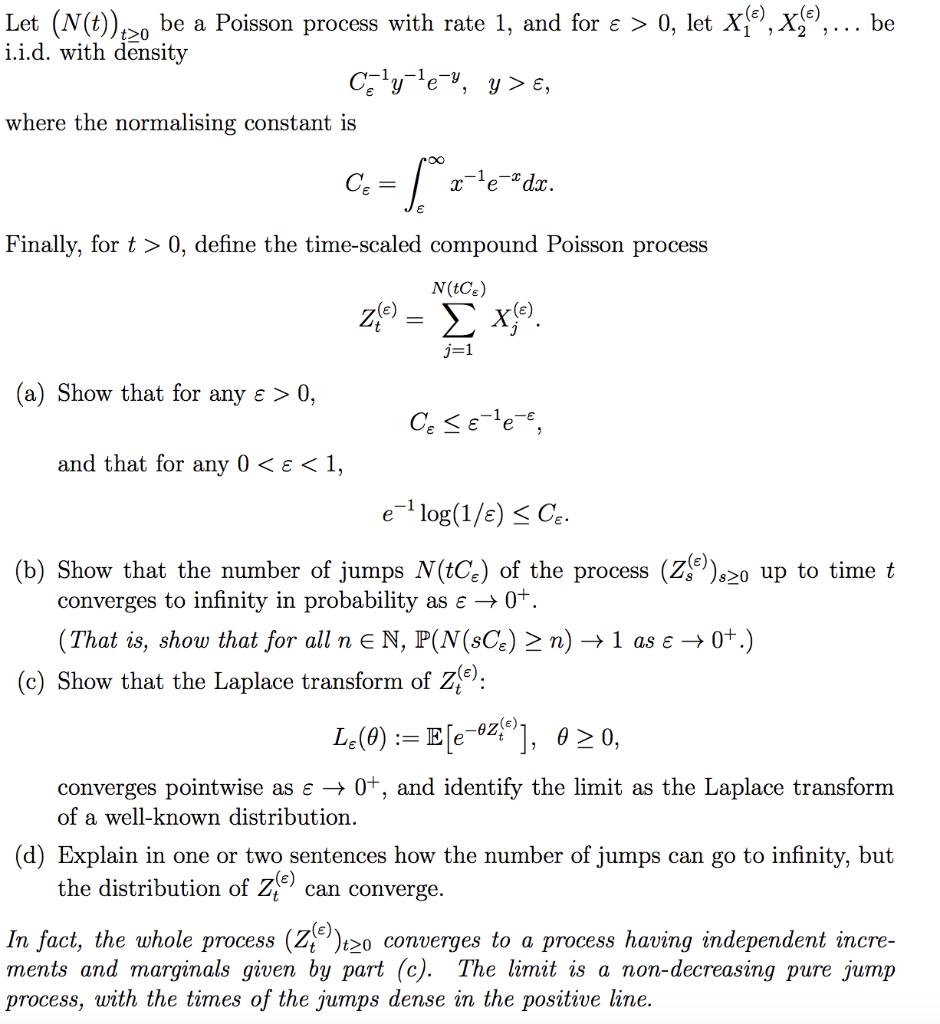
Let (N(t)),>, be a Poisson process with rate 1, and for e > 0, let X, X,... be i.i.d. with density C'yle-", y > , where the normalising constant is x-le"dx. Finally, for t > 0, define the time-scaled compound Poisson process N(tCe) %3D j=1 (a) Show that for any > 0, C; n) 1 as e 0+.) (c) Show that the Laplace transform of Z): L(0) := E[e=0z;], 0 >0, converges pointwise as e 0+, and identify the limit as the Laplace transform of a well-known distribution. (d) Explain in one or two sentences how the number of jumps can go to infinity, but the distribution of Ze) can converge. In fact, the whole process (Z)t20 converges to a process having independent incre- ments and marginals given by part (c). The limit is a non-decreasing pure jump process, with the times of the jumps dense in the positive line.
Step by Step Solution
3.41 Rating (157 Votes )
There are 3 Steps involved in it
Lets tackle each part of the problem stepbystep a Show the inequalities for Cvarepsilon To establish the bounds for Cvarepsilon 1 Evaluate the Integra... View full answer

Get step-by-step solutions from verified subject matter experts
 Study Help