







Question: Let X and Y be independent exponentially distributed random variables with identical probability density functions, i.e., fx(x) = de-A for a > 0, fy
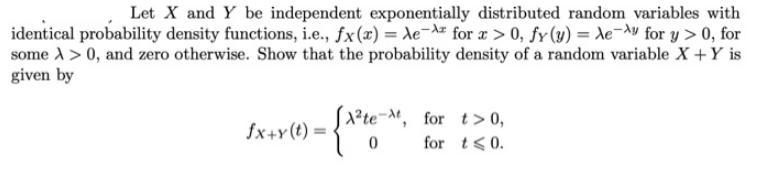
Let X and Y be independent exponentially distributed random variables with identical probability density functions, i.e., fx(x) = de-A for a > 0, fy (y) = de-v for y > 0, for some A > 0, and zero otherwise. Show that the probability density of a random variable X + Y is given by fx+y(t) = S1?te-, for t>0, for t
Step by Step Solution
★★★★★
3.39 Rating (155 Votes )
There are 3 Steps involved in it
1 Expert Approved Answer
Step: 1 Unlock

To solve this problem we need to find the probability density function pdf of the sum of two indepen... View full answer
Question Has Been Solved by an Expert!
Get step-by-step solutions from verified subject matter experts
Step: 2 Unlock
Step: 3 Unlock
 Study Help