







Question: Let X1, ..., Xn be i.i.d. random variables with c.d.f. F(x) = P(X; 0. 1. Show n(x) is an unbiased estimator of P(X sx). [10
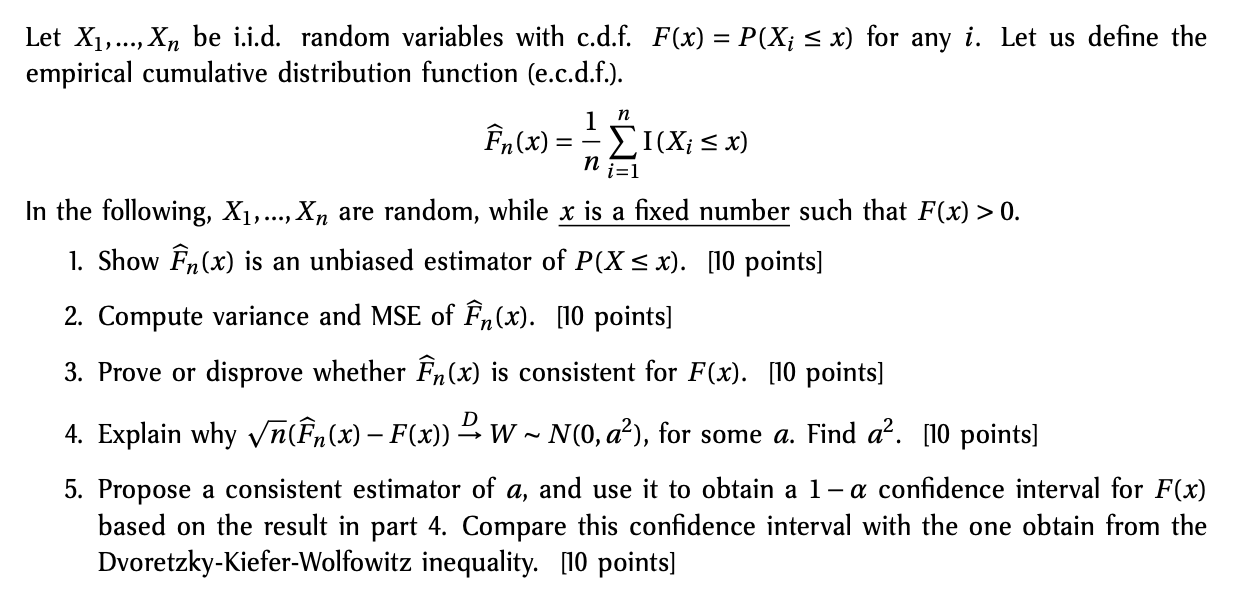
Let X1, ..., Xn be i.i.d. random variables with c.d.f. F(x) = P(X; 0. 1. Show n(x) is an unbiased estimator of P(X sx). [10 points) 2. Compute variance and MSE of n(x). [10 points] 3. Prove or disprove whether n(x) is consistent for F(x). [10 points] 4. Explain why Vn(n (x) F(x)) -- W ~ N(0, a?), for some a. Find a?. [10 points) 5. Propose a consistent estimator of a, and use it to obtain a 1-a confidence interval for F(x) based on the result in part 4. Compare this confidence interval with the one obtain from the Dvoretzky-Kiefer-Wolfowitz inequality. [10 points) Let X1, ..., Xn be i.i.d. random variables with c.d.f. F(x) = P(X; 0. 1. Show n(x) is an unbiased estimator of P(X sx). [10 points) 2. Compute variance and MSE of n(x). [10 points] 3. Prove or disprove whether n(x) is consistent for F(x). [10 points] 4. Explain why Vn(n (x) F(x)) -- W ~ N(0, a?), for some a. Find a?. [10 points) 5. Propose a consistent estimator of a, and use it to obtain a 1-a confidence interval for F(x) based on the result in part 4. Compare this confidence interval with the one obtain from the Dvoretzky-Kiefer-Wolfowitz inequality. [10 points)
Step by Step Solution
There are 3 Steps involved in it

Get step-by-step solutions from verified subject matter experts
 Study Help