



Question: Let z(t) be the continuous-time complex exponential signal iuot = (r(t with fundamental frequency and fundamental period To = 27/wo. Consider the discrete-time signal
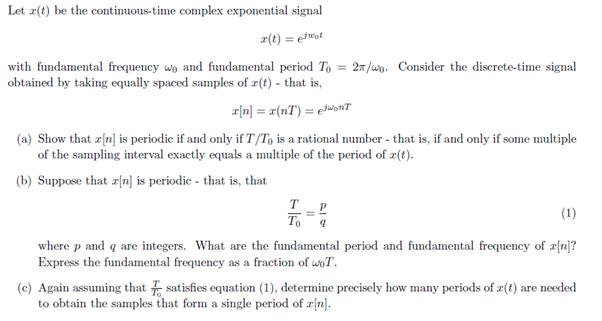
Let z(t) be the continuous-time complex exponential signal iuot = (r(t with fundamental frequency and fundamental period To = 27/wo. Consider the discrete-time signal obtained by taking equally spaced samples of r(t) - that is, x[n] = x(nT) = ent (a) Show that a[n] is periodic if and only if T/To is a rational number that is, if and only if some multiple of the sampling interval exactly equals a multiple of the period of r(t). (b) Suppose that r[n] is periodic - that is, that T To P 4 (1) where p and q are integers. What are the fundamental period and fundamental frequency of a[n]? Express the fundamental frequency as a fraction of woT. (c) Again assuming that satisfies equation (1), determine precisely how many periods of z(t) are needed to obtain the samples that form a single period of z[n].
Step by Step Solution
3.34 Rating (151 Votes )
There are 3 Steps involved in it
The detailed ... View full answer

Get step-by-step solutions from verified subject matter experts