







Question: Let's now consider an embedded system that can be implemented in three different ways (A, B or C), each having multiple independent tasks that are
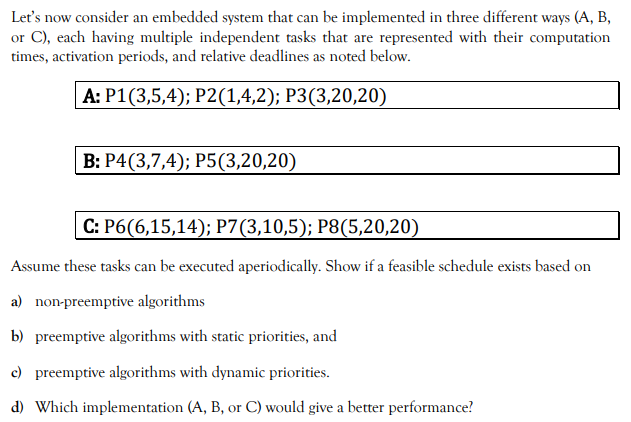
Let's now consider an embedded system that can be implemented in three different ways (A, B or C), each having multiple independent tasks that are represented with their computation times, activation periods, and relative deadlines as noted below. A: P1(3,5,4); P2(1,4,2); P3(3,20,20) B: P4(3,7,4); P5(3,20,20) C: P6(6,15,14): P7(3,10,5): P8(5,20,20) Assume these tasks can be executed aperiodically. Show if a feasible schedule exists based on b) preemptive algorithms with static priorities, and c) preemptive algorithms with dynamic priorities d) Which implementation (A, B, or C) would give a better performance? Let's now consider an embedded system that can be implemented in three different ways (A, B or C), each having multiple independent tasks that are represented with their computation times, activation periods, and relative deadlines as noted below. A: P1(3,5,4); P2(1,4,2); P3(3,20,20) B: P4(3,7,4); P5(3,20,20) C: P6(6,15,14): P7(3,10,5): P8(5,20,20) Assume these tasks can be executed aperiodically. Show if a feasible schedule exists based on b) preemptive algorithms with static priorities, and c) preemptive algorithms with dynamic priorities d) Which implementation (A, B, or C) would give a better performance
Step by Step Solution
There are 3 Steps involved in it

Get step-by-step solutions from verified subject matter experts
 Study Help