







Question: Let's think about an accretion disk: see the Lecture Notes, section 2.1. A disk of gas orbits a central object (mass M), so the
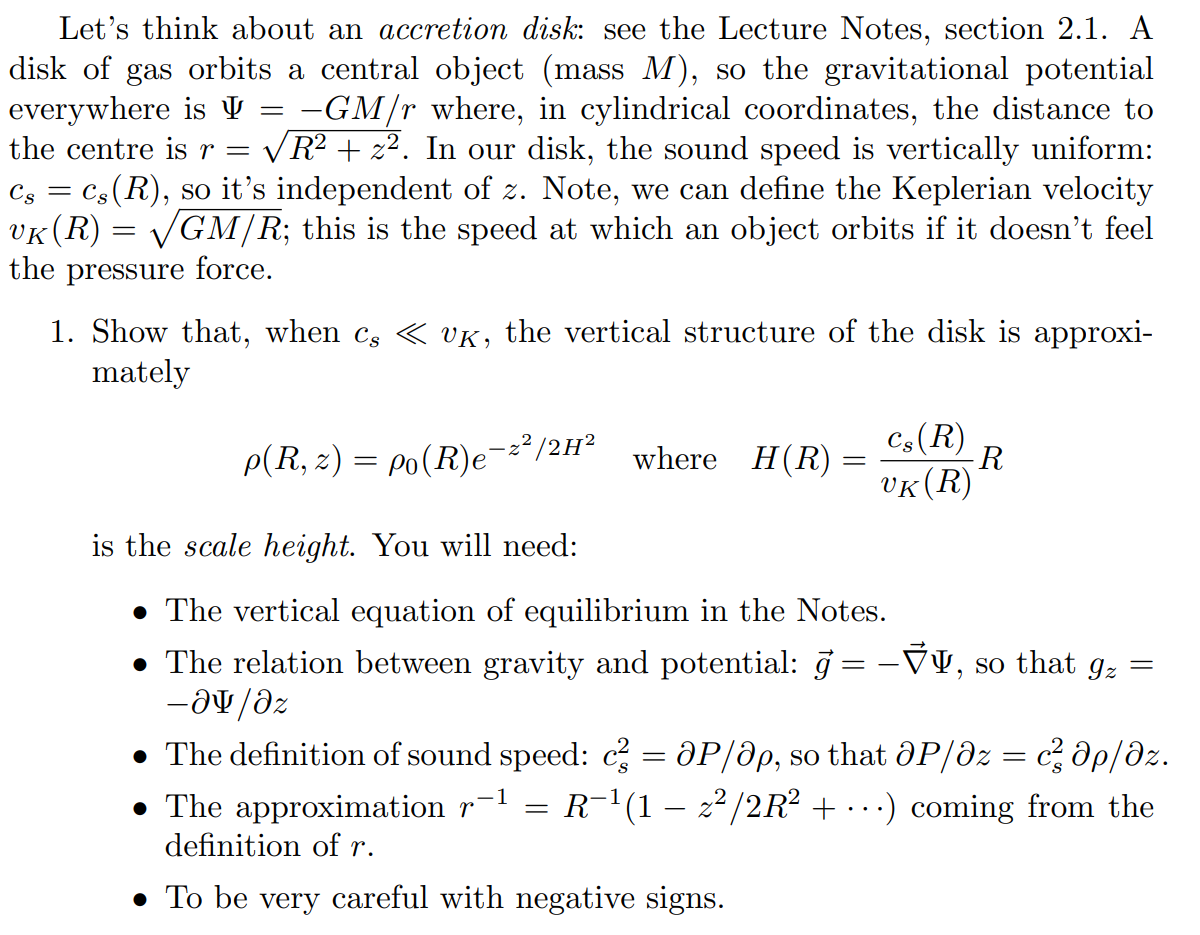
Let's think about an accretion disk: see the Lecture Notes, section 2.1. A disk of gas orbits a central object (mass M), so the gravitational potential everywhere is = GM/r where, in cylindrical coordinates, the distance to the centre is r = R + z. In our disk, the sound speed is vertically uniform: Cs = cs(R), so it's independent of z. Note, we can define the Keplerian velocity VK (R) = GM/R; this is the speed at which an object orbits if it doesn't feel the pressure force. 1. Show that, when c < VK, the vertical structure of the disk is approxi- mately p(R, z) = po(R)e/2H2 where H(R) is the scale height. You will need: = Cs (R) (R) R The vertical equation of equilibrium in the Notes. The relation between gravity and potential: = , so that g = The definition of sound speed: c 3 = P/p, so that P/z = cp/z. The approximation r definition of r. -1 = R(1 z/2R + ...) coming from the To be very careful with negative signs.
Step by Step Solution
There are 3 Steps involved in it

Get step-by-step solutions from verified subject matter experts
 Study Help