



Question: Liam Martin found himself overwhelmed by the workload he faced as the tutoring - service business he had launched started to take off. Exhausted from
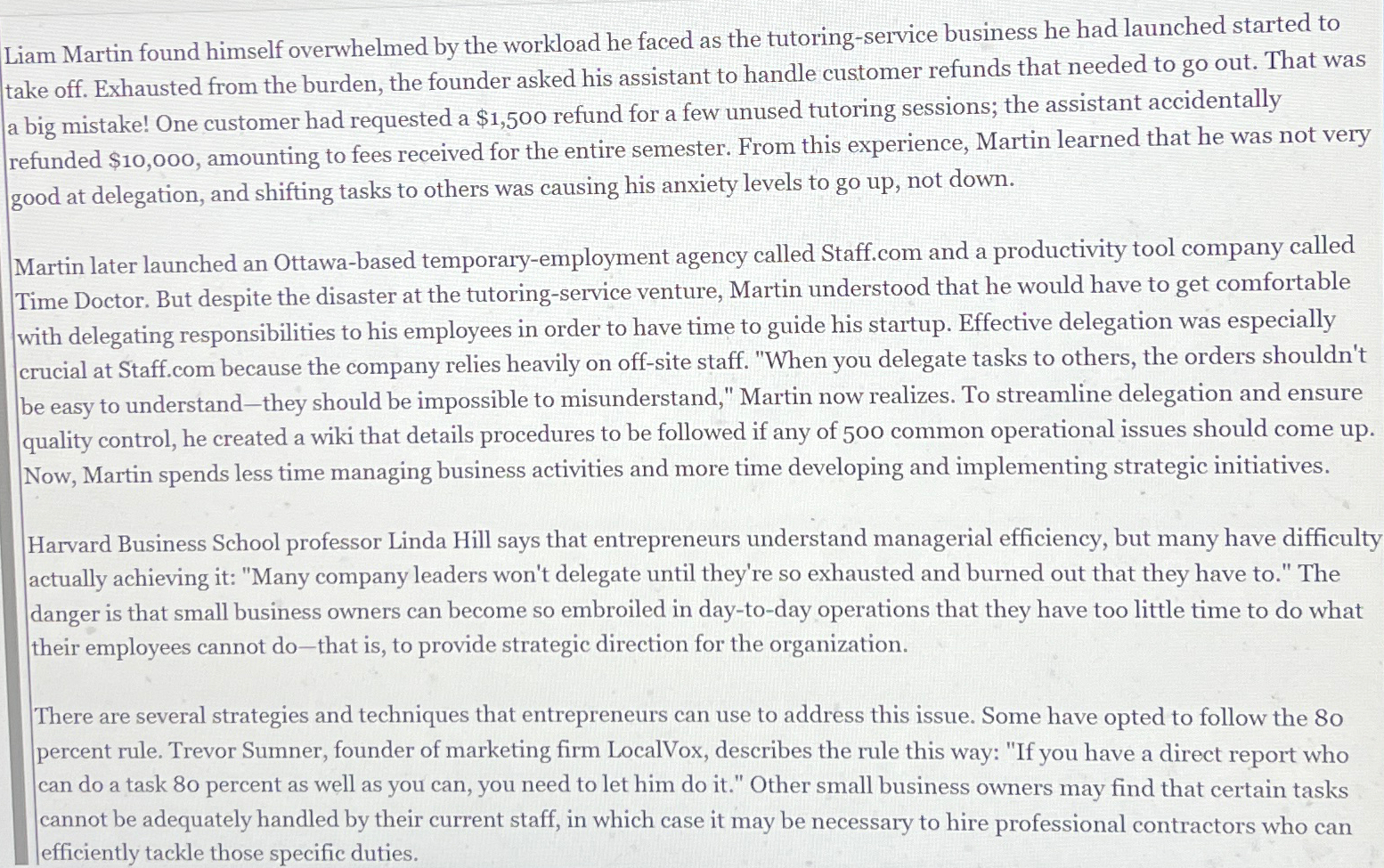
Liam Martin found himself overwhelmed by the workload he faced as the tutoringservice business he had launched started to take off. Exhausted from the burden, the founder asked his assistant to handle customer refunds that needed to go out. That was a big mistake! One customer had requested a $ refund for a few unused tutoring sessions; the assistant accidentally refunded $ amounting to fees received for the entire semester. From this experience, Martin learned that he was not very good at delegation, and shifting tasks to others was causing his anxiety levels to go up not down.
Martin later launched an Ottawabased temporaryemployment agency called
Staff.com and a productivity tool company called Time Doctor. But despite the disaster at the tutoringservice venture, Martin understood that he would have to get comfortable with delegating responsibilities to his employees in order to have time to guide his startup. Effective delegation was especially crucial at
Staff.com because the company relies heavily on offsite staff. "When you delegate tasks to others, the orders shouldn't be easy to understand they should be impossible to misunderstand," Martin now realizes. To streamline delegation and ensure quality control, he created a wiki that details procedures to be followed if any of common operational issues should come up Now, Martin spends less time managing business activities and more time developing and implementing strategic initiatives.
Harvard Business School professor Linda Hill says that entrepreneurs understand managerial efficiency, but many have difficulty actually achieving it: "Many company leaders won't delegate until they're so exhausted and burned out that they have to The danger is that small business owners can become so embroiled in daytoday operations that they have too little time to do what their employees cannot dothat is to provide strategic direction for the organization.
There are several strategies and techniques that entrepreneurs can use to address this issue. Some have opted to follow the percent rule. Trevor Sumner, founder of marketing firm LocalVox, describes the rule this way: If you have a direct report who can do a task percent as well as you can, you need to let him do it Other small business owners may find that certain tasks cannot be adequately handled by their current staff, in which case it may be necessary to hire professional contractors who can efficiently tackle those specific duties.
Step by Step Solution
There are 3 Steps involved in it
1 Expert Approved Answer
Step: 1 Unlock

Question Has Been Solved by an Expert!
Get step-by-step solutions from verified subject matter experts
Step: 2 Unlock
Step: 3 Unlock