Question: linear equation and its application system of linear function function ( constant, linear, quadratic) polynomial function - rational function polynomial and rational function square root
linear equation and its application
system of linear function
function ( constant, linear, quadratic)
polynomial function -
rational function
polynomial and rational function
square root and absolute value
exponential and logarithmic
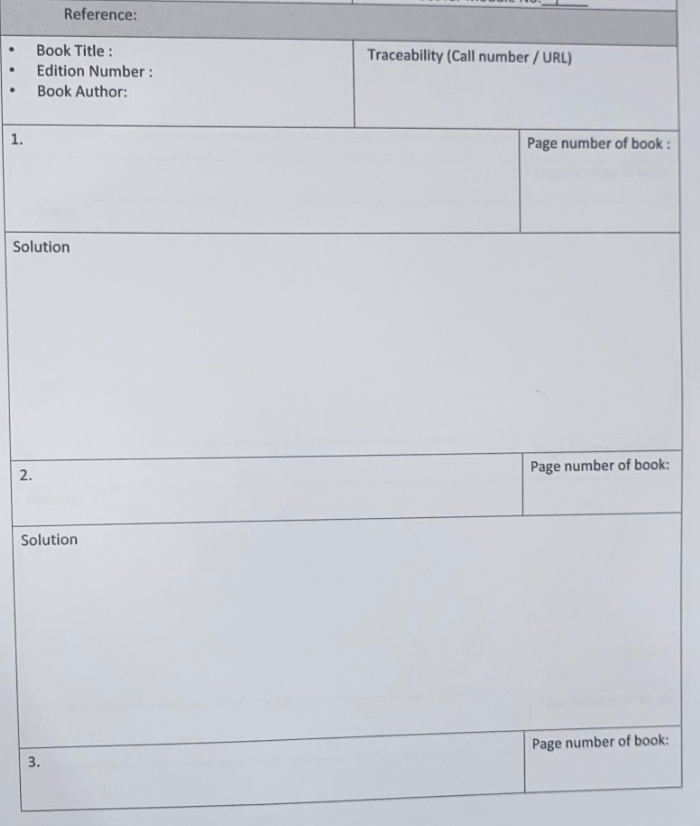
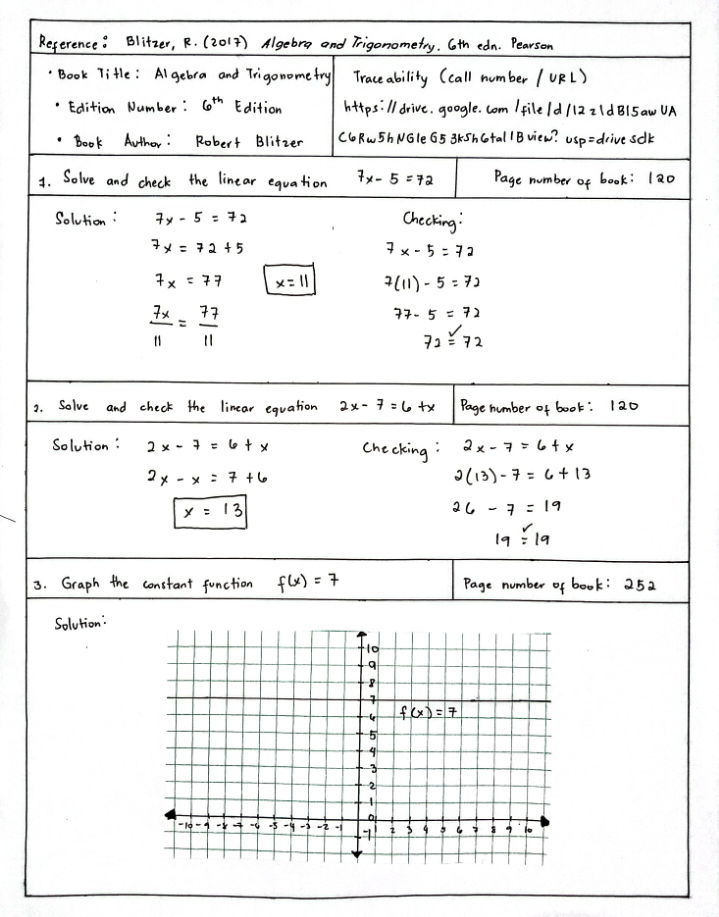
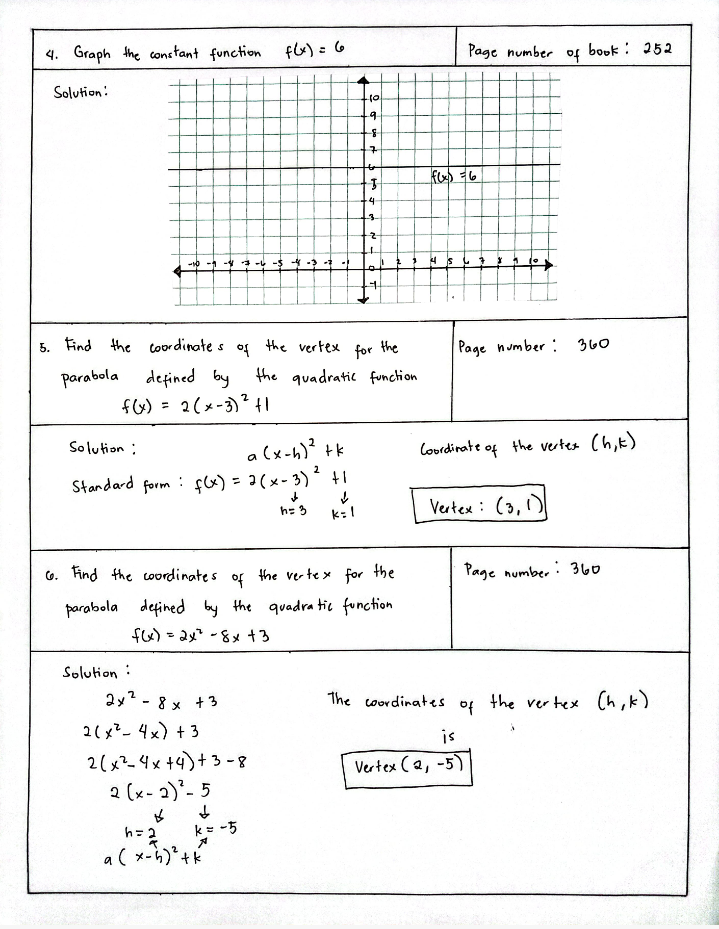
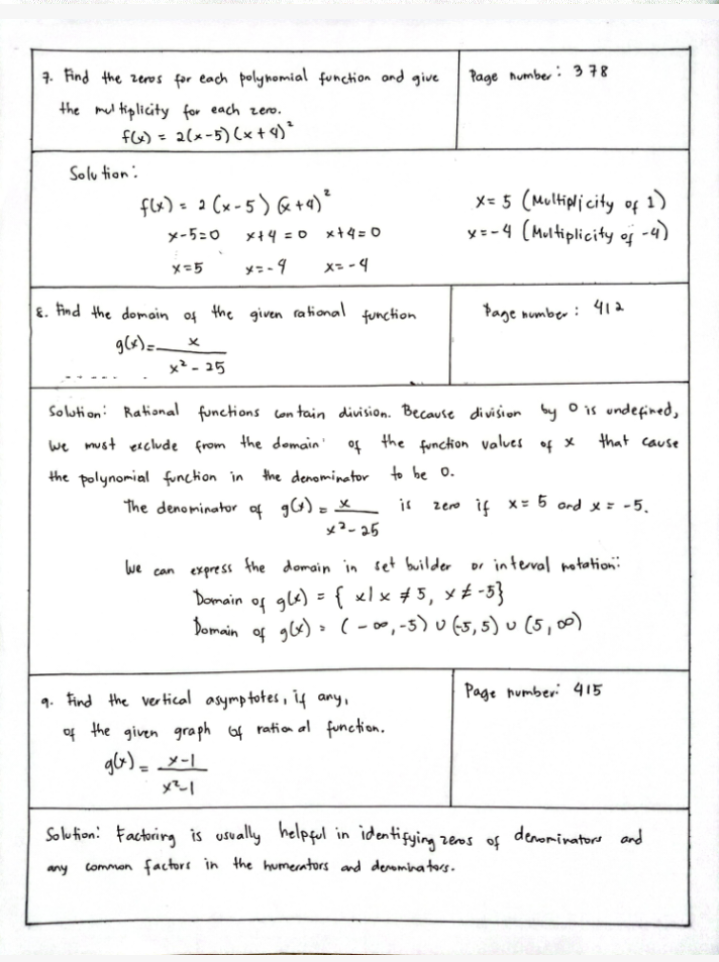
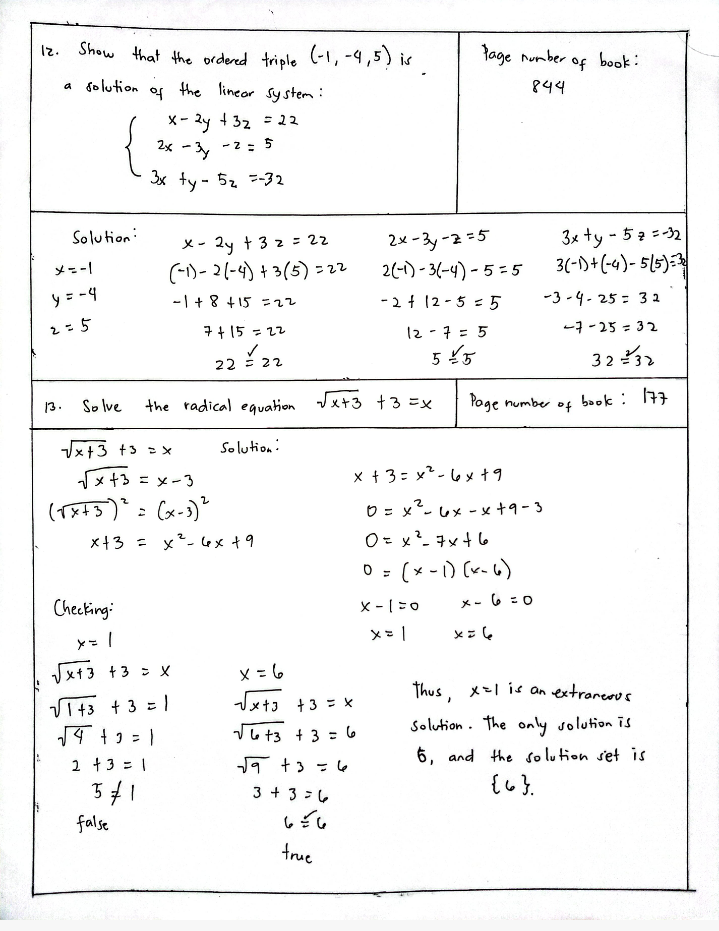
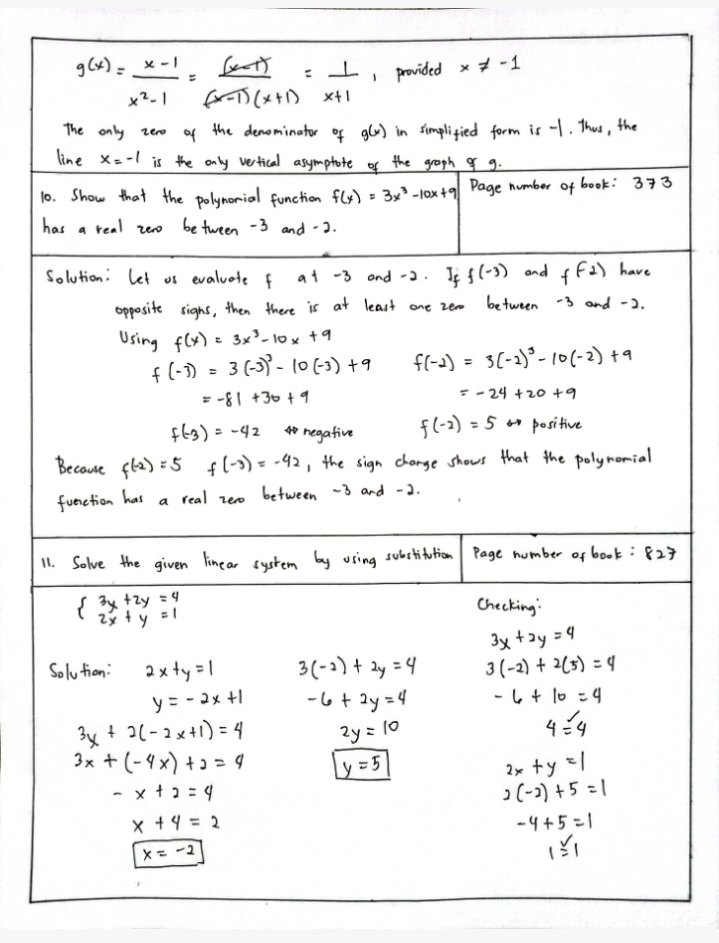
Reference: Book Title : Traceability (Call number / URL) Edition Number : Book Author: 1. Page number of book : Solution Page number of book: 2. Solution Page number of book: 3.task: look for 20 problems it must includes topics from above and solve , it must be from a credible e- books or books send references here |Reference : Blitzer, R. (2017) Algebra and Trigonometry. Goth edn. Pearson . Book Title : Algebra and Trigonometry Traceability (call number / URL ) . Edition Number : 6th Edition https:// drive. google. com /file /d/12 zld B15 aw UA . Book Author: Robert Blitzer C6 Rw 5h NGle 65 3kSh Gtal IBview? usp= drive sdk 4. Solve and check the linear equation 7x - 5 : 72 Page number of book: 120 Solution : 7y - 5 : 72 Checking . 7y = 72+5 7 x - 5 : 72 7 x = 77 * = 11 7 (11 ) - 5 :73 77 77 - 5 = 72 11 11 71 = 72 Solve and check the linear equation 2x - 7 : 6 +x Page number of book : 120 Solution : 2x- 7 : 6tx Checking : 2x - 7 : 6 +x 2x - x :7+6 2 ( 13 ) - 7 = 6+13 = 13 26 - 7 : 19 19 : 19 3 . Graph the constant function fly ) = 7 Page number of book: 252 Solution : - 10 - 44. Graph the constant function f (x ) = 6 Page number of book: 252 Solution: 5 . Find the coordinates of the vertex for the Page number: 360 parabola defined by the quadratic function f (x ) = 2( * - 3) 2 +1 Solution : a ( x - h )* + k Coordinate of the vertex ( h, k ) Standard form : f ( x ) = 2 ( x - 3 ) 2 +1 h = 3 K = 1 Vertex : ( 3 , 1 ) 6. Find the coordinates of the vertex for the Page number: 360 parabola defined by the quadratic function f(x ) = 247 - 8x+3 Solution : 2x 2 - 8 x +3 The coordinates of the vertex ( h , k ) 2 ( x 7 - 4 x ) +3 is 2 ( x 2 - 4 * +4 ) +3-8 Vertex ( 2 , - 5 ) 2 (x - 2)' - 5 h = 2 k=- 5 a ( * - h ) " t k7. Find the zeros for each polynomial function and give Page number: 378 the multiplicity for each zero . fly) = 2 ( x - 5 ) ( * + 4 )" Solution: f ( x ) = 2 ( x - 5 ) ( + 9 ) " x = 5 ( Multiplicity of 1 ) * -5=0 x14 =0 x14=0 * = - 4 ( Multiplicity of -4) * =5 * =- 9 X= - 4 E. Find the domain of the given rational function Page number : 412 g( x ) =x x 2 - 25 Solution: Rational functions contain division. Because division by 0 is undefined, We must exclude from the domain' of the function values of x that cause the polynomial function in the denominator to be 0. The denominator of g ( + ) = x is zero if * = 5 and x = - 5. * 2- 25 We can express the domain in set builder or interval notation : Domain of g( x ) = { x1 x # 5, x #- 5] Domain of gl x ) = ( - 00 , - 5 ) 0 ( 5 , 5 ) U ( 5 , 00 ) 9. Find the vertical asymptotes, if any. Page number: 415 of the given graph by rational function. g(x) =x-1 Solution: Factoring is usually helpful in identifying zeros of denominators and any common factors in the humerators and denominators.12. Show that the ordered triple (-1 , -4 , 5) is tage number of book : a solution of the linear system : 844 x - 24 + 32 = 22 2x - 3 - 2 = 5 3x ty - 52 =- 32 Solution: x - 2y + 3 2 = 22 2x- 34-2=5 3 xty - 5 2 =- 32 * = -1 (-1)- 21- 4) +3(5) = 22 2( -1)-3(-4)-5=5 3(-D)+ ( -4) - 5(5)=32 y = - 4 - 1+ 8 +15 = 22 - 2 + 12 - 5 = 5 - 3 - 4-25 = 32 2 =5 7 + 15 = 22 12 - 7 = 5 -7 - 25 = 32 22 = 22 5+5 32-32 13. Solve the radical equation 7*+3 +3 =x Page number of book : 177 Vx 13 +3 = x Solution . J x +3 = x-3 x + 3 = x 2 - 6 x+9 ( 1 x + 3 ) " = ( x - 3 ) 2 D = X '- VX- x +9-3 x +3 = x 2 - 4x +9 0 = x 2 - 7 x 46 D = ( x - 1 ) ( x- 6) Checking: X - 1=0 X - 6 =0 * = / * = 1 *= 4 x13 +3 = X X = 6 V 1+3 +3 =1 Vx+3 +3 = X Thus, * = 1 is an extraneous 14 +9 =1 VU+3 + 3 = 6 Solution . The only solution is 2 +3 = 1 19 +3 = 6 6, and the solution set is 571 3 + 3 : 4 false 6 : 6 trueg( x ) = x-1 fx = 1, provided x # - 1 * 2 - 1 EX- 1) ( * + 1 ) x+1 The only zero of the denominator of g(x) in simplified form is - 1. thus, the line X=-1 is the only vertical asymptote of the graph of 9. 10. Show that the polynomial function f(x ) = 3x3-10x+9 Page number of book: 373 has a real zero between - 3 and - ?. Solution: let us evaluate f at -3 and - 2. If f (- 3) and f F2) have opposite signs, then there is at least one zero between -3 and - 3. Using f( x ) = 3x 3 - 10 * + 9 f ( - 3 ) = 3 ( - 3 ) - 10 ( - 3 ) + 9 f ( - 2) = 3[- 2 ) 3- 10 (- 2 ) + 9 = -81 + 30 + 9 = - 24 + 20+9 f (3 ) = - 42 4 negative f ( - 2 ) = 5 0 positive Because ((2) = 5 f ( - 3) = - 42, the sign charge shows that the polynomial function has a real zero between - 3 and - 2. 11. Solve the given linear system by using substitution Page number of book : 827 34 +2y = 4 2xty = 1 Checking : 3 x tay = 4 Solution: 2 x ty = 1 3 (- 2 ) + 24 = 4 3 ( -2) + 2( 5 ) = 4 y = - 2x +1 - 6 + 24 = 4 - 6 + 10 = 4 3 4 + 2( - 2 x +1 ) = 4 Zy = 10 4: 4 3x + (- 4 x) +2 =4 y = 5 2 x ty =1 - x+2 :4 2 (-2 ) +5 = 1 x +4 = 2 - 4+5 =1 X= -2 181
Step by Step Solution
There are 3 Steps involved in it
1 Expert Approved Answer
Step: 1 Unlock
Question Has Been Solved by an Expert!
Get step-by-step solutions from verified subject matter experts
Step: 2 Unlock
Step: 3 Unlock
Students Have Also Explored These Related Mathematics Questions!










 Study Help