







Question: Liquid helium is called a quantum liquid because the quantum-mechanical zero-point mo- tion of the helium atoms significantly affects the properties of the liquid.
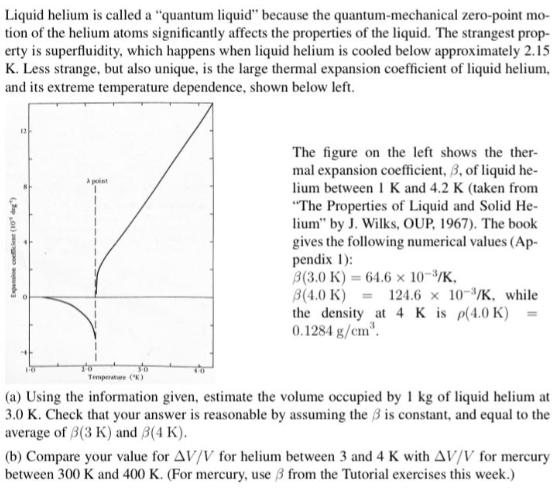
Liquid helium is called a "quantum liquid" because the quantum-mechanical zero-point mo- tion of the helium atoms significantly affects the properties of the liquid. The strangest prop- erty is superfluidity, which happens when liquid helium is cooled below approximately 2.15 K. Less strange, but also unique, is the large thermal expansion coefficient of liquid helium, and its extreme temperature dependence, shown below left. Expension coefficient (10deg) The figure on the left shows the ther- mal expansion coefficient, 3, of liquid he- lium between 1 K and 4.2 K (taken from "The Properties of Liquid and Solid He- lium" by J. Wilks, OUP, 1967). The book gives the following numerical values (Ap- pendix 1): 3(3.0 K) = 64.6 x 10-/K. 3(4.0 K) 124.6 x 10-/K, while the density at 4 K is p(4.0 K) 0.1284 g/cm. Temperature (K) (a) Using the information given, estimate the volume occupied by 1 kg of liquid helium at 3.0 K. Check that your answer is reasonable by assuming the 3 is constant, and equal to the average of 3(3 K) and 3(4 K). (b) Compare your value for AV/V for helium between 3 and 4 K with AV/V for mercury between 300 K and 400 K. (For mercury, use 3 from the Tutorial exercises this week.)
Step by Step Solution
3.42 Rating (152 Votes )
There are 3 Steps involved in it
Explanation In this step we used the given thermal expansion coefficients and density values to estimate the volume occupied by 1 kg of liquid helium at 30 K We first calculated the volume at 40 K usi... View full answer

Get step-by-step solutions from verified subject matter experts
 Study Help