







Question: Log-returns or dataset.csv: factors.csv: Consider a 3-factor model. Find the and for the model with the factors provided in the attached file factors.csv. Now we
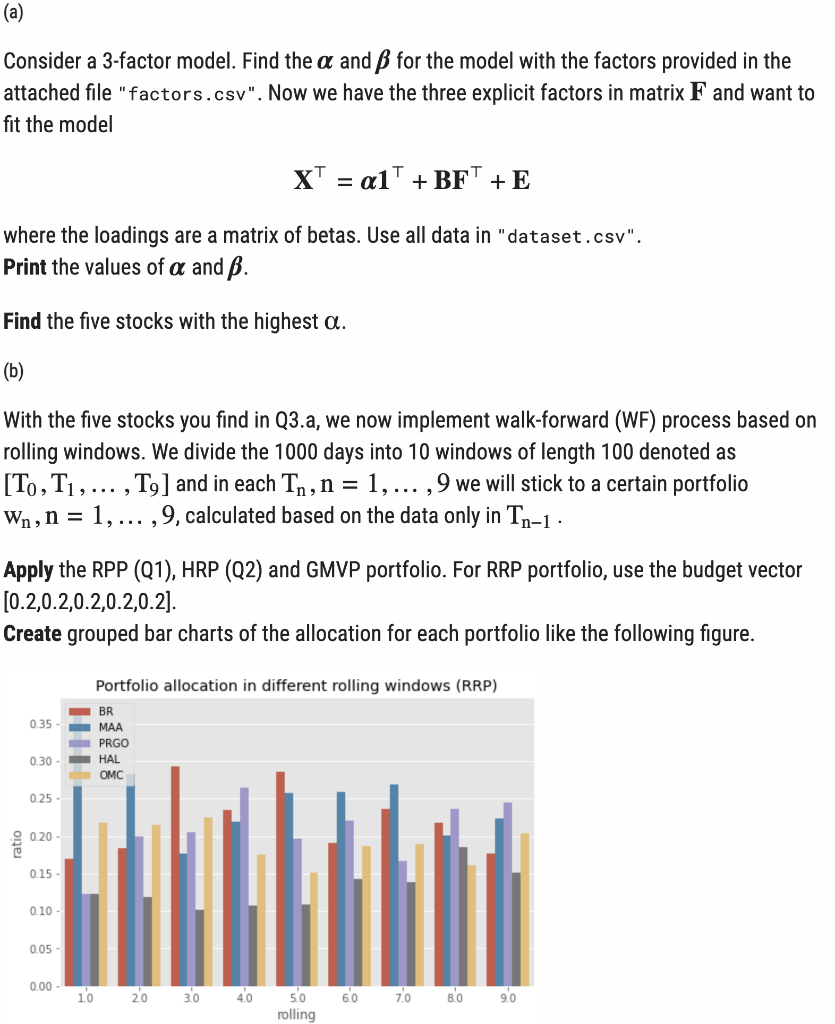
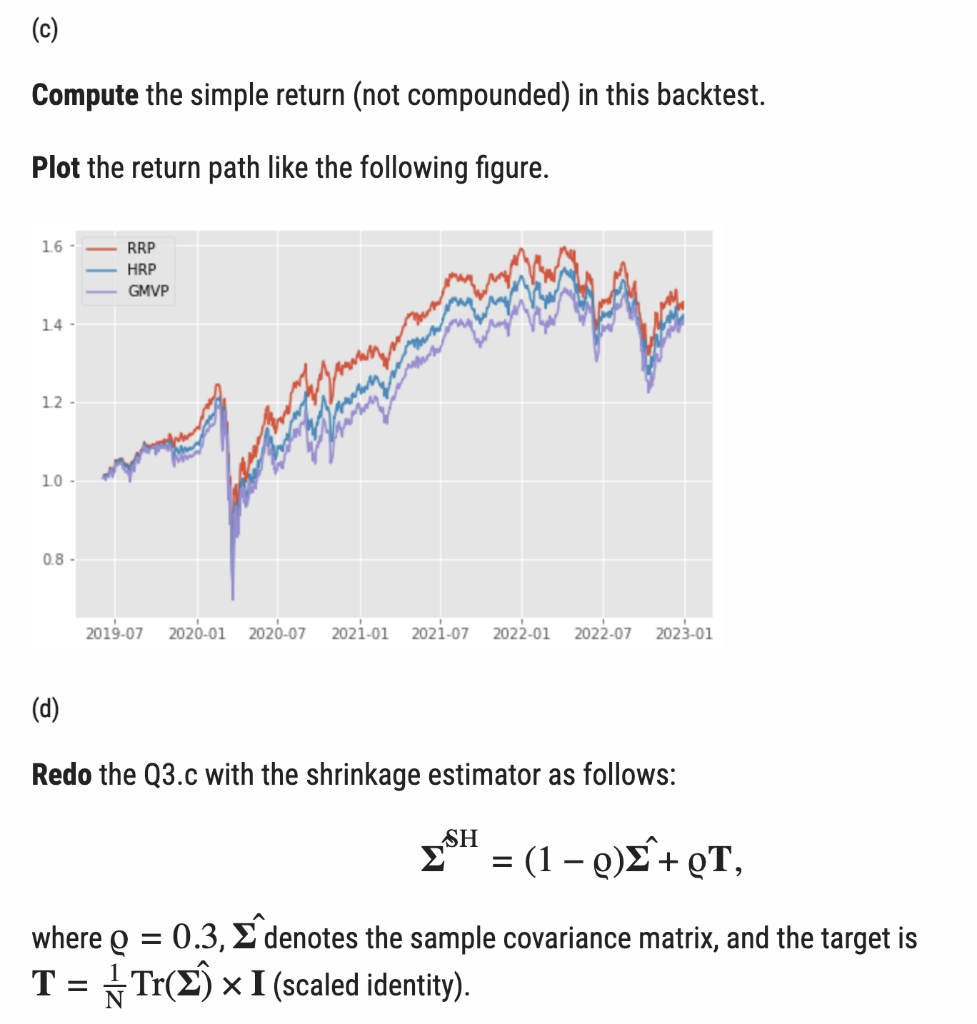
Log-returns or dataset.csv:
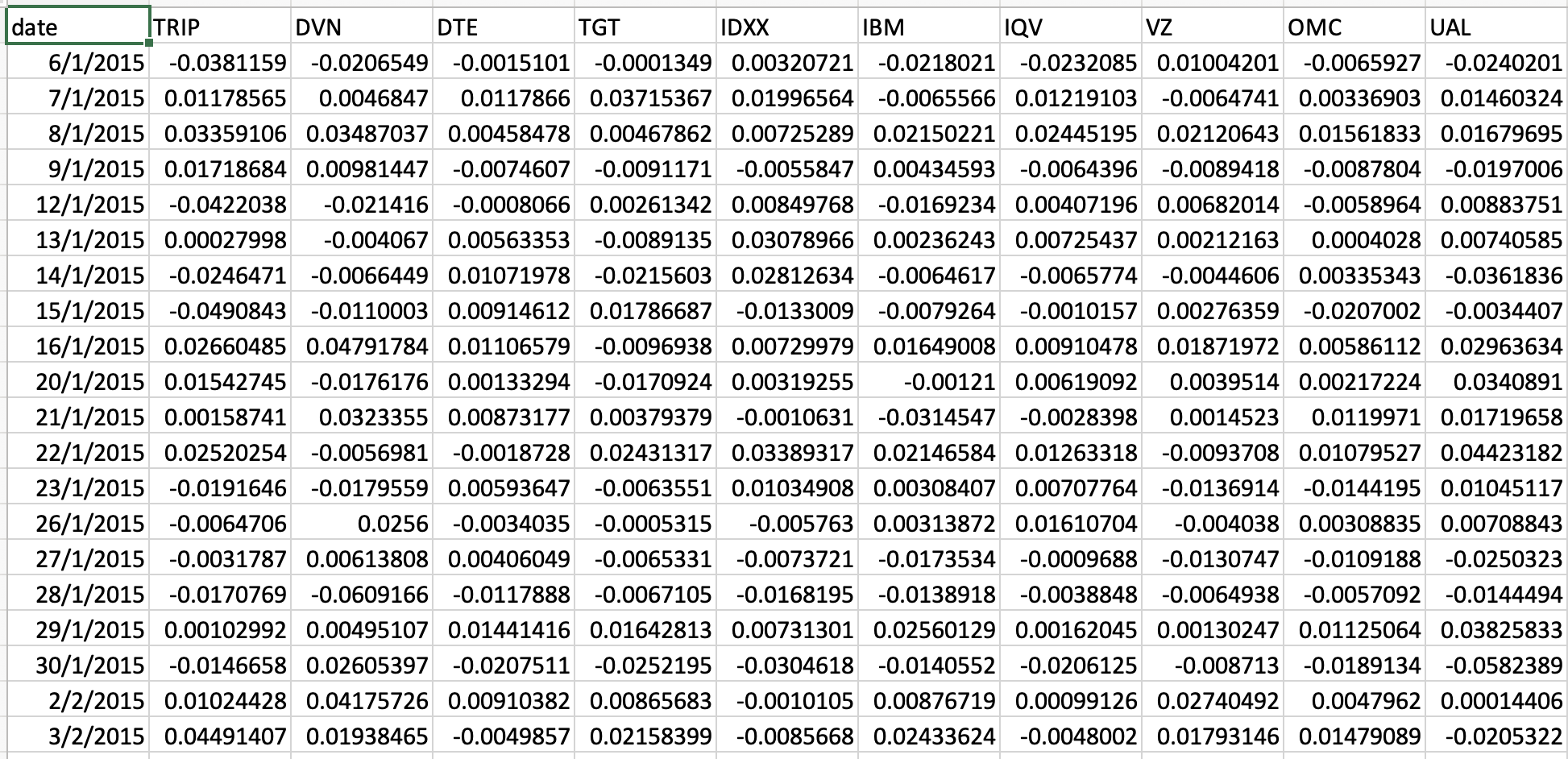
factors.csv:
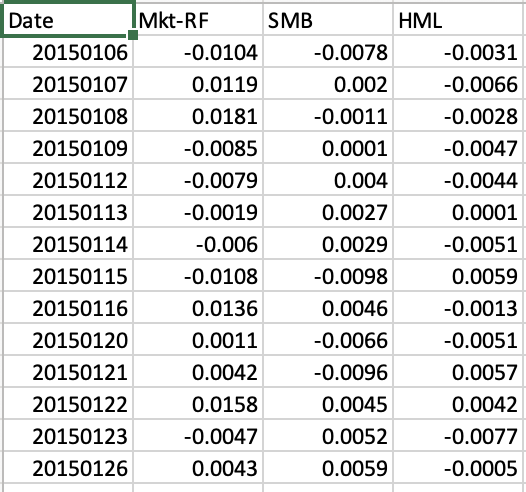
Consider a 3-factor model. Find the and for the model with the factors provided in the attached file "factors.csv". Now we have the three explicit factors in matrix F and want to fit the model X=1+BF+E where the loadings are a matrix of betas. Use all data in "dataset.csv". Print the values of and . Find the five stocks with the highest . (b) With the five stocks you find in Q3.a, we now implement walk-forward (WF) process based on rolling windows. We divide the 1000 days into 10 windows of length 100 denoted as [T0,T1,,T9] and in each Tn,n=1,,9 we will stick to a certain portfolio wn,n=1,,9, calculated based on the data only in Tn1. Apply the RPP (Q1), HRP (Q2) and GMVP portfolio. For RRP portfolio, use the budget vector [0.2,0.2,0.2,0.2,0.2] Create grouped bar charts of the allocation for each portfolio like the following figure. (c) Compute the simple return (not compounded) in this backtest. Plot the return path like the following figure. (d) Redo the Q3.c with the shrinkage estimator as follows: SH=(1)^+T where =0.3,^ denotes the sample covariance matrix, and the target is T=N1Tr()^I (scaled identity) \begin{tabular}{|r|r|r|r|} \hline Date & Mkt-RF & \multicolumn{1}{l|}{ SMB } & \multicolumn{1}{l|}{ HML } \\ \hline 20150106 & -0.0104 & -0.0078 & -0.0031 \\ \hline 20150107 & 0.0119 & 0.002 & -0.0066 \\ \hline 20150108 & 0.0181 & -0.0011 & -0.0028 \\ \hline 20150109 & -0.0085 & 0.0001 & -0.0047 \\ \hline 20150112 & -0.0079 & 0.004 & -0.0044 \\ \hline 20150113 & -0.0019 & 0.0027 & 0.0001 \\ \hline 20150114 & -0.006 & 0.0029 & -0.0051 \\ \hline 20150115 & -0.0108 & -0.0098 & 0.0059 \\ \hline 20150116 & 0.0136 & 0.0046 & -0.0013 \\ \hline 20150120 & 0.0011 & -0.0066 & -0.0051 \\ \hline 20150121 & 0.0042 & -0.0096 & 0.0057 \\ \hline 20150122 & 0.0158 & 0.0045 & 0.0042 \\ \hline 20150123 & -0.0047 & 0.0052 & -0.0077 \\ \hline 20150126 & 0.0043 & 0.0059 & -0.0005 \\ \hline \end{tabular} Consider a 3-factor model. Find the and for the model with the factors provided in the attached file "factors.csv". Now we have the three explicit factors in matrix F and want to fit the model X=1+BF+E where the loadings are a matrix of betas. Use all data in "dataset.csv". Print the values of and . Find the five stocks with the highest . (b) With the five stocks you find in Q3.a, we now implement walk-forward (WF) process based on rolling windows. We divide the 1000 days into 10 windows of length 100 denoted as [T0,T1,,T9] and in each Tn,n=1,,9 we will stick to a certain portfolio wn,n=1,,9, calculated based on the data only in Tn1. Apply the RPP (Q1), HRP (Q2) and GMVP portfolio. For RRP portfolio, use the budget vector [0.2,0.2,0.2,0.2,0.2] Create grouped bar charts of the allocation for each portfolio like the following figure. (c) Compute the simple return (not compounded) in this backtest. Plot the return path like the following figure. (d) Redo the Q3.c with the shrinkage estimator as follows: SH=(1)^+T where =0.3,^ denotes the sample covariance matrix, and the target is T=N1Tr()^I (scaled identity) \begin{tabular}{|r|r|r|r|} \hline Date & Mkt-RF & \multicolumn{1}{l|}{ SMB } & \multicolumn{1}{l|}{ HML } \\ \hline 20150106 & -0.0104 & -0.0078 & -0.0031 \\ \hline 20150107 & 0.0119 & 0.002 & -0.0066 \\ \hline 20150108 & 0.0181 & -0.0011 & -0.0028 \\ \hline 20150109 & -0.0085 & 0.0001 & -0.0047 \\ \hline 20150112 & -0.0079 & 0.004 & -0.0044 \\ \hline 20150113 & -0.0019 & 0.0027 & 0.0001 \\ \hline 20150114 & -0.006 & 0.0029 & -0.0051 \\ \hline 20150115 & -0.0108 & -0.0098 & 0.0059 \\ \hline 20150116 & 0.0136 & 0.0046 & -0.0013 \\ \hline 20150120 & 0.0011 & -0.0066 & -0.0051 \\ \hline 20150121 & 0.0042 & -0.0096 & 0.0057 \\ \hline 20150122 & 0.0158 & 0.0045 & 0.0042 \\ \hline 20150123 & -0.0047 & 0.0052 & -0.0077 \\ \hline 20150126 & 0.0043 & 0.0059 & -0.0005 \\ \hline \end{tabular}
Step by Step Solution
There are 3 Steps involved in it

Get step-by-step solutions from verified subject matter experts
 Study Help